



In classical physics, laser light is described as an electromagnetic wave with well-defined properties. In quantum optics, however, the electromagnetic field itself is a quantum system. Light can exist in various quantum states, each characterized by its own quantum fluctuations in the electromagnetic field.
The researchers used an analytically solvable model to examine how these fluctuations affect a single electron wave packet. Following an idea originally proposed by Péter Földi (a research fellow at the ELI ALPS Facility and head of the Department of Theoretical Physics at the University of Szeged), Szabolcs Hack (a research fellow in the Theoretical and Simulation Research Group at the ELI ALPS Facility and an assistant professor in the Department of Theoretical Physics at the University of Szeged) and his co-authors used an analytically solvable model to investigate how these quantum fluctuations affect a single electron wave packet.
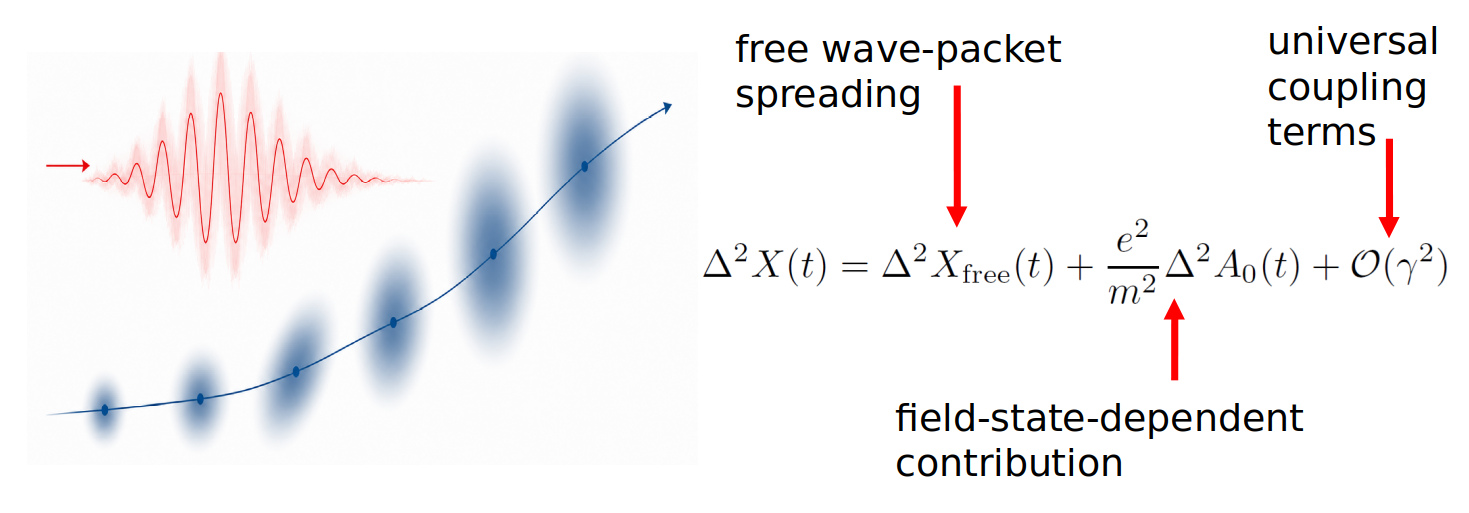 mage: Schematic illustration of an electron wave packet interacting with a laser pulse. While its average motion approximately follows the classical prediction, its spatial uncertainty contains a contribution that depends on the quantum state of the electromagnetic field.
The results were published in the New Journal of Physics titled “Wave packet motion in a quantized electromagnetic field: analytic results”. The calculations show that the centre of the electron wave packet largely follows the trajectory predicted by classical physics. The effect of quantum light becomes apparent in another property: the width of the wave packet.
This width represents the quantum-mechanical uncertainty in the electron’s position. According to the calculations, it depends directly on the quantum fluctuations of the interacting electromagnetic field. “The quantum fluctuations of the laser field manifest themselves in the quantum mechanical uncertainty of the electron’s position,” explains Szabolcs Hack.
The results suggest that the motion of an electron could carry information about the quantum properties of the light with which it interacts. This could provide a basis for future methods of investigating quantum light by observing the electron dynamics it produces.
The researchers also investigated non-classical states of light, such as squeezed states, in which the quantum uncertainties of light can be controlled. If the quantum state of light can be controlled, the spatial uncertainty of the electron wave packet may also be influenced.
This possibility could contribute to future methods for controlling electron beams. It may also have longer-term relevance for fields such as electron microscopy, where precise control over the properties of an electron beam plays an important role. However, the current findings are theoretical, and further research will be needed to assess how the predicted effects could be measured and translated into experimental methods.
The interaction between a free electron and a laser field is a well-established problem in classical electrodynamics. In this research, the scientists treat both the electron and the electromagnetic field as quantum-mechanical objects.
The electron is described by a wave packet, while the light is represented as a quantized, potentially multimode electromagnetic field. This approach allows the researchers to examine aspects of the interaction that remain outside the classical description.
The work connects with ELI’s research areas in quantum optics, strong-field physics and attosecond science. Alongside the development of intense and ultrashort laser pulses, researchers are increasingly investigating how the quantum state of light influences its interaction with matter. Since quantum measurements require different instruments and methods from conventional laser diagnostics, theoretical studies such as this can help define possible experimental approaches.
The researchers plan to continue developing the model and investigating possible experimental implementations and new measurement methods. In the longer term, this work could contribute to methods for diagnosing the quantum properties of strong laser fields and controlling electron dynamics with greater precision.