On 30 April 2021, the Extreme Light Infrastructure (ELI) was granted the legal status of European Research Infrastructure Consortium (ERIC) by the European Commission. ELI ERIC will provide access to world-class high power and ultra-fast lasers for science and enable cutting-edge research in physical, chemical, materials, and medical sciences, as well as breakthrough technological innovations.
The ERIC is a specific legal form designed to facilitate the establishment and operation of Research Infrastructures of European interest. ERICs are participated by States and international organisations as members. As a main statutory mission, ELI ERIC is responsible for making the ELI Facilities available to the scientific community as a single international organisation, with unified governance and management.
The Czech Republic hosts the ELI ERIC statutory seat in Dolní Břežany, in the South of Prague, at the ELI Beamlines Facility. A second Facility, ELI ALPS, is hosted by Hungary in Szeged. The Czech Republic and Hungary are joined by Italy and Lithuania as Founding Members, Bulgaria transitioned to be a full Member as of 1 January 2025, while Germany holds an Observer status. A third ELI Facility is operating in Romania which was accepted as a Founding Observer in ELI ERIC from 1 January 2024. Most recently, Montenegro, Slovakia and Poland joined ELI ERIC as Observers in March and June 2026.
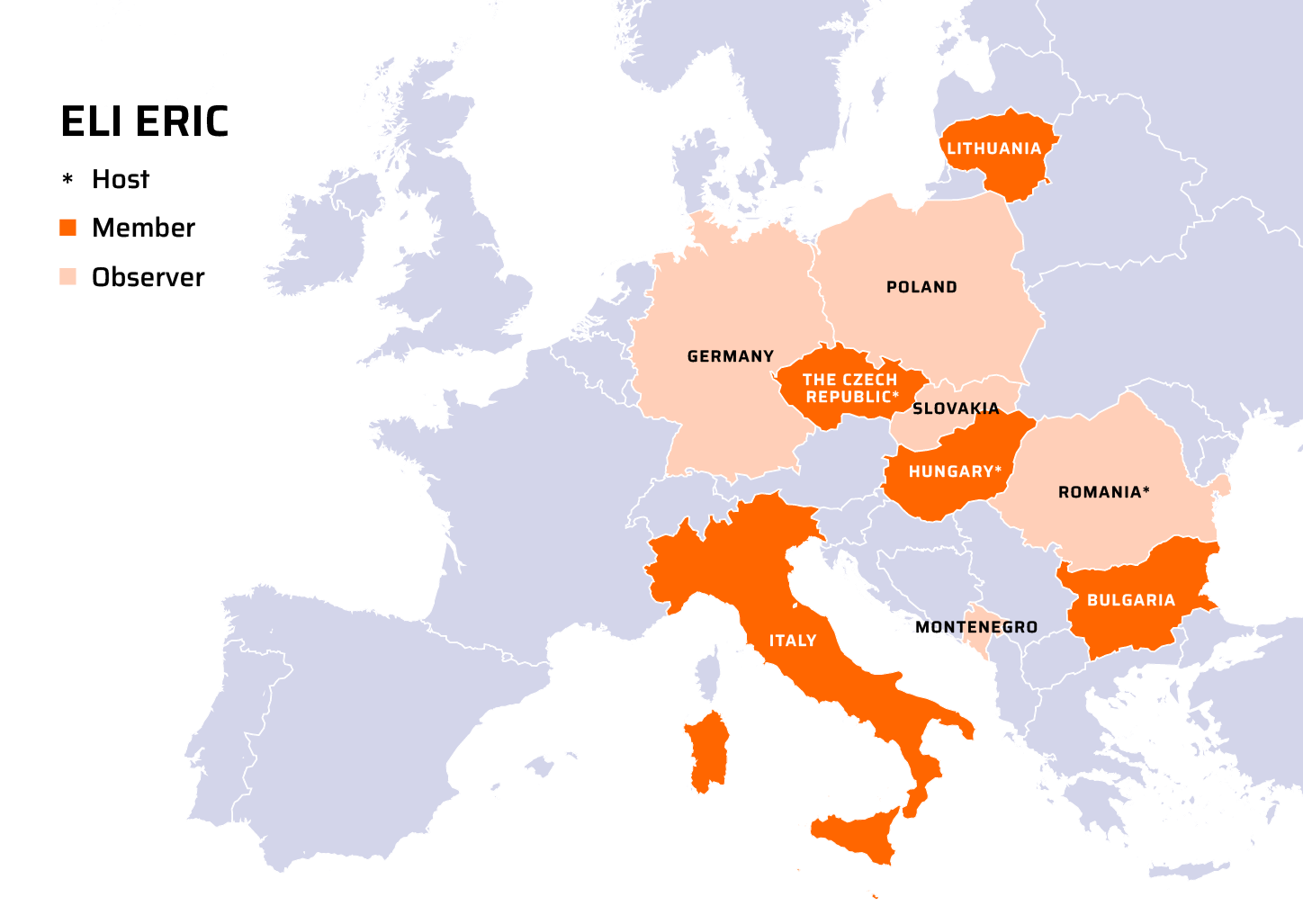
The ELI ERIC is tasked with enabling scientists to access the state-of-the-art lasers at the ELI Facilities. Access is open for all scientists and based on proposals evaluated by an independent panel.
The
decision by the European Commission and the
ERIC statutes
from 2021 are publicly available in the EU Official Journal.
The most recent amendments to the ELI ERIC Statutes came into effect on 8 October 2025, and the consolidated amended version is available for preview
HERE.
Key policies and other documents
ELI ERIC Gender Equality Plan (2022-2026)
Information on the protection of whistleblowers
General Assembly and Appointed Representatives
On 16 June 2021, the first General Assembly of ELI ERIC was held with delegates and experts from each member and observer country. Allen Weeks, former Director General of ELI DC (Delivery Consortium, an international non-profit association that supported the coordinated implementation of the ELI research facilities) was appointed the Director General of ELI ERIC. The Chair of the General Assembly is Jan Hrušák.
Allen Weeks Jan Hrušák
Director General of ELI ERIC Chair of the General Assembly
Delegates and Experts of the General Assembly
Hosts & Founding Members:
Czech Republic
Jan Řídký (Delegate)
Czech Academy of Sciences (CAS)
Marek Vyšinka (Delegate)
Ministry of Education, Youth and Sports (MEYS)
Michael Prouza (Expert Advisor)
Institute of Physics of the Czech Academy of Sciences (IoP)
Hungary
Ferenc Nagy-Rébék (Delegate)
Head of Department, Ministry of Culture and Innovation (KIM)
Péter Dombi (Delegate)
FRONTIERS Top Research and Talent Development Foundation
Host & Founding Observer:
Romania
Mihnea Cosmin Costoiu (Delegate)
National University of Science and Technology
Founding Members:
Italy
Caterina Vozzi (Delegate)
National Research Council (CNR)
Michele Crisafi (Delegate)
Ministry of Education, University and Research (MIUR)
Eugenio Nappi (Expert advisor)
National Institute for Nuclear Physics (INFN)
Giorgio Rossi (Expert advisor)
University of Milan “Statale”
Lithuania
Gediminas Račiukaitis (Delegate)
Center for Physical Sciences and Technology
Aidas Matijošius (Delegate)
Laser Research Center, Vilnius University (VU)
Tadas Juknevičius (Expert advisor)
Ministry of Education, Science and Sport (SMMIN)
Dalia Kaškelytė (Delegate)
Laser Research Center, Faculty of Physics of Vilnius University
Member:
Bulgaria
Lubomir Kovachev (Delegate)
Bulgarian Academy of Sciences (BAS)
Ekaterina Iordanova (Expert Advisor)
Director of Institute of Solid State Physics, Bulgarian Academy of Sciences (BAS)
Observer:
Germany
Eckart Lilienthal (Delegate)
Federal Ministry of Research, Technology and Space (BMFTR)
Sebastian Schmidt (Delegate)
Helmholtz-Zentrum Dresden-Rossendorf (HZDR)
Bernadette Klose (Expert advisor)
DLR Project Management Agency
Barbara Schramm (Expert advisor)
Helmholtz-Zentrum Dresden-Rossendorf (HZDR)
Montenegro
Gordana Laštovička Medin
University of Montenegro
Anđela Radulović
Ministry of Education, Science and Innovation
Administrative and Finance Committee (AFC) members
Chair: László Bódis, Hungary,
Ministry of Culture and Innovation (KIM)
Hosts & Founding Members:
Czech Republic
Jan Buriánek (Vice-Chair, Delegate)Ministry of Education, Youth and sports (MEYS)
Petr Lukáš (Delegate)
Nuclear Physics Institute (CAS)
HungaryLászló Lengyel (Delegate)
National Research, Development and Innovation Office
(NRDI)
Host & Founding Observer:
Romania
Andreea Crupa (Delegate)
Ministry of Research, Innovation and Digitalization
Founding Members:
Italy
Veronica Buccheri (Delegate)
Istituto Nazionale di Fisica Nucleare (INFN)
Antonella Tajani (Delegate)
National Research Council (CNR)
Michele Crisafi (Delegate)
Ministry of University and Research (MUR)
Lithuania
Artūras Malysis (Delegate)
Ministry of Education, Science and Sport (SMMIN)
Member:
Bulgaria
Zornitsa Georgieva (Delegate)
Ministry of Education and Science (MON)
Observer:
Germany
Bernadette Klose (Delegate)
DLR Project Management Agency
Barbara Schramm (Delegate)
Helmholtz-Zentrum Dresden-Rossendorf (HZDR)Montenegro
Martina LukićMinistry of Education, Science and Innovation
International Scientific and Technical Advisory Committee (ISTAC) members
Chair: Roger Falcone (University of California, Berkeley)
Félicie AlbertLawrence Livermore National Laboratory (LLNL)
Andrius BaltuškaPhotonics Institute TU Wien
Angela BraccoUniversità degli Studi di Milano
John CollierCentral Laser Facility, STFC
Per Eng-JohnssonLund University
Ekaterina IordanovaG. Nadjakov Institute, Bulgarian Academy of Sciences
Katalin KamarasInstitute for Solid State Physics and Optics, Wigner Research Centre for Physics
Katia ParodiLudwig-Maximilians University Muenchen (LMU)
Tomáš PolívkaUniversity of South Bohemia
Ulrich SchrammHelmholtz-Zentrum Dresden-Rossendorf (HZDR)
Thomas TschentscherEuropean XFEL
Jonathan D. ZuegelUniversity of Rochester


