


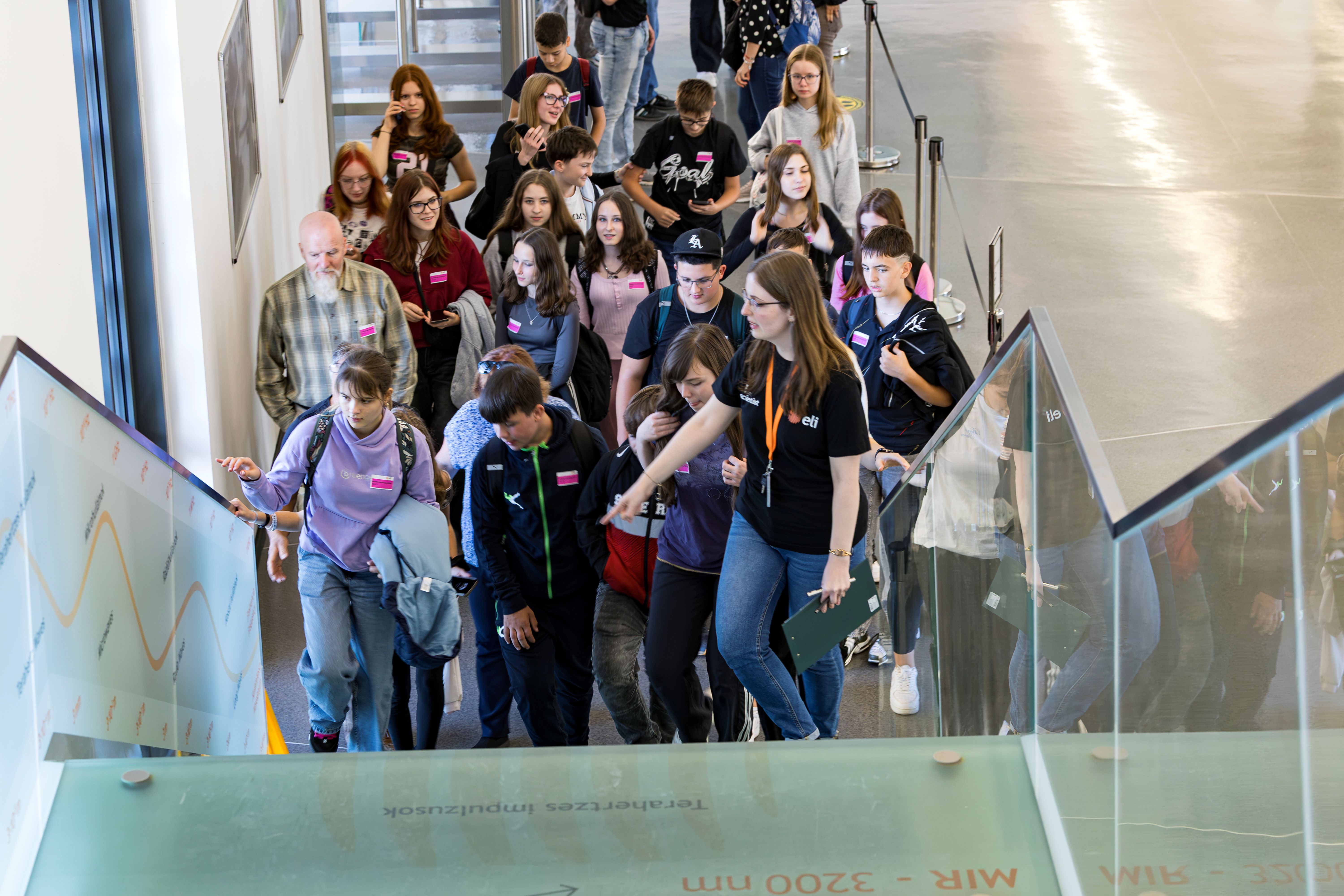
What happens at the laser research institute after the sun goes down? In the evening of 25 September, nearly 500 visitors came to ELI ALPS to find out. On Researchers’ Night, we once again opened our doors so that the general public could get a closer look at the unique world where light is used in scientific experiments.
During the approximately one-hour tours, which took place in groups of 35, our colleagues introduced visitors to the institute through their own areas of research and their day-to-day work. Topics ranged from the motion of electrons to the behaviour of ions and nanoparticles, and from electricity generated from light to biology and laser beams.
“What we learn in school can be linked to what’s been said here.”
The audience included many students, for whom the evening may have been an important experience in terms of further education and career choices too.
Marcell Kovalik, an 18-year-old from Mezőkovácsháza, visited ELI ALPS for the third time. The senior secondary school student, who is planning to become an electrical technician, is primarily interested in physics. He took a liking to the institute during his very first visit. The novelties he heard about this year included new information about the recently commissioned solar power plant. Marcell considered it particularly important to be able to connect the knowledge he gained here with what he had learned in school. During the tour led by Krisztina Sallai, he heard about topics related to the material covered in his school physics classes. He said he would likely return, and that he would be happy to work at the institute as an electrical technician in the future.
Year 6 student Alex Gábor Kormányos visited ELI ALPS two years ago, and he returned this year with his grandparents because he is interested in unusual phenomena and lasers. Although he does not have physics lessons yet, he is already looking forward to learning about the subject. During the evening, he gained “experiences and a wealth of information.” He was particularly interested in whether ELI ALPS conducts research on the lasers themselves or uses lasers to study other materials. He wants to become an engineer, although he hasn’t yet decided on a specific field. He also found himself thinking that he would love to work here.
“Until now, the children thought that all researchers were old and bearded.”
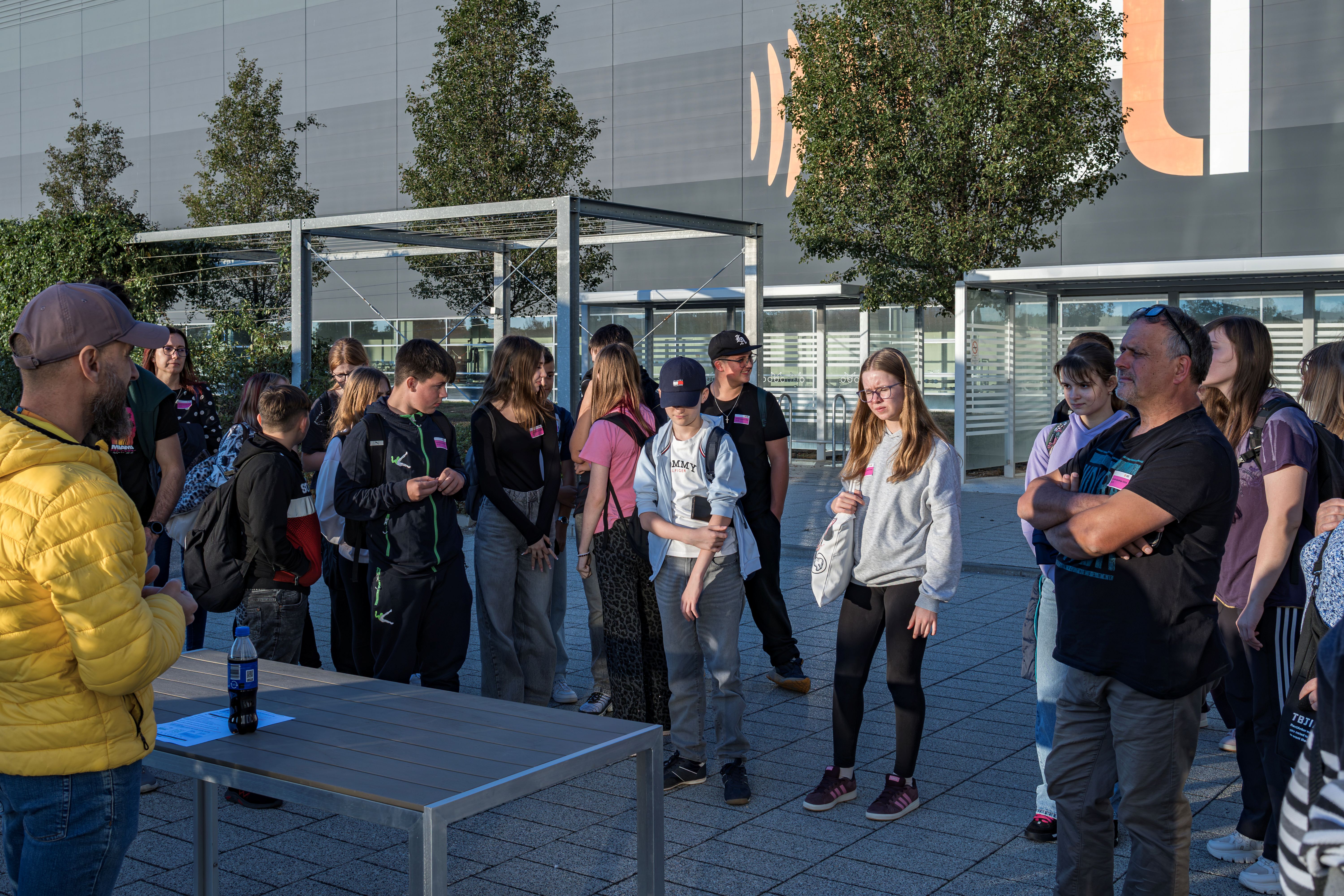
Students from the Battonya Bilingual Hungarian-Serbian Primary School and Kindergarten, as well as from Mikes Kelemen Catholic School arrived in three minibuses. Mrs. Miklós Karancsi, a staff member at the latter institution, said they had learned about the opportunity from the local government, and the programme immediately caught the children’s interest. The teacher was impressed by the institute’s building but considered the meeting with the researchers to be just as important.
“I think, for the kids, this building is a miracle in itself,” she said. She was particularly pleased that the students had the opportunity to meet ELI ALPS staff members in person. It also came as a surprise to the children that there were so many young people and so many women among the researchers: „Until now, the children thought that all researchers were old and bearded.”
“There’s always something new that makes it worth coming back”
Zoltán Kirs visited the institute for the third time with his wife and three children. This time, they wanted to see where and under what conditions laser research is conducted. “There’s always something new that makes it worth coming back,” he said.
This time, they found the presentation given at the beginning of the programme particularly interesting. During the tour, which also explored the secret lives of zebrafish, they learned that laser research is connected not only to physics but also to other scientific fields, such as biology and materials science.
When the role of the explainer is new even to the researcher
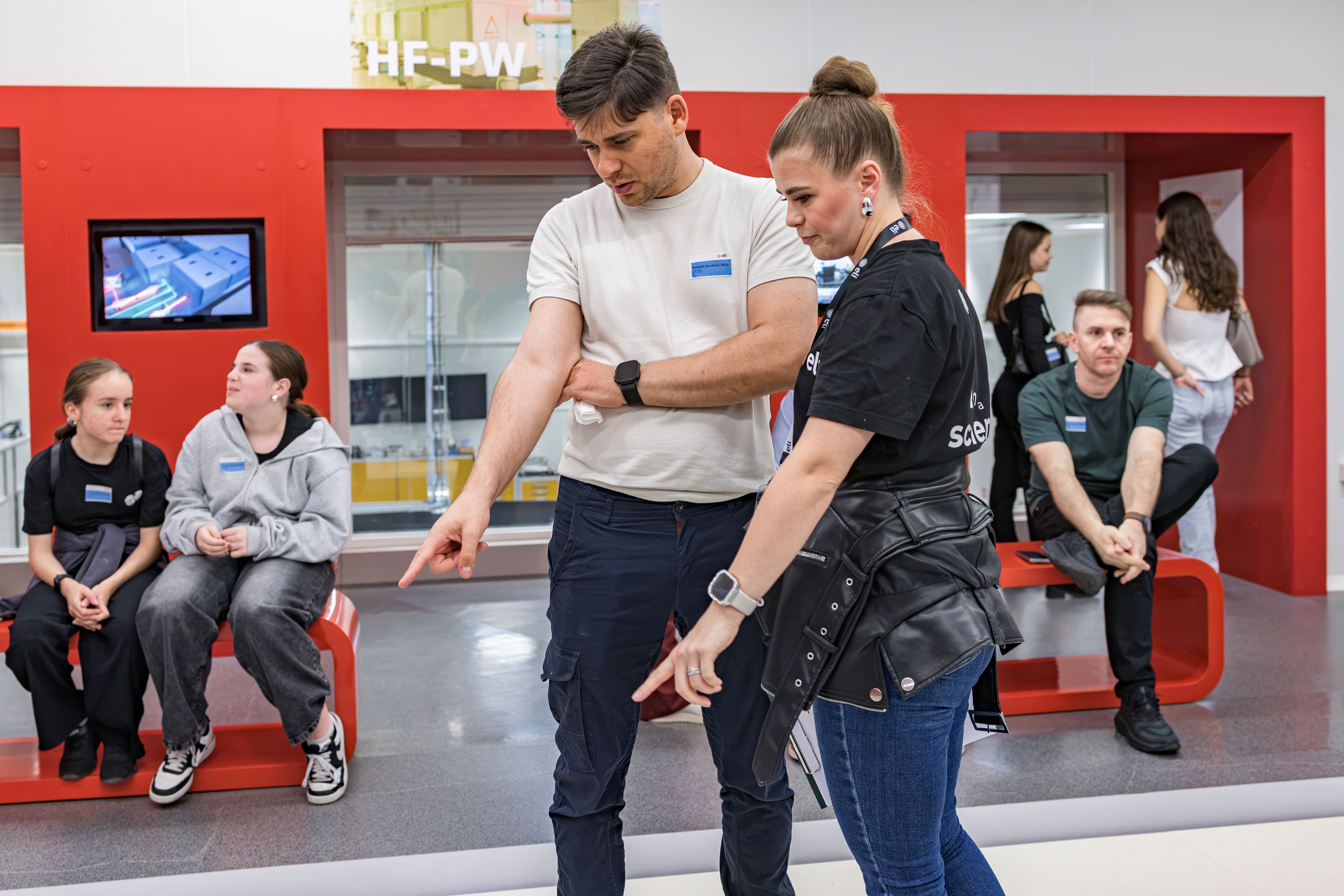
This year’s programme also posed a challenge for the researchers: they had to turn highly specialized technical language – the kind used in everyday work – into lingo that is easy for the general public to understand. Levente Lehotai, the guide for the tour titled “The heavy hitter of ELI ALPS,” took on this role for the first time. As he explained, presenting research in a way that’s easy for the public to understand is a challenge in itself, since even he and his wife – who works in a similar field – sometimes find themselves speaking different languages when discussing specific topics. And on this particular evening, he had to speak not to physicists working in other fields, but to lay people.
During the tour, he emphasized the importance of making the size of the equipment, the essence of its operation, and the fascinating nature of the work carried out at the institute tangible to the visitors. This is especially important in the case of optics, which is covered, for example, at the end of year 10 in four-year secondary schools, but for which there is often not enough time due to the overloaded syllabus.
According to Dr. Krisztina Trényi-Sárosi, the one-hour tours gave her much more opportunity to discuss the various topics than before, although she still felt she was short on time. She would have liked to spend even more time with the audience.
According to Krisztina, it’s always an exciting challenge to present research topics to lay people. This is especially true for laser physics, where even explaining the most basic concepts requires a thorough background explanation. Throughout the evening, she was guided by Einstein’s idea: “Everything should be made as simple as possible, but not simpler.” Her primary goal was to show what life as a researcher is like, while also presenting the specific topic – the principles behind transient absorption spectroscopy – in a way that was easy to understand without losing any of the essential content. She did all this using a clean, minimalist presentation with a black background, featuring white stick figures and simple hand-drawn illustrations. Based on the feedback, the visitors really enjoyed it.
Electron florescence, zebra fish and a Nobel laureate’s beamline
The tour topics showcased the diversity of the research world at ELI ALPS. Dr. Nikolett Oláh, Júlia Soós-Dudás and Vera Horváth welcomed visitors with the topics “Electron florescence,” “The Secret Life of Zebra Fish,” and “Where everything is brought to light,” respectively. Dr. Krisztina Trényi-Sárosi, Levente Lehotai and Dr. Zsuzsanna Márton led tours titled “Electricity from light – following charges,” “The heavy hitter of ELI ALPS,” and “When nanoparticles meet photons,” respectively. Krisztina Sallai showcased another aspect of the researcher’s mindset with a programme titled “Let’s suppose —or how every exciting problem begins.” Balázs Farkas guided visitors through “A Nobel Laureate’s beamline,” while Dr. Lénárd Oldal Gulyás led a tour titled “Neither with you nor without you— Adventures of electrons and ions.”
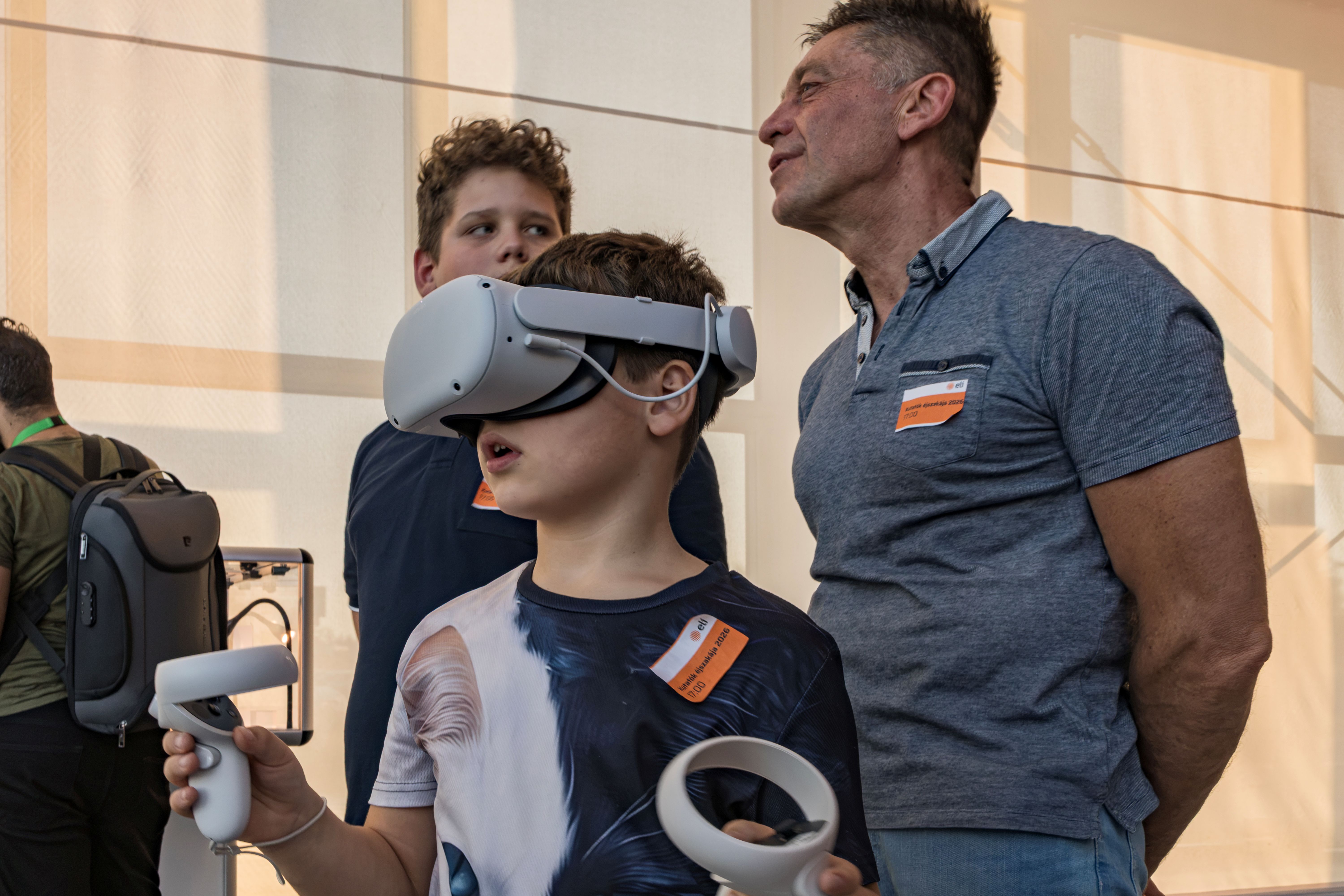
In addition to the tours, interactive exhibits were also available for visitors. At the “Superconductivity and other chilling experiments” stand, Dr. Levente Ábrók and Dr. Nikolett Oláh welcomed visitors; at the “Touch-and-Feel components” stand, Krisztián Kasza; at the “Optics Workshop,” Zénó Szabó; and at the “Beam transport system” stand, Konrád Törőcsik took the visitors breath away. At the Radiation physics stand, Dr. Róbert Polanek, Péter Traj, and Dr. Tamara Kecskés presented their research, while at the Biology stand, Dr. Róbert Polanek and Dr. Attila Ébert did the same. Zoltán Jóri introduced visitors to laser safety eyewear, Dr. Tamás Csizmadia to VR goggles, Kinga Fejős-Mészáros to the mandatory cleanroom attire worn in the laboratories, and Zoltán Leindler to the building complex.
Science truly becomes accessible when we encounter it firsthand
The presence of nearly 500 visitors provided important feedback for ELI ALPS. The success of the evening demonstrated that those interested are drawn not only to the unique research infrastructure and spectacular experiments, but also to the people behind the science.
At this year’s Researchers’ Night event, it wasn’t just the doors of ELI ALPS that opened: the researchers opened up their own world to visitors, who left with a wealth of experiences.