


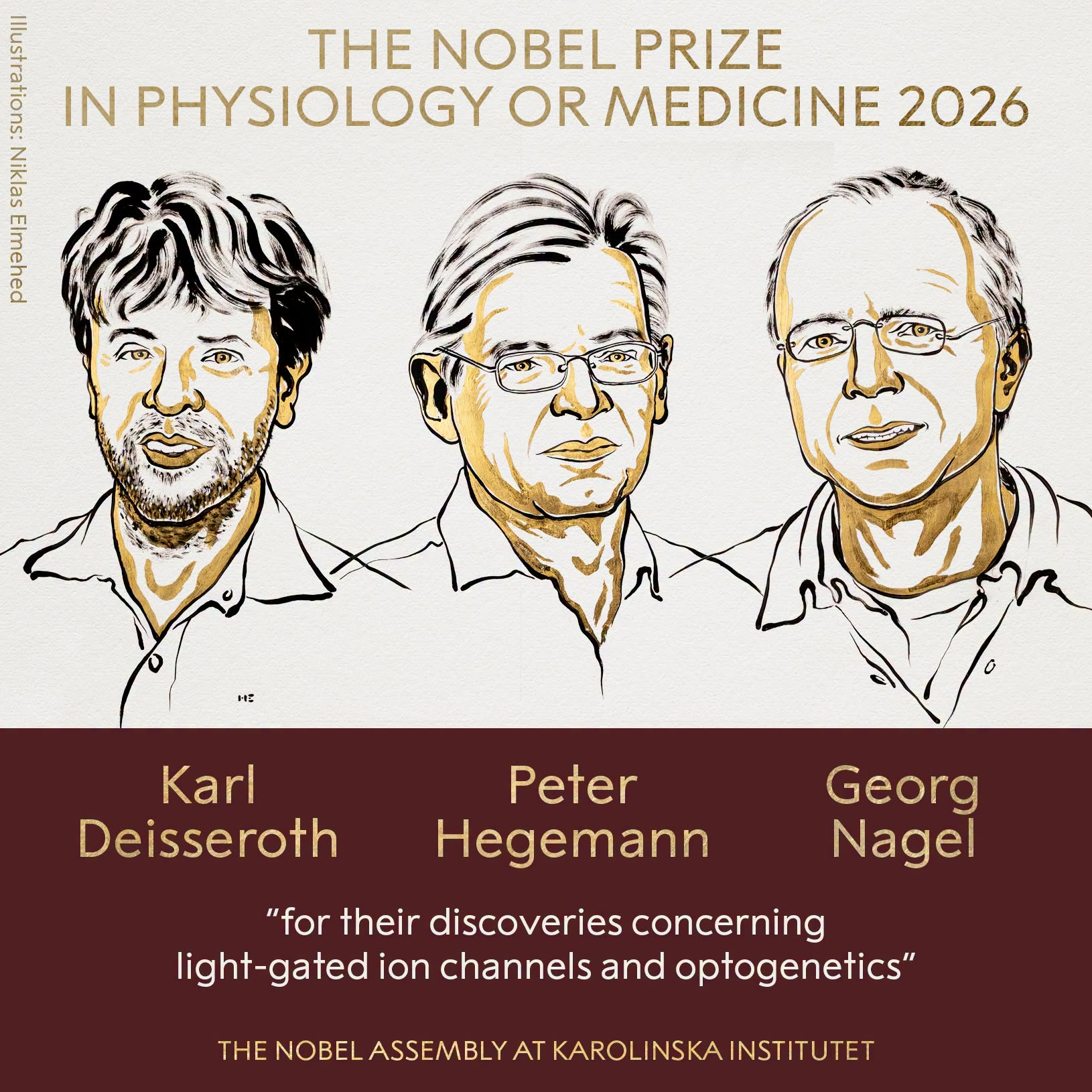
The Extreme Light Infrastructure (ELI) congratulates Professor Peter Hegemann of Humboldt-Universität zu Berlin on the award of the 2026 Nobel Prize in Physiology or Medicine. He shares the prize with Karl Deisseroth and Georg Nagel "for their discoveries concerning light-gated ion channels and optogenetics."
Hegemann’s research began with the study of light-sensitive behaviour in algae. Together with Georg Nagel, he discovered channelrhodopsin, a protein that enables cells to respond to light by opening an ion channel. This finding provided the biological basis for optogenetics.
By introducing channelrhodopsin into nerve cells, Karl Deisseroth showed that light could be used to control neural activity with high precision. The technique has since become widely used in neuroscience to study brain circuits and their links to behaviour and disease.
Hegemann continues to investigate the light-sensitive proteins that made optogenetics possible as a regular user of ELI’s femtosecond stimulated Raman spectroscopy (FSRS) and transient absorption (TA) stations at the ELI Beamlines Facility, Czech Republic.
His groups’s collaboration with ELI focuses on transient absorption experiments spanning femtoseconds to milliseconds, combined with FSRS measurements. These techniques characterise new biological photoreceptors in terms of their dynamics, temporal response, efficiency and mechanisms of operation. ELI’s laser capabilities make it possible to follow multiple timescales within a single, sample-efficient experiment by combining ultrafast phenomena occurring on the femtosecond timescale with chemical processes operating on the nanosecond-to-microsecond timescale and the biological dynamics of proteins occurring on the millisecond timescale.
"ELI's lasers help reveal how these molecules function at the most fundamental level," says Miroslav Kloz, Senior Scientist at ELI Beamlines and Leader of FSRS Technology. "They act like an ultra-high-speed camera: in a single experiment, we can capture processes from the femtosecond laser pulse all the way to the biological response of the protein. Thanks to our cutting-edge infrastructure, we are jointly pushing the boundaries of biochemistry and medicine."
The collaboration, which also includes John Kennis's group at Vrije Universiteit Amsterdam, has produced six joint publications since 2020. Among the results is the first observation of energy transfer from one rhodopsin to another, reported in the Journal of the American Chemical Society in 2025. https://pmc.ncbi.nlm.nih.gov/articles/PMC12046560/