


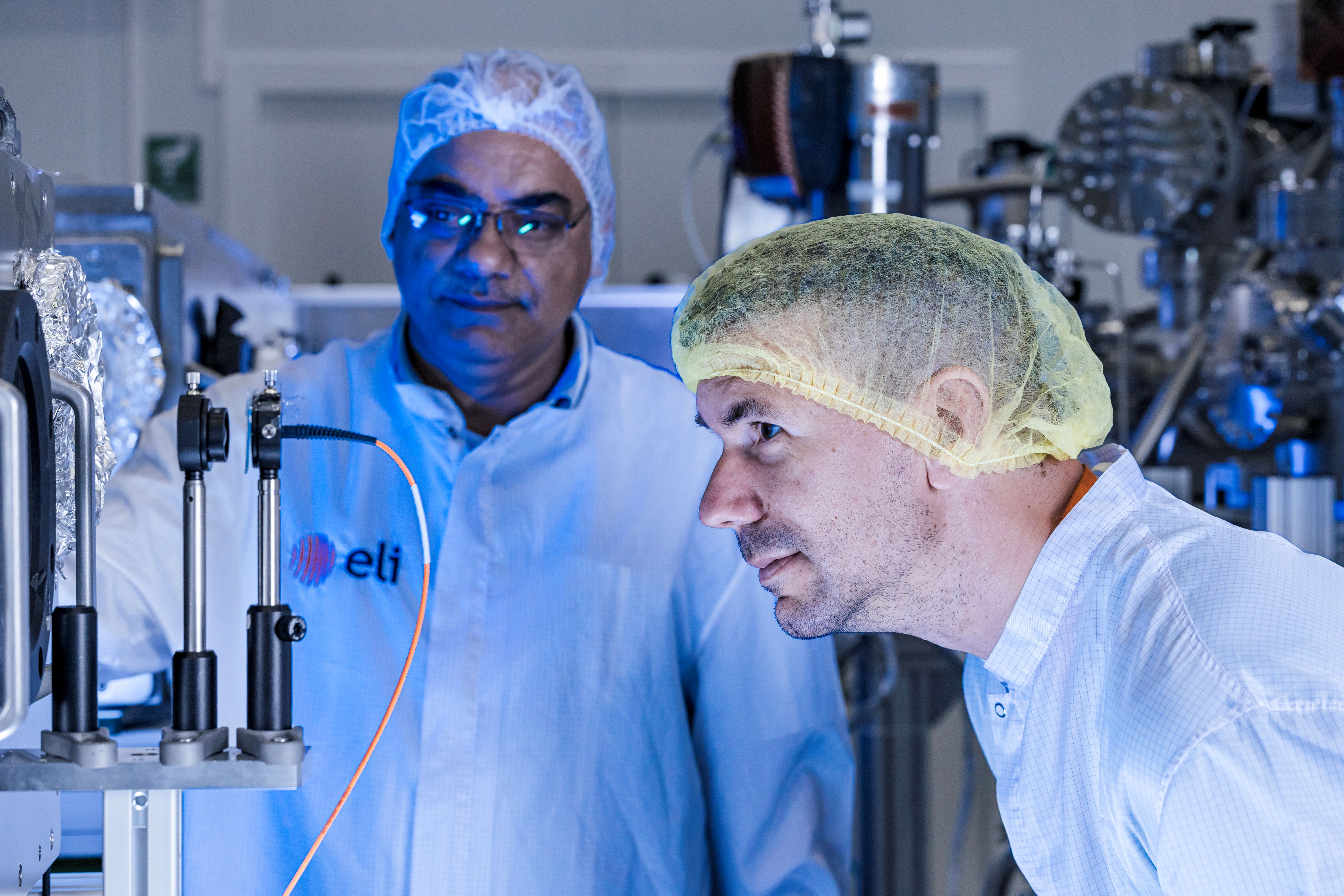
“The article published in UltraFast Science with the title A High-Intensity Attosecond Light Source in Compact Geometry at the ELI ALPS User Facility summarizes the tasks the SYLOS Compact beamline was designed for, and the specific technical parameters with which the initial ideas were realized. “This article is a milestone and a guide for future users, so they know what this beamline is capable of,” said Zsolt Divéki, group leader for the SYLOS GHHG beamlines at the ELI ALPS Facility.
What makes the SYLOS Compact beamline unique is that at the very beginning, the designers of the equipment, i.e. researchers of the Foundation for Research and Technology – Hellas (FORTH) — supervised by Dimitris Charalambidis — provided a list of the components needed to build the equipment, which was then constructed by Szeged-based experts. They themselves procured all the screws, vacuum tubes, and mirrors and then put them together. The beamline was commissioned in 2024 and has been continuously improved ever since.
The primary purpose of the SYLOS Compact beamline is to study processes on the attosecond timescale using XUV (extreme ultraviolet) radiation. Generating this radiation poses a significant technological challenge, as high-energy photons with wavelengths between 10 and 121 nanometres are absorbed within a few micrometres in air. Therefore, the radiation-generating equipment must be placed in a vacuum chamber.
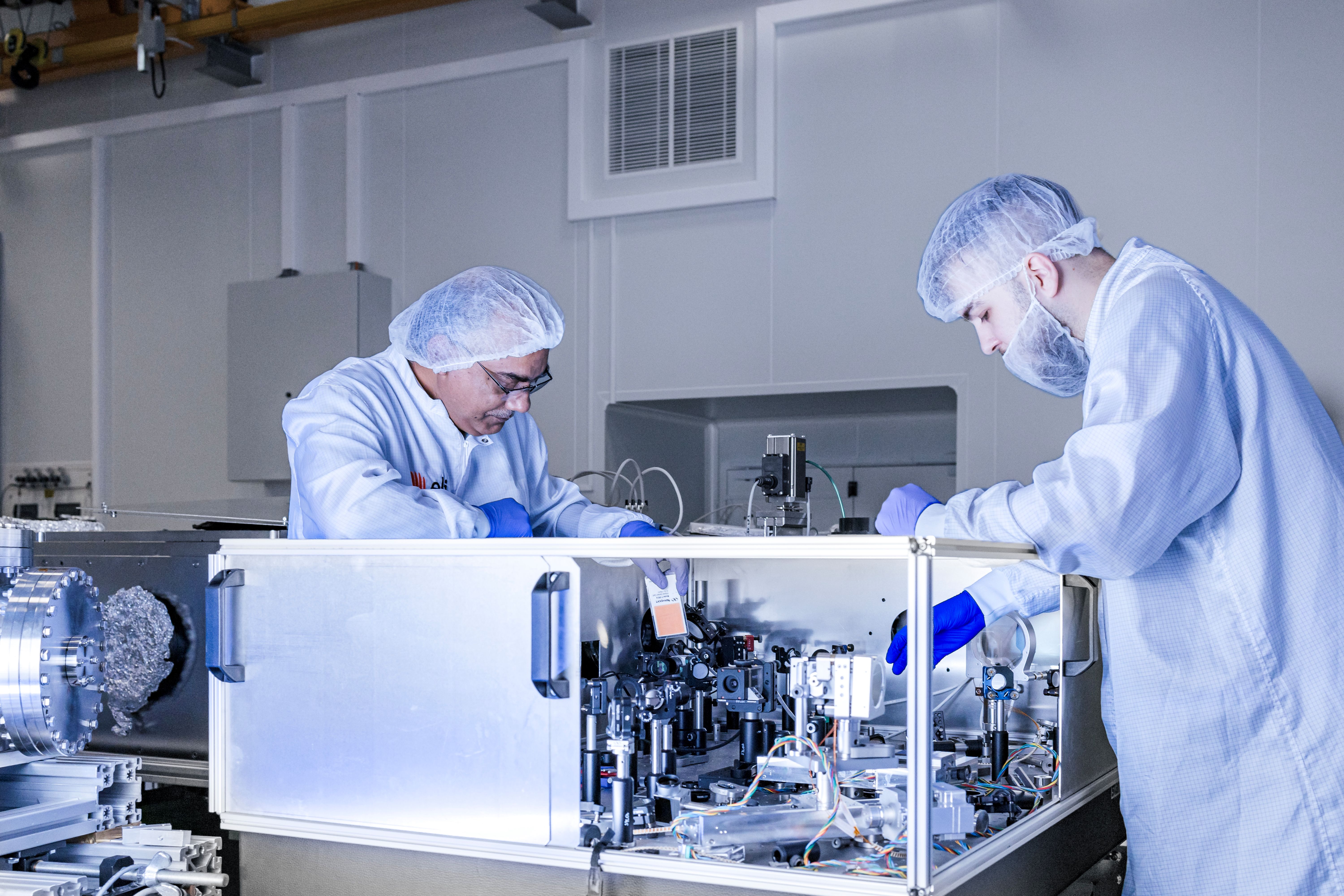
At the ELI ALPS Facility, XUV radiation is produced through high-harmonic generation (HHG). As the first step in the process, an extremely intense, ultrashort (femtosecond-scale) infrared laser pulse is focused into a noble gas (e.g. argon or neon). Through the tunnelling effect, the laser’s immense electric field makes an electron break free from the atomic nucleus. The alternating laser field accelerates the resulting free electron and then, upon phase transition, drives it back toward the atomic nucleus to recombine with the atom. The extra kinetic energy gained during this motion is radiated in the form of a single, high-energy XUV photon. At the end of the process, coherent, laser-like XUV light pulses in the attosecond time domain are generated.
Until now, 13-femtosecond lasers have been used to generate attosecond pulses, but physicists in Szeged are also working on reducing the duration of the generating pulses to nearly 4 femtoseconds. This would be important for the generation of isolated attosecond pulses. Incidentally, there are indirect indications — which have not yet been confirmed by temporal characterization — that an isolated attosecond pulse has also been successfully generated using the so-called polarization gating technique, as reported in the aforementioned paper.
“The commissioning of the 1 kHz SYLOS Compact GHHG beamline overcomes the historical trade-off between high pulse energy and high repetition rates, resolving a critical bottleneck in ultrafast optics,” said Sourin Mukhopadhyay, senior research fellow in the SYLOS Gas Attosources Group.
While free-electron lasers (FELs) offer exceptional peak brilliance, their operational complexity and restricted access limit widespread use. Our tabletop alternative provides the high flux profiles required to drive high-order nonlinear processes, serving as an accessible platform to map complex, multidimensional electron correlations via phenomena like two-photon double ionization, mapping complex electron correlations in multidimensional space across the femtosecond to attosecond regime.
By operating entirely within the perturbative XUV regime, the beamline shifts the experimental paradigm away from conventional XUV–IR pump–probe schemes, where strong infrared dressing fields inevitably distort the target system. This allows for the direct, undistorted observation of pure electronic correlations. Operating as an open-access user facility, it makes high-flux attosecond science accessible to a wider research community while pushing the boundaries of time resolution, pulse energy and experimental complexity.

The laser beam can be focused at different distances — 10, 6, and 3 metres. Using different focal lengths is necessitated by the fact that the process is very inefficient: it takes one million laser photons to generate a single XUV photon. Efficiency can be improved, for example, by increasing the laser’s energy; however, a laser with too much energy can knock electrons out of the target atoms, in which case no useful light pulse is produced. This problem can also be addressed by using an appropriate laser intensity range. By varying the focal length, the size of the focal spot can be increased to generate a large number of high-energy XUV photons. In this case, more atoms are illuminated, i.e. more XUV sources are generated.
It is also important to know the duration and spectral range of the pulse, as a user might rightly ask about these parameters. Using radiation characterization instruments, our physicists analyzed the spatial and temporal shape, energy, and spectrum of the attosecond radiation, as discussed in the publication.
According to Zsolt Divéki, you practically need to be a polymath to operate equipment like the lasers in Szeged. You need to have an understanding of computer science, networks, the control of moving components, optics, vacuums, nuclear physics, spectroscopy, materials science, and many other fields.
“Standardized endstations enable external researchers to deploy these pulses to explore and control the electron dynamics across various phases of matter in molecular physics, condensed matter physics etc., directly facilitating advancements in atto-chemistry, quantum control, and the development of petahertz-scale optoelectronics”, said Sourin Mukhopadhyay.