


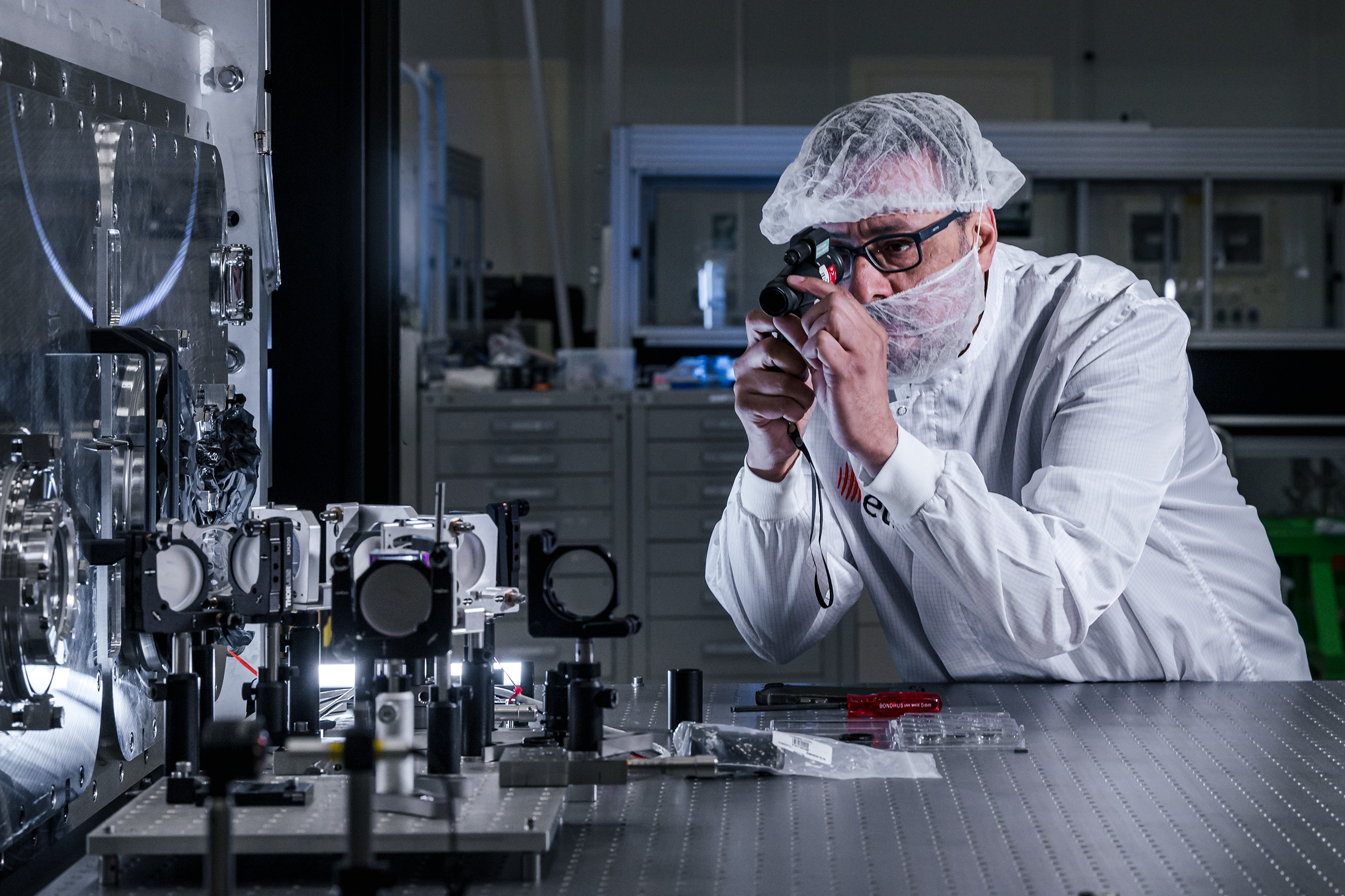
This beamline is a multi-GeV, multi-Hz laser-driven electron accelerator, based on the laser wakefield acceleration mechanism (LWFA), and has the unique feature of operating in two distinct laser focusing geometries, with short and long focal lengths, targeting different application themes. With short focusing, “modest” relativistic energies (~400 MeV) with high charge (>nC) were achieved. Such electron output makes ePW an ideal instrument for Very High Energy Electron (VHEE) radiotherapy investigations. With long focusing, up to 1 GeV beams were detected to utilize the self-generated high-energy, betatron X-rays for the investigation of biological and industrial samples with tomographic and other imaging techniques. This betatron X-ray capability of ePW complements the Gammatron beamline at the ELI Beamlines Facility, and effectively doubles ELI’s capacity to provide such compact X-ray instruments to the users.
“The design and construction of the ePW beamline began six years ago (under the guidance of principal investigators Christos Kamperidis and Nasr A. M. Hafz). The first commissioning experiment started in July 2025. Our goal was to prepare the endstation so that users could apply for beamtime and use it,” said Particle Acceleration Group Leader Nasr A. M. Hafz.
Electron beams were generated using two different geometries. In one geometry, described in our article published in Physical Review Research, the so-called F-number was F15, meaning the focal spot had to be approximately 15 μm in diameter. In the experiment, an electron beam energy of approximately 500 MeV was achieved, which was almost in complete agreement with our predictions based on theoretical models and simulations. This highly complex system thus worked.

The results were interpreted by Zsolt Lécz (the first author of the article), a theoretical physicist in the Particle Acceleration Group at ELI ALPS. One of the phenomena Zsolt analyzed was that the electron beams exiting the accelerator did not have the same divergence in each shot (i.e. the experiment showed a shot-to-shot variation in the angular distribution of the accelerated electrons). This directional variation is a very serious problem in laser-driven accelerators because the plasma medium itself is difficult to control or reproduce with identical parameters every time. Consequently, the produced electron beams do not always have identical parameters.
According to Zsolt’s theory, this phenomenon is not explained solely by the variation in the plasma density. During the interaction between the laser and the plasma, the laser pulse undergoes a so-called redshift and converts into a near-single cycle, which leads to the off-axis injection of electrons into the wakefield and hence destabilizes the beam pointing of the accelerated electron beam. This is one reason why the electron beams from laser-plasma accelerators do not converge on the exact same point. Another source of pointing fluctuation could be the asymmetry in the laser beam profile, which will be investigated later.
To improve the angular distribution of the electron beam, the redshift process must be avoided in the laser–plasma interaction. This is possible by adjusting the plasma density or the plasma length and certain laser parameters, but further experiments are needed to confirm these findings. ELI ALPS’ physicists have verified this mechanism through experiments. Once this problem is solved, there will be an electron beam that has a better pointing stability.
“I am very proud that this is the ePW laboratory’s first scientific result. This marks the completion of the ePW system’s construction. The project took six years, and the publication of this article is the final element of this project,” said Nasr Hafz noting that another great thing is that barely six months passed between the completion of the experiment and the publication of the article in one of the most prestigious professional journals. He has over 100 publications – some of which appeared in Nature Photonics, Science Advances, PNAS, HPLSE etc. – but this one is very special to him, as it marked the culmination of six years of work.
How can this result help users in their work?
“ELI users applying to use the ePW beamline are divided into two categories. Several users aim to generate high-quality electron beams using their own ideas and equipment. They belong to the research and development category. Others use the electron beam as a tool for their experiments, including Katalin Hideghéty, head of the Biomedical Research Group at the ELI ALPS Facility conducts radiobiological research using the electron beam,” said the group leader.
According to the physicist, this result is useful for both groups. Furthermore, the driving laser of the ePW beamline, i.e. the High-field Petawatt (HF PW) laser of the ELI ALPS Facility has been added to the user portfolio, which is an important milestone.