


The joint project between the University of Szeged and ELI ALPS Laser Research Institute is characterized by pioneering solutions and innovative technologies, such as the country’s first solar panel system floating on water. The aim of the programme, which was launched three years ago, was to create a state-of-the-art solar power plant with a total of 13,460 solar panels on the research institute’s premises and in its immediate vicinity, on the surface of the rainwater collection pond belonging to the Science Park of the University of Szeged, to supply electricity to the facilities of ELI ALPS. All units of the power plant were required to use high-efficiency, low-degradation solar panels, achieve the highest possible area-specific production and the longest possible service life.
“By using the electrical energy generated by the solar power park, ELI ALPS has become the greenest large scientific facility in the world,” said our managing director, Professor Gábor Szabó, at the handover ceremony. The five-megawatt solar panel system can cover 35 percent of the research institute’s energy needs, but with optimized energy storage, a 50 percent ratio can also be achieved. The efficiency and cost-effectiveness of various energy storage technologies are currently being analyzed. One of the possible solutions is an ice storage system, which stores surplus energy generated during the day in the form of ice. If the pilot project with a five-cubic-metre tank proves successful, a 100-cubic-metre ice storage tank could store up to 7 MWh of energy. This would cover a significant part of our institute’s nighttime energy needs.
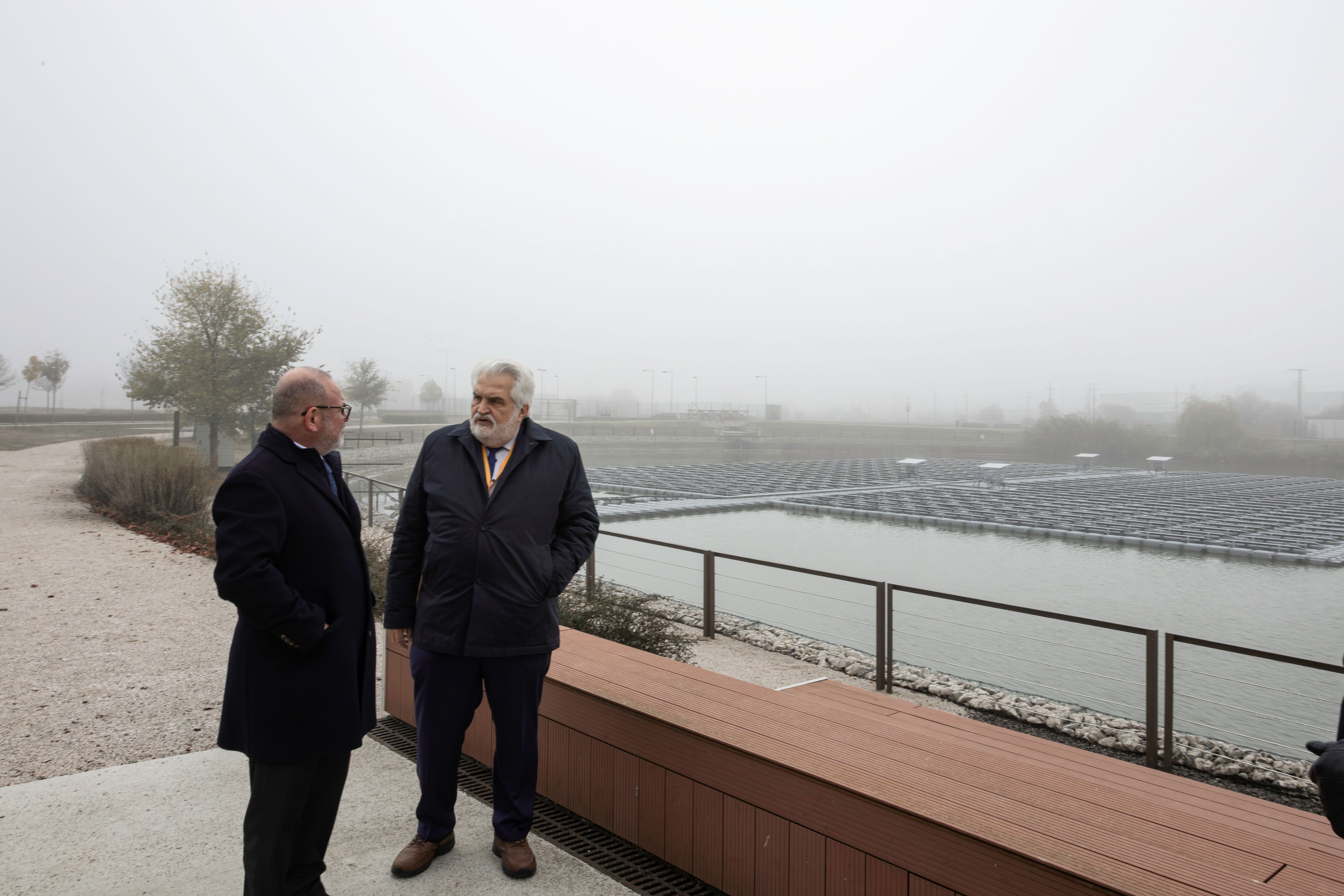
At the ceremony, Professor László Rovó, Rector of the University of Szeged, emphasized that this environmental investment is part of an elaborate programme. For some time, the University of Szeged has already been considered the greenest university in Hungary, as ten percent of its energy consumption comes from renewable sources.
On behalf of the contractor, László Makai, operations director of Energosun Investment Plc. emphasized that technologies not used elsewhere were also employed during construction. His company is most proud of the floating solar panel system, the first of its kind in the country.
Energy Minister Csaba Lantos said that the ministry had provided a total of five billion forints in support for renewable energy investments by the University of Szeged and ELI ALPS; our research institute received two billion forints of this amount. According to the minister, this solar power plant embodies the principle that energy should be produced as efficiently as possible and with as few harmful emissions as possible, wherever it is needed. Hungary already has 8,200 megawatts of solar power capacity, but the construction of new wind farms will also be possible, and, building on favourable potential, the increased use of geothermal energy and biomass is also being encouraged.
According to Csaba Lantos, from April to the end of September—when solar panels produce large amounts of electricity—the country may have a surplus of electricity, but due to fluctuations in the price of electricity, it is essential to build storage capacity.
According to our managing director, the installation of the solar panels did not significantly alter the environment, and the green space taken up by the power plant is minimal. The trees cut down due to construction work will be replaced with a dense, diverse, fast-growing mini forest, known as Miyawaki forest. It was also mentioned that thanks to the shading effect of the solar panels installed on the pond, the water will heat up less in the summer, so the fish living in it will feel more comfortable during the heatwaves.
After the inauguration of the solar power park, our guests had the opportunity to see the innovative solutions for themselves on a guided tour.