



Radiotherapy is one of the most common treatment modalities for cancer with two primary delivery mechanisms: external beam and internal radionuclide therapy. Whilst external beam radiotherapy employs medium to larger scale accelerators to generate beams of photons, electrons, protons or ions to irradiate the patient, internal radionuclide therapy uses radiopharmaceuticals (functionalized drugs with radioisotopes attached) that pool at the tumour site within the patient and irradiate the local area with electron/positrons and alpha particles.
Beta-emitting radioisotopes Lutetium-177, Terbium-161 and Copper-67 are of major interest for targeted radionuclide therapy in metastatic prostate cancer, with Lutetium-177 being most established in terms of marketed products. At present, Lu-177 can only be produced in ten special nuclear reactors across the globe, which presents a significant supply chain issue if one of these reactors goes offline for maintenance.
Laser-driven radiation sources provide a potential alternative to traditional methods (accelerators, cyclotrons, nuclear reactors, etc.) for generating radioisotopes used in the production of radiopharmaceuticals. This can be seen via the success of two recent independent experimental campaigns at ELI ALPS on the SYLOS3-LEIA-n beamline and at the Institute of Laser Engineering at Osaka University, which illustrated the feasibility for laser-driven neutron sources for the generation of such radioisotopes.

“We will utilize the Low Energy Ion Acceleration (LEIA-n) beamline driven by the SYLOS 3 laser implement in its ion target (pitcher) and neutron converter (catcher) configuration. We will irradiate a total of four metal and metal oxide samples with the generated fast neutron beam over either a single or multiple days, depending on the target radionuclide we aim to produce. The activity of each sample will then be determined with multiple gamma-ray spectroscopic measurements staggered relative to the half-life of generated radionuclides of interest,” said Jeremy Brown about the goal of the pilot program. The research was conducted in collaboration with Lithuanian colleagues at Vilnius University, as Swinburne University of Technology in Melbourne and Vilnius University have a close professional relationship thanks to a long-term agreement.
The Australian researcher admits that the idea of using laser-controlled neutron sources to produce radiopharmaceuticals seems strange at first glance. However, laser technology has advanced to such a level that this approach now seems feasible. Jeremy Brown spent six and a half years in Europe, but always worked in the nuclear field.
“ELI is full of incredibly talented people. From radiation safety staff to doctoral students working on the beamline, postdocs, and laser technicians. Not only we users, but they too are key to the success of the experiments,” said Jeremy Brown, who believes that Europe takes science seriously and invests a lot of energy in it. He admitted that until a year and a half ago, he had no idea that ELI ALPS existed. When he arrived in Szeged, he realized that the facility was much better than he had expected. It is a wonderful institute, and Szeged is also a beautiful and pleasant place, but most importantly, everyone here is very competent, helpful, open, and willing to discuss even the most basic problems.
The nuclear physicist has found the experience gained here very instructive. LEIA-n was a great start, but there are other radiation beams that may be better suited to this type of experiment. However, this will require unique endstations. The goal of their first experiment was to see if the concept worked. Some results suggest that this method could be used to produce special drugs.
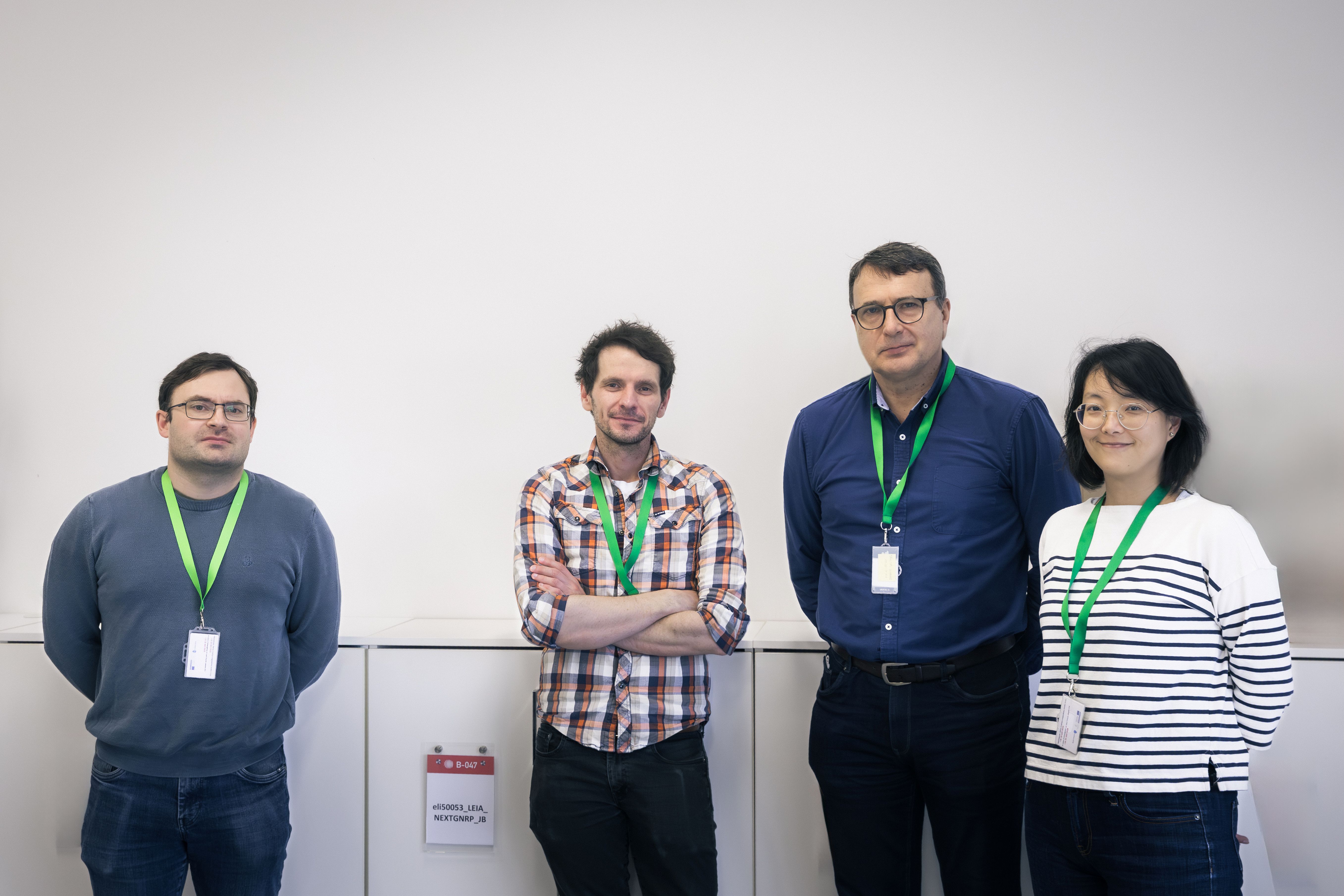
According to Jeremy Brown, this work could lead to a joint Australian-Lithuanian-Hungarian program aimed at developing a compact, laser-controlled neutron source system that can be easily installed in nuclear medicine departments in hospitals around the world.
The nuclear physicist initially thought that this development could be achieved within a few years. However, he now believes that it will take at least four to ten years. In his opinion, of all the facilities available, ELI is probably one of the best equipped to really advance this technology. The Australian physicist would like to return to Szeged to continue his research toward this goal.
___________________________________________________________________________________________________________________________________________________________________________________________
The LEIA beamline was designed and has been run by the NLTL (National Laser-Initiated Transmutation Laboratory) team of the University of Szeged, led by Karoly Osvay, currently also as a senior scientist of ELI ERIC. It is worth mentioning, that further two colleagues of the University have recently become part-time employees of ELI ALPS. Tibor Gilinger (Early Stage Researcher) and Zoltán Jäger (Research Fellow) work at the institute as members of the Scientific Directorate.
Further key persons were Parvin Varmazyar, Árpád Mohácsi, and Ádám Kovács. Parvin Varmazyar is a research fellow at the University of Szeged, while Ádám Kovács is a PhD student at the same institution. Árpád Mohácsi is the ELI ALPS Vacuum Technology Group Leader and acting Head of Optical Workshop.
Photos: Gábor Balázs