


In pump–probe experiments, the delay must be set with high precision. For processes occurring on an attosecond timescale, the delay setting must also be accurate to the attosecond, which poses a serious technical and scientific challenge. This is particularly true for beamlines driven by high-power lasers, where the optical setup – most of which is kept in vacuum – is exposed to significant heat loads. These thermal effects (including, for example, thermal expansion) make it extremely difficult to maintain the path length difference between the several-metre-long arms of pump–probe interferometers with nanometre-level precision.
“Originally, we thought that (micro) vibrations would be the biggest obstacle to setting the right path length – and thus the pump–probe delay – but it turned out that we had to consider something else. We work with a laser with a very high average power, and even though we use highly reflective mirrors to deflect the beam, some of the light is absorbed, which heats them up. However, in vacuum, there is nothing to dissipate this heat, so the mirrors expand. This expansion can alter the beam path,” said senior research fellow Balázs Major, head of the ELI ALPS HR Attosources Group, and one of the authors of the paper published in APL Photonics.
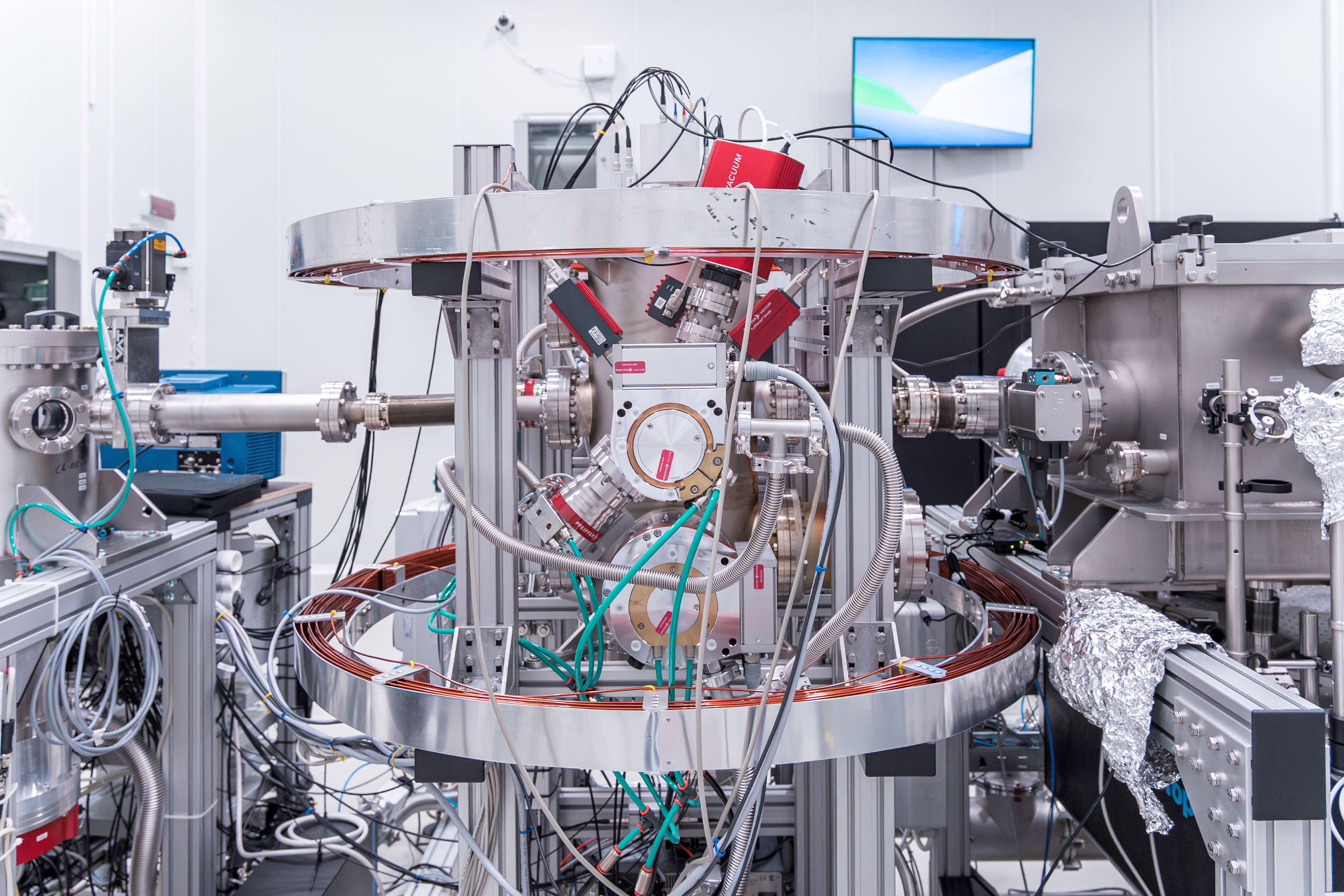
Due to the high average power, the laser beams had to be synchronized with a new technique capable of measuring the pump–probe delay with high accuracy without interfering with the main experiment. In general, active stabilization methods are based on measuring the change in the delay, and the subsequent modification of the beam path length accordingly. To measure the delay, we developed a polarization-sensitive method. This active feedback can compensate for any change.
“At ELI ALPS, we built an active feedback interferometer that maintains a stable pump–probe delay and is capable of operating with an accuracy of 80 attoseconds for up to 70 hours,” Balázs Major said, describing the results achieved on the HR Gas beamline. According to him, this approach allows the delay to be maintained with high precision even in an attosecond beamline driven by a high-average-power laser. The thermal expansion of the mirrors remains, but the distorting effect is eliminated.
According to Balázs Major, this method can be used in any experiment at ELI where attosecond pump–probe measurements are needed. Our physicist also pointed out that it can be successfully applied anywhere in the world irrespective of the average power of the laser in use.
“This achievement enables many experiments that were previously impossible or could only be carried out at the cost of significant compromises. Until now, we have obtained less accurate and somewhat noisy data. With this development and research result, our lasers have become much more attractive to users,” our senior research fellow added to highlight the accomplishment.
Our colleagues submitted their article to a special issue of APL Photonics. Featuring it on the cover page was the decision of the editorial board.
Photos: Gábor Balázs