


Are you following family traditions or did you embark on a scientific career out of personal motivation?
My father, who graduated from Batsányi János Grammar School in Csongrád, started his career with a strong foundation in science. This interest accompanied him in his adult years too, and this mindset permeated our family’s everyday life. In primary school, I was interested in geography and biology, and turned to chemistry during my years at Batsányi Grammar School. I applied to the Chemistry programme of the University of Szeged, and in hindsight, I can say that this was the best place I could have landed. After one of his lectures at the university, Prof. Csaba Visy offered me to join his research group and do my thesis with him if I wanted to. I was happy to accept this invitation. The professor did have a keen eye for choosing young people to join his electrochemistry research group: Csaba Janáky, Balázs Endrődi, Péter Sándor Tóth, Attila Kormányos and I are still working at the university (too). I was intrigued by the fact that electrochemistry is considered one of the most challenging areas of chemistry. I was curious to see what this field could offer me – and this work has resulted in a lifelong commitment.
Why is this discipline so challenging?
Electrochemistry involves complex processes that need time to understand. However, it is also an incredibly useful and exciting field, as many of the devices we use every day – such as batteries, electrolysers, photoelectrodes – rely on electrochemical processes to operate. It is also important to understand these processes in the context of solar cells, where they lead to corrosion that we must prevent. I became attracted to this discipline precisely because of its application orientation.
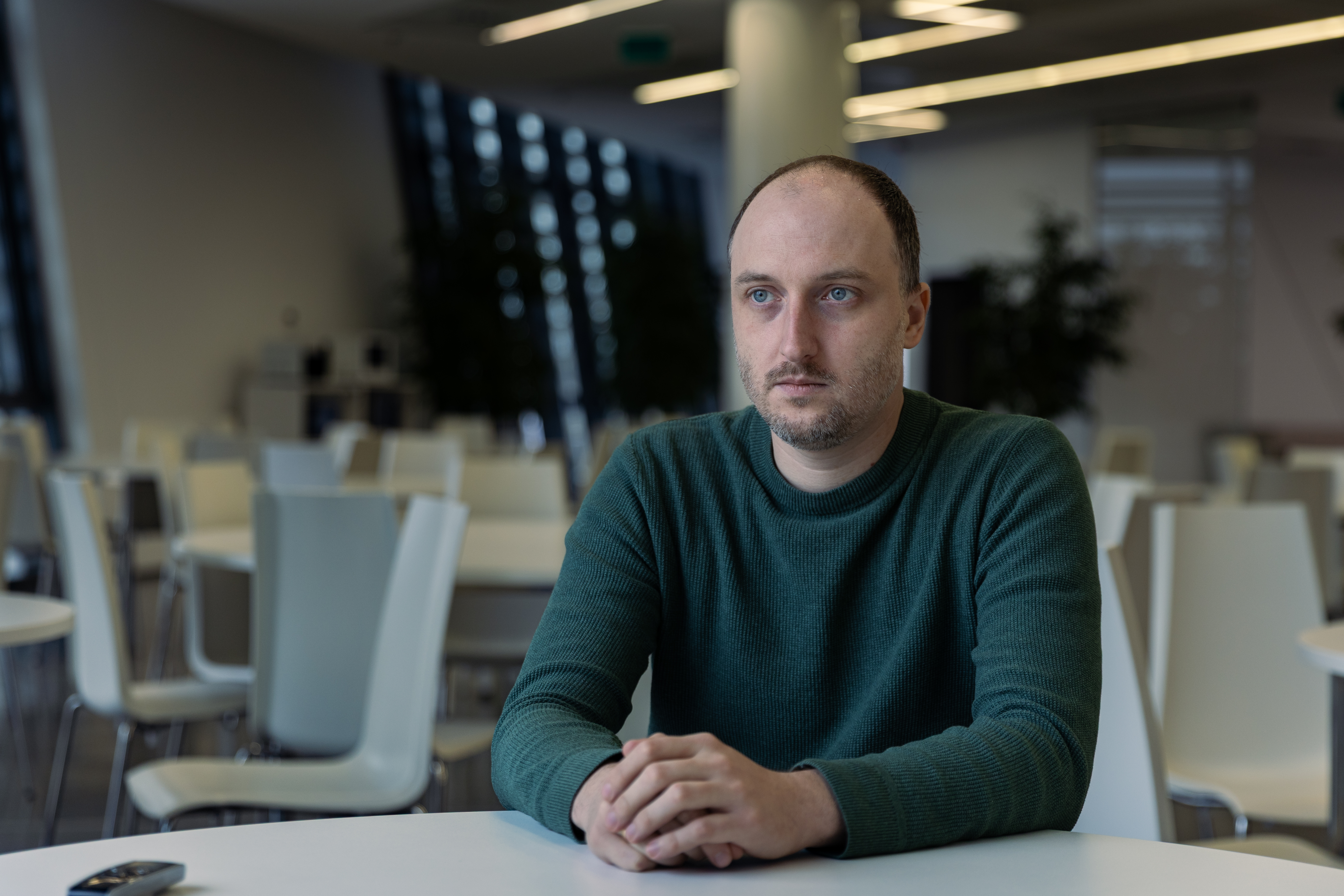
You received the Academic Youth Prize for your work on metal halide perovskites. Why are these materials interesting?
Researchers discovered materials with perovskite crystal structures back in the 1940s and 1950s, but it was only around 2010–2011 that the optically active versions of these materials came to the forefront of attention. It is important to point out that these variants, which I am also working with, can only be produced in the laboratory and do not occur in nature. Metal halide perovskites have gained interest because they are incredibly efficient at utilizing light. My favourite example is the following: a thousand times thinner layer of perovskite absorbs the same amount of light as the materials currently used in silicon solar cells. This family of materials has been studied by hundreds of research groups around the world in recent years due to their special properties. Thanks to the developments, perovskites can now be used to make solar cells with an efficiency of 22–23%. This is a major achievement because the maximum theoretical solar conversion efficiency is 33 percent. Upon his return from the United States, my supervisor, Csaba Janáky, organized his research group around the photoelectrochemical investigation of various new-generation semiconductor materials. On his recommendation, I wrote my PhD thesis on metal halide perovskites.
Did the results come straight away?
Not quite. For almost two years, my work did not bring any breakthrough. The turning point was my research in the USA, where I learned how to make solar cells from perovskites. One important contribution of that period was that I was introduced to the transient absorption measurement technique suitable for studying photophysical processes. This is the knowledge I brought to ELI ALPS.
You have won the Academic Youth Prize for your proposal on the study of charge carrier dynamics of metal halide perovskites and the development of scintillator detectors. You earned the award as an employee of the University of Szeged and ELI ALPS. What role did ELI ALPS play in the results described in the application?
The study of the charge carrier dynamics of metal halide perovskites is fundamentally linked to the laser centre. The ultrafast measurements – at the nanosecond, picosecond and femtosecond timescales – were performed here. The material systems that were tested in the experiments had been produced at the university. My activities at the university and at the laser centre are mutually reinforcing each other: one would not work, or more accurately, would not work well without the other.
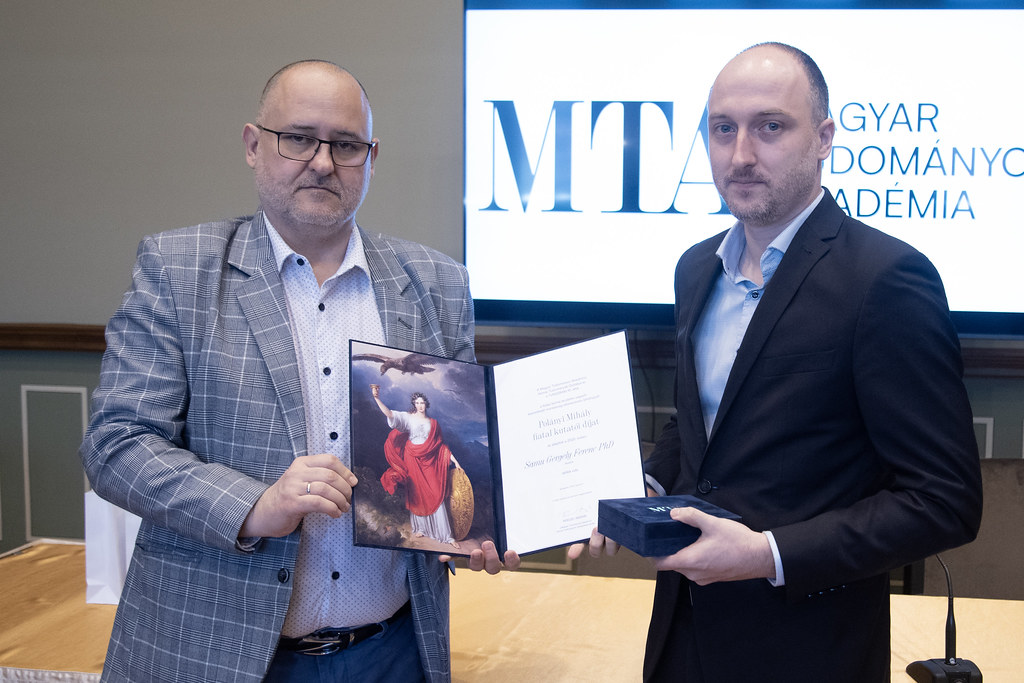
Award ceremony of the Polányi Mihály Youth Prize at the Hungarian Academy of Sciences (Photo: Tamás Szigeti/HAS)
You received the Polányi Mihály Youth Prize for your pioneering work in the production of new-generation semiconductor materials, in the exploration of the photochemical and photophysical properties of such materials, as well as in the investigation of the functional parameters of optoelectronic devices made from them. Is the role of the laser centre also evident here?
Of course. I have always aimed to explore a new field of science by combining my research activities in electrochemistry and laser science, and to use these results to better understand materials that surround us every day. This is why we combine laser and electrochemical techniques at the laser research centre to study the effects of external electric fields on the charge-carrying dynamics of materials.
How can a chemist support the work of physicists at the laser centre?
My physicist colleagues also work with material systems. However, they focus more on understanding and investigating new physical processes, than the systems used for such purposes. For this reason, a chemist’s detailed knowledge of the materials’ properties can give momentum to their work too. By developing alternative preparation methods, we can contribute to the success of experiments. My physicist colleagues tell me what they want, and we try to fulfil their ideas. To effectively support the experiments of users coming to the laser centre, we must be able to work in different disciplines. For example, occasionally we have had to improvise and produce the experimental samples because the materials sent by the user did not survive transportation.
What goals do you envision for yourself at the laser centre?
Together with two young colleagues we are striving to participate in as many user experiments as possible with our transient absorption setup. Among other things, we would like to demonstrate that TAS is indeed a useful tool for a deeper understanding of photophysical phenomena. As we built the instrument ourselves, we can fine-tune it according to the users’ requirements and thus support exciting research directions.
You are the first ELI ALPS employee to have won the Academic Youth Prize. What message do these awards convey?
I was very pleased, as the Academic Youth Prize is a type of award for which you can apply with the summary of a research work. I chose a topic that I find the greatest achievement of my career so far. The prize reinforces in me that the professional jury also found my topic interesting. In other words, the discipline that is important to me is also recognized by others. On the other hand, the Polányi Prize is awarded to a researcher upon a recommendation from a working group of the Hungarian Academy of Sciences. This also conveys a positive message for me, as it means that I am also backed by a research community.
Photos: Gábor Balázs