-
Stimulated emission
Kényszerített emisszió
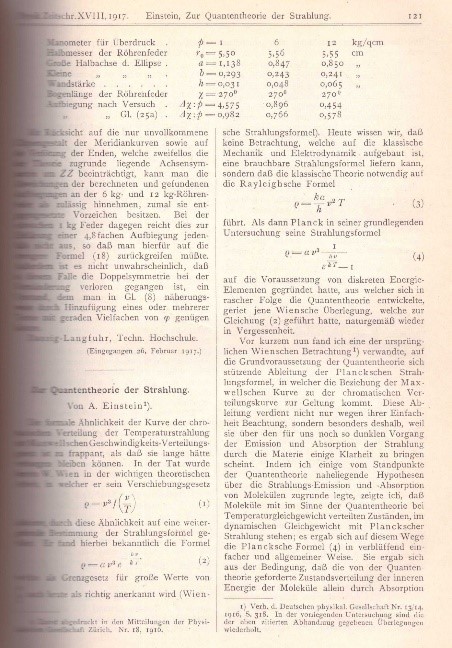
The phenomenon utilized in the production of laser light was first discussed by Albert Einstein in his 1917 paper titled The Quantum Theory of Radiation [1].
In atoms, the nucleus is surrounded by an electron cloud with electrons of various energies. The possible energy levels are determined by the laws of physics.
In the ground state, electrons in an atom occupy the lowest energy levels, but they can be forced to move to a higher energy level and get into an excited state by absorbing a sufficient amount of energy. However, this excited state is not stable and after some time the electrons will spontaneously return to their ground state. The difference between the two energy levels (the excess energy they originally gained) is emitted by electrons returning to the lower energy level in the form of light radiation.
A lézerfény előállításának elméleti alapjául szolgáló jelenséget Albert Einstein „A sugárzás kvantumelmélete” című, 1917-ben publikált cikkében tárgyalta [1].
Az atomokban az atommagot elektronfelhő veszi körül, amelyben különböző energiájú elektronok vannak. A lehetséges energiaszinteket fizikai törvények határozzák meg.
Alapállapotban az atomokban lévő elektronok a legalacsonyabb energiaszinteket töltik be, de megfelelő mennyiségű energia felvételével egy magasabb energiaszintre kerülhetnek. Ez a gerjesztett állapot azonban nem stabil: egy idő után az elektron spontán visszatér alapállapotába, és a két energiaszint közötti energia-különbséget az alacsonyabb szintre visszatérő elektron leadja. A folyamat elején felvett és a végén leadott energia egy foton formájában érkezik és egy foton formájában sugárzódik ki. A foton egy „energiacsomag”: az elektromágneses sugárzás (melynek egyik megjelenési formája a látható fény) elemi részecskéje, kvantuma.
The energy absorbed at the beginning and released at the end of the process arrives in the form of a photon, and is emitted in the form of a photon. The photon is the quantized unit of electromagnetic radiation (which takes many forms, including visible light).
This spontaneous absorption-emission process can be developed further by external intervention. Einstein predicted that if an excited atom absorbs another photon whose energy equals the exact energy of the excited state, not one but two photons are emitted when the atom returns to the ground state. During stimulated emission, the two emitted photons are coherent: they travel in the same direction with identical energy and phase.
Einstein’s theoretical prediction was later confirmed experimentally, which created the possibility for the production of laser light.
Ez a spontán abszorpciós-emissziós folyamat külső beavatkozással továbbfejleszthető. Einstein megsejtette és elméletileg igazolta, hogy ha a gerjesztett állapotban lévő atom még egy, a gerjesztett állapottal megegyező energiájú fotont vesz fel, akkor az alapállapotba való visszatéréskor nem egy, hanem két fotont sugároz ki, és e két foton egymással minden jellemzőjét tekintve megegyezik. Azt mondjuk, hogy a kényszerített emisszió folyamata során a kisugárzott két foton koherens: irányuk, energiájuk és fázisuk is azonos.
Einstein elméletileg igazolt sejtését később kísérletek is igazolták, megteremtve a lézerfény előállításának lehetőségét.
Referencia
[1] A. Einstein: Quantentheorie der Strahlung; Physikalische Zeitschrift 18 (1917) 121-128
Reference
[1] A. Einstein: Quantentheorie der Strahlung; Physikalische Zeitschrift 18 (1917) 121-128
-
Optical pumping
Optikai pumpálás
In thermal equilibrium the majority of particles in a matter are in their ground state, and the short-lived, spontaneously excited particles spontaneously relax to the ground state. To produce laser light, the majority of the particles must be in the excited state, when the number of emitted coherent photons can be increased by stimulated emission. This unusual ratio of ground-state and excited-state particles, i.e. population inversion can be achieved by giving particles sufficient energy.
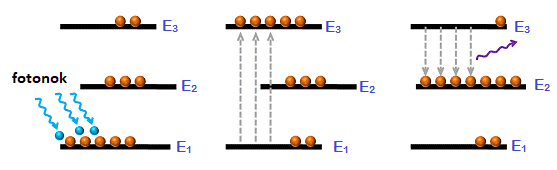
Termikus egyensúlyban egy anyaghalmaz részecskéinek döntő többsége alapállapotban van, és a rövid ideig tartó spontán gerjesztett állapotból a részecskék spontán módon térnek vissza alapállapotukba. Lézerfény előállításához azonban az szükséges, hogy a részecskék túlnyomó része gerjesztett állapotú legyen, mert így kényszerített emisszióval növelhető a kibocsátott koherens fotonok száma. Az alapállapotú és gerjesztett állapotú részecskék számának ezt a szokatlan arányát, a populációinverziót úgy lehet elérni, ha a részecskék megfelelő mennyiségű energiát kapnak.
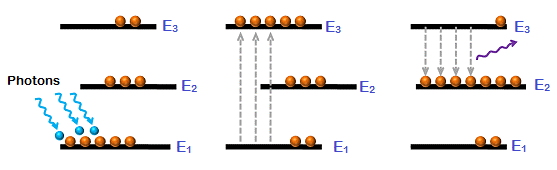
For the laser to operate, population inversion must be continuously maintained, i.e. the medium must contain more excited than relaxed particles.
A lézer működéséhez a populációinverziót nemcsak létre kell hozni, hanem fenn is kell tartani, vagyis folyamatosan biztosítani kell, hogy az anyaghalmazban több gerjesztett, mint alapállapotú részecske legyen.
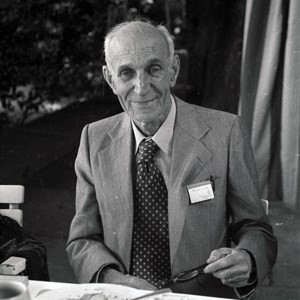
To this end, Alfred Kastler developed the method of optical pumping, during which the necessary energy was provided by a light source having sufficient power, e.g. an arc lamp, a flash tube and later, a laser.
For his research, Alfred Kastler was awarded the Nobel Prize in 1966.
Erre a célra dolgozta ki Alfred Kastler az optikai pumpálás módszerét, amelynek során a szükséges energiát egy megfelelő teljesítményű fényforrás, például ívlámpa, villanólámpa, majd később lézer szolgáltatja.
Kutatásaiért Alfred Kastler 1966-ban Nobel díjat kapott.
Referencia
A. Kastler: Quelques suggestions concernant la production optique et la détection optique d'une inégalité de population des niveaux de quantifigation spatiale des atomes. Application à l'expérience de Stern et Gerlach et à la résonance magnétique; J. Phys. Radium 11 (1950) 255-265
Reference
A. Kastler: Quelques suggestions concernant la production optique et la détection optique d'une inégalité de population des niveaux de quantifigation spatiale des atomes. Application à l'expérience de Stern et Gerlach et à la résonance magnétique; J. Phys. Radium 11 (1950) 255-265
-
MASER — The forerunner of laser
MÉZER – A lézer elődje
Military developments in World War II brought significant advances in microwave and radio wave technology, and boosted academic research in the field.
The theory of stimulated emission and the method of optical pumping were applied simultaneously but independently by Charles H. Townes (USA), as well as by Nikolai G. Basov and Alexander M. Prokhorov (USSR) to stimulate gaseous ammonia in a suitably sized resonator cavity to emit coherent photons in quantities exceeding those of exciting photons. This radiation occurred in the microwave spectrum, wherefore they named their device microwave resonator and then MASER, which is the acronym of Microwave Amplification by Stimulation Emission of Radiation.
These research activities paved the way for the development of devices suitable for practical applications, including masers emitting in the infrared and visible spectrum, i.e. lasers. Their efforts were rewarded with a shared Nobel Prize in 1964.
A második világháború haditechnikája a mikro- és rádióhullámok területén komoly technológiai fejlődést hozott, lendületet adva ezen a területen az akadémiai kutatásoknak.
A kényszerített emisszió elméletét és az optikai pumpálás metódusát felhasználva egymással párhuzamosan, de egymástól függetlenül érte el Charles H. Townes (Amerikai Egyesült Államok), valamint Nyikolaj G. Baszov és Alekszandr M. Prohorov (Szovjetunió), hogy megfelelően méretezett üregbe zárt ammónia-gáz a gerjesztő fotonoknál nagyobb számban sugározzon ki koherens fotonokat. Ez a sugárzás a mikrohullámú tartományba esett, ezért eszközüket mikrohullámú rezonátornak, majd – a Microwave Amplification by Stimulation Emission of Radiation (mikrohullám erősítése sugárzás kényszerített emissziójával) rövidítéseként – mézernek nevezték el.
Kutatásaik megnyitották az utat a gyakorlatban is alkalmazható eszközök kifejlesztéséhez, beleértve az infravörös, és látható fény tartományban sugárzó mézerek, vagyis lézerek kifejlesztéséhez. Érdemeiket 1964-ben megosztott Nobel-díjjal ismerték el.
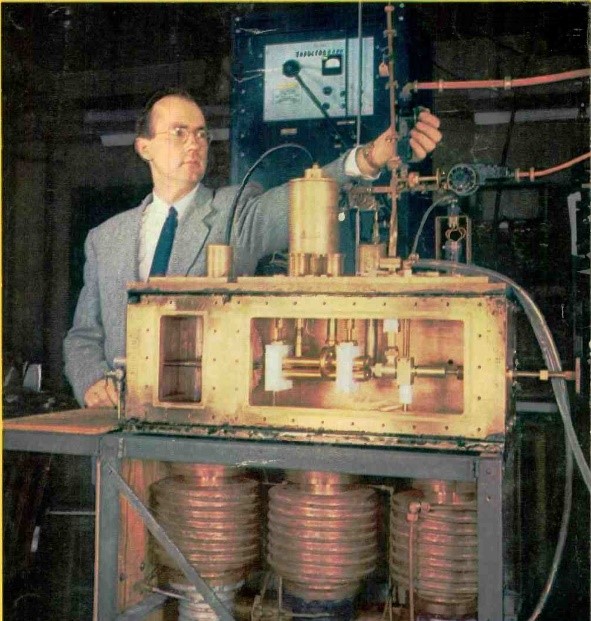
The ammonia maser at Columbia University and Charles H. Townes (1954).
The device emitted photons with a wavelength of a little over one centimetre, while its power was around 10 nW.A Columbia Egyetemen megépített ammónia-mézer és mellette Charles H. Townes (1954).
A készülék közelítőleg 10 nW teljesítménnyel sugárzott 1 cm-nél valamivel nagyobb hullámhosszúságú fotonokat. -
The first laser
Az első lézer
After the construction of masers emitting in the microwave range, research activities focused on the development of devices emitting coherent beams in the infrared and visible domain. These devices were named LASER, an acronym for Light Amplification by Stimulated Emission of Radiation. The description of the building blocks of the laser – and the acronym itself – first appeared in Gordon Gould’s authenticated laboratory notes dated 13 November 1957.
The first working laser was fired by Theodore H. Maiman on 16 May 1960, and the new invention was demonstrated to the public at a press conference on 7 July 1960.
Maiman was hired by Hughes Aircraft Company in 1956 to lead the ruby maser redesign project for the US Army Signal Corps. Following the successful project, the company agreed on a $50,000 fund for his laser project, which started in 1959. Maiman developed the laser using a synthetic ruby crystal and used a pulsed, high-power quartz flashlamp to create the population inversion in the ruby crystal.A mikrohullámú tartományban sugárzó mézerek megalkotása után az infravörös és a látható tartományban koherens sugárzást kibocsátó eszközök kifejlesztésére irányultak kutatások. A Light Amplification by Stimulated Emission of Radiation – fény erősítése sugárzás kényszerített emissziójával – rövidítéseként ezek az eszközök a lézer nevet kapták. A lézer szerkezeti felépítése és a betűszó Gordon Gould 1957. november 13-án hitelesített laborjegyzeteiben jelent meg.
Az első működő lézert Theodore H. Maiman indította be 1960. május 16-án, majd az új találmányt 1960. július 7-én mutatta be egy sajtótájékoztatón. Maiman 1956-ban állt alkalmazásba a Hughes Repülőgépgyárban, ahol az amerikai hadsereg híradós alakulatának megbízásából a rubinmézer továbbfejlesztésére irányuló munkálatokat vezette. A sikeres projekt nyomán a cég vállalta, hogy 50 000 dollárral támogatja Maiman 1959-ben megkezdett lézerfejlesztési kutatását. Maiman lézeréhez egy mesterségesen előállított rubinkristályt használt, amelyben impulzusüzemű, nagy teljesítményű kvarc villanólámpával idézte elő a populációinverziót.
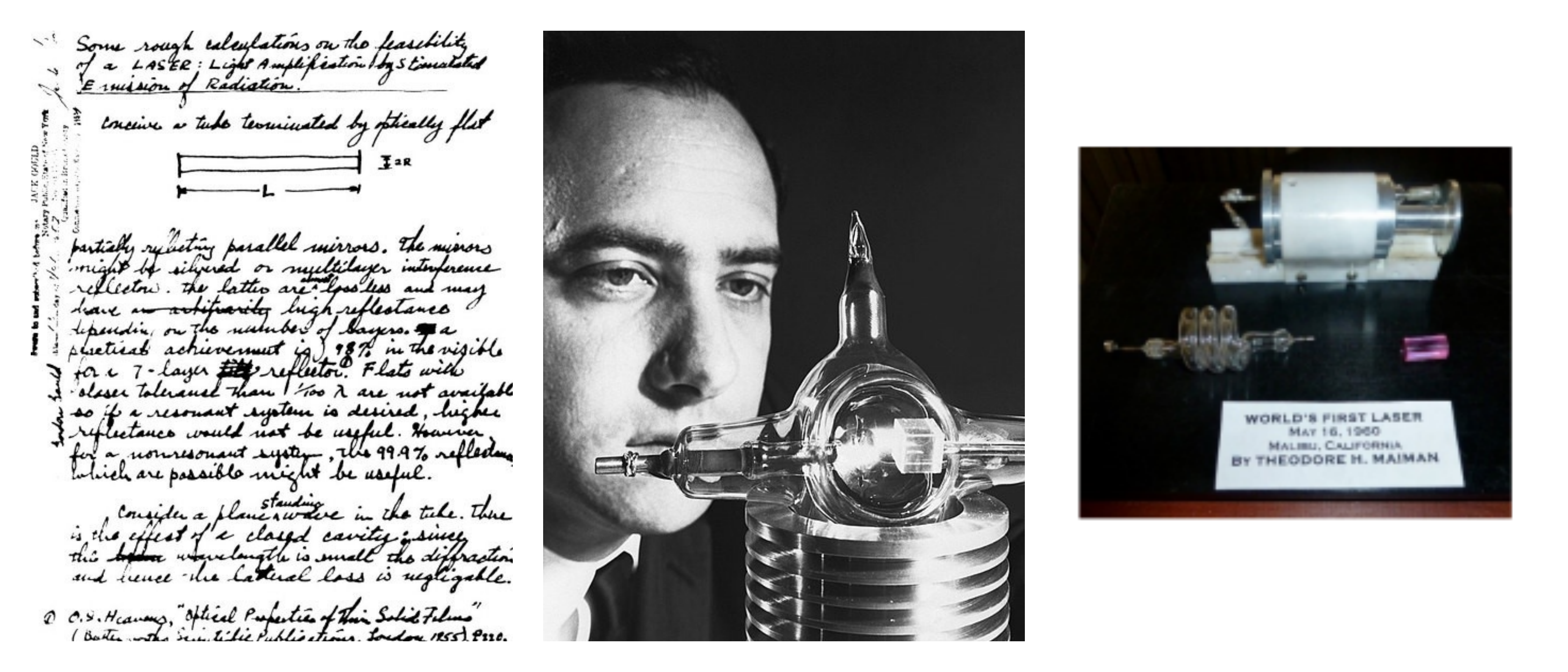
Theodore H. Maiman, and the laser he built at Hughes Research Laboratories (1960) A Hughes Kutatólaboratóriumokban megépített lézer és megalkotója, Theodore H. Maiman (1960) -
Fibre lasers
Szállérezek
Some of the scientists working on the further development of lasers focused their efforts on finding materials to be used as active medium. The active medium consists of a host material and impurities distributed homogeneously within it. In addition to other materials, devices using doped glass as medium were introduced thanks to Elias Snitzer’s research efforts.
It had been known since the mid-19th century that in a thin glass fibre light is able to follow the curvatures of the fibre through a series of total internal reflections, i.e. optical fibres are able to guide light. This sparked the idea for the development of lasers using optical fibres as medium [1]. Three years later, optical amplification was achieved in a 1 m long fibre [2]. These developments have led to high quality fibre lasers currently used in a wide range of applications. In fibre lasers, the active medium is an optical fibre up to a few hundred metres in length and with a diameter ranging from a few micrometres to a few hundred micrometres (µm). A long medium has excellent pumping efficiency and high amplification performance, while heat effects are negligible due to the small diameter. The different optical elements can be inserted into the optical fibres, wherefore the laser beam can be produced wherever it is needed, and propagation mid-air can be avoided. On the other hand, fibre lasers have limited performance due to nonlinear phenomena caused by the geometry of the fibres as well as optical damage.
A lézerek továbbfejlesztésének egyik iránya a médiumként – vagyis a lézerműködés aktív közegeként – használható anyagok körével foglalkozott. Az aktív közeg valamilyen hordozóanyagból és ebben eloszlatott adalékanyagból áll. Több más anyag mellett Elias Snitzer fejlesztéseként megjelentek a médiumként adalékolt üveget használó készülékek is.
Már a XIX. század közepétől ismert volt, hogy egy vékony üvegszálban a fény sorozatos teljes visszaverődések folytán követi az üvegszál görbületeit, vagyis az üvegszál képes a fényt vezetni. Ezt felhasználva alakult ki a médiumként üvegszálat alkalmazó lézer koncepciója [1]. Három évvel később már 1 m hosszúságú szálban hoztak létre optikai erősítést [2]. E fejlesztések vezettek el a ma már széles körben alkalmazott, magas minőségű szállézerekhez. A szállézerek aktív közege egy optikai szál, amelynek hossza akár néhány száz méter is lehet, az átmérője pedig néhány µm-től a néhány száz µm-ig terjedhet. A hosszú médium igen hatékonyan pumpálható és vele nagy erősítés érhető el, a kis keresztmetszet pedig elhanyagolhatóvá teszi a hőhatásokat. A fényvezető szálba beépíthetők a különböző optikai elemek, így a lézersugár ott állítható elő, ahol arra szükség van, ezáltal elkerülhető a nyaláb levegőben való vezetése. A szállézerekkel elérhető teljesítmény a geometriai adottságok miatt fellépő nemlineáris jelenségek és az erőteljesebb optikai roncsolódás miatt korlátozott.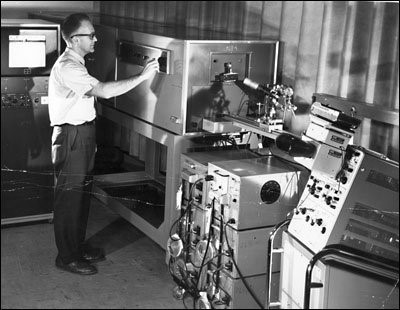
Elias Snitzer working at American Optical in 1964 Elias Snitzer munka közben az American Optical cégnél 1964-ben
Referenciák
[1] E. Snitzer: Optical Maser Action of Nd +3 in a Barium Crown Glass; Physical Review Letters 7 (1961) 12
[2] C. J. Koester, E. Snitzer: Amplification in a Fiber Laser; Applied Optics 3 (1964) 10, 1182-1186
References
[1] E. Snitzer: Optical Maser Action of Nd +3 in a Barium Crown Glass; Physical Review Letters 7 (1961) 12
[2] C. J. Koester, E. Snitzer: Amplification in a Fiber Laser; Applied Optics 3 (1964) 10, 1182-1186
Nonlinear optics
Nemlineáris optika
When a light beam reaches the boundary of a new medium, part of the beam is reflected, part is transmitted and part is absorbed by the new medium. In the case of low intensity light beams this usually happens without any change in the wavelength of the light beam: incident, reflected, transmitted and absorbed light beams have identical wavelengths.
Nonlinear optical effects were first reported by Peter A. Franken and co-workers in 1961 [1]: in their experiments they focused the beam of the newly developed ruby laser (λ=694.2 nm) into a quartz crystal and found that the wavelength of the light leaving the crystal was shorter than that of the incident light. The high intensity laser beam used in the experiments produced a new, coherent beam in the ultraviolet range (λ=347.1 nm) upon interaction with the quartz crystal.
One year later, Robert W. Terhune and co-workers observed third harmonic generation in calcite crystal.
The attosecond light pulses of ELI-ALPS are high harmonics in the extreme ultraviolet (XUV) range produced via nonlinear processes from infrared laser pulses.
Új közeg határához érve a fénysugár részben visszaverődik, részben behatol az új közegbe. Alacsony intenzitású fénynyalábok esetén ez rendszerint a fény hullámhosszának megváltozása nélkül történik: a beérkező, a visszavert és az új közegbe hatoló fény hullámhossza megegyezik.
Első alkalommal 1961-ben Peter A. Franken és munkatársai számoltak be nemlineáris optikai effektusról [1]: kísérleteikben az akkoriban felfedezett rubinlézerrel (λ=694,2 nm) kvarckristályon világítottak keresztül, és azt tapasztalták, hogy a kristályt az eredetinél rövidebb hullámhosszúságú fénysugár hagyta el. A kísérletekben használt nagyintenzitású lézersugár a kvarckristállyal való kölcsönhatásakor új, koherens nyalábot hozott létre az ultraibolya tartományban (λ=347,1 nm).
Egy évvel később Robert W. Terhune és munkatársai kalcitkristályban mutatták ki harmadik felharmonikus keltését.
Az ELI-ALPS attoszekundumos fényimpulzusai infravörös lézerimpulzusokból nemlineáris folyamatok során előállított, az extrém ultraibolya tartományba eső magasrendű felharmonikusok.
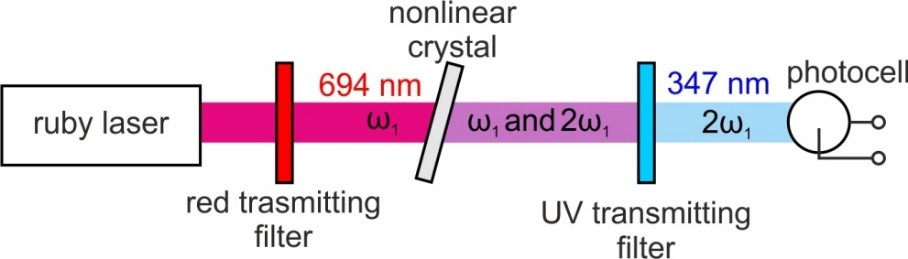
A Franken és munkatársai által másodrendű harmonikus keltéséhez használt
kísérleti elrendezés sematikus rajza
(http://www.physics.ttk.pte.hu/files/TAMOP/FJ_Nonlinear_Optics/1_introduction.html)Scheme of the second-harmonic generation experiment of Franken and co-workers
(http://www.physics.ttk.pte.hu/files/TAMOP/FJ_Nonlinear_Optics/1_introduction.html)
Referenciák
[1] P. A. Franken, A. E. Hill, C. W. Peters, and G. Weinreich: Generation of Optical Harmonics; Physical Review Letters 7 (1961) 118
[2] R. W. Terhune, P. D. Maker, and C. M. Savage: Optical Harmonic Generation in Calcite; Physical Review Letters 8 (1964) 404
References
[1] P. A. Franken, A. E. Hill, C. W. Peters, and G. Weinreich: Generation of Optical Harmonics; Physical Review Letters 7 (1961) 118
[2] R. W. Terhune, P. D. Maker, and C. M. Savage: Optical Harmonic Generation in Calcite; Physical Review Letters 8 (1964) 404
The semiconductor laser
A félvezető lézer
The uniqueness of semiconductor lasers – also known as diode lasers – lies in their small size and suitability to be pumped by electrical current. A further advantage is that they can be cost-efficiently mass produced.
After the demonstration of the first operational laser in 1960, one direction of development was to study materials that can potentially be used as gain medium.
The first semiconductor laser was constructed in the laboratory of General Electric in the early 1960s, only few years ahead of the researchers of IBM. The prototype comprised merely one n-type (excess negative charge) and one p-type (excess positive charge) semiconductor layer, and the laser beam was produced in the narrow junction between these two layers.
A félvezető lézerek — más néven dióda-lézerek — különlegessége a kis méret és az elektromos árammal való vezérelhetőség. További előnyük, hogy költséghatékonyan, tömeggyártásban készíthetők.
Az első működő lézer 1960-as bemutatása után az egyik fejlesztési irány a médiumként alkalmazható anyagok kutatása volt.
Az első félvezető lézert a General Electric laborjában készítették az 1960-as évek elején, csupán néhány héttel megelőzve az IBM kutatóit. A prototípus mindössze egy n-típusú (elektrontöbblettel rendelkező) és egy p-típusú (elektronhiánnyal rendelkező) félvezető rétegből állt, és a lézersugár pedig e két réteg közötti vékony határrétegben alakult ki.

If the two ends of the diode (anode and cathode) are connected with a voltage source, charge transfer starts between the two semiconductor layers. During the recombination of the electron and hole pairs, when the electron moves from a higher to a lower energy level, the excess energy is released in the form of photons.
At low current densities the process is not self-sustaining: light is emitted from the junction without amplification. This is spontaneous emission, which forms the operating principle of ordinary LEDs (light emitting diodes).
At higher current densities, a self-sustaining process starts (stimulated emission). If the end planes of the semiconductor crystal are polished to be perfectly parallel to each other, they work as a mirror resonator and reinforce the process. Then high intensity, coherent and monochromatic light is emitted from the junction.
A dióda két vége (az anód és a katód) közé feszültséget kapcsolva a két félvezető réteg között megindul a töltésáramlás. Az elektron és lyuk párok rekombinációs folyamata során, amikor az elektron magasabb energiaszintről alacsonyabb energiaszintre kerül, a többletenergia foton formájában távozik.
Kis áramerősség mellett a folyamat még nem önfenntartó: a fény erősödés nélkül jön ki a határrétegből. Ez a spontán emisszió, így működik a hétköznapi LED (light emitting diode).
Nagyobb áramerősség mellett beindul egy önfenntartó folyamat (kényszerített emisszió). Ha a félvezető kristály véglapjait párhuzamosra polírozzuk, azok tükörrezonátorként működnek és erősítik a folyamatot. Ekkor nagy intenzitású, koherens és monokromatikus lézerfény lép ki a határrétegből.
The colour of the laser light depends on the chosen semiconductor material. For example, when InGaN is used as semiconductor material, the emitted light is blue or green, but when InGaAs is used, infrared light leaves the laser. The active gain mediums of semiconductor lasers are typically the combinations of elements in the third group (e.g. Al, Ga, In) and the fifth group (e.g. N, P, As, Sb) of the periodic table. The medium of the first semiconductor laser built in 1962 was GaAs, and the wavelength of the emitted light was in the infrared spectrum. Present-day diode lasers are much more sophisticated, and generate light in the UV, the visible and the infrared ranges alike.
Although early laser diodes were produced a few years after the demonstration of the first laser, the semiconductor industry had to undergo significant development to improve the reliability, increase the life and reduce the production costs of these devices, and thus to allow them to become part of our lives. By today, diode lasers have become the most frequently used lasers and can be found almost everywhere: in barcode scanners, remote controllers, telecommunication devices, etc. They are also widely used to pump solid-state lasers.
A lézerfény színe a választott félvezető anyagtól függ. Például InGaN félvezető esetén kék vagy zöld lézerfény hozható létre, InGaAs félvezető alkalmazásakor pedig infravörös fény keletkezik. A félvezető lézerek médiumait jellemzően a periódusos rendszer harmadik (pl. Al, Ga, In) és ötödik csoportjába (pl. N, P, As, Sb) tartozó elemek kombinációi alkotják. Az 1962-ben előállított első félvezető lézer médiuma GaAs volt, a kibocsátott fény hullámhossza pedig az infravörös tartományba esett. A mai dióda-lézerek már jóval kifinomultabb szerkezetűek, és az UV, a látható és az infravörös tartományban állítanak elő fényt.
Bár a korai lézerdiódák már az első lézer felfedezését követően néhány évvel megépültek, a félvezető ipar jelentős fejlődésére volt szükség ahhoz, hogy ezen eszközök megbízhatóvá, hosszú élettartamúvá, olcsón előállíthatóvá, és így mindennapi életünk részeivé váljanak. Manapság már ez a leggyakrabban használt lézertípus, szinte mindenhol megtalálható: pl. vonalkód-olvasókban, távirányítókban, telekommunikációs eszközökben, valamint széles körben használják őket szilárdtest-lézerek pumpálására.
Ábrák
https://circuitglobe.com/laser-diode.html
Figures
https://circuitglobe.com/laser-diode.html
The first Hungarian laser
Az első magyar lézer
Soon after T. H. Maiman’s ruby laser (1960) and the first helium-neon gas laser (1961) implemented by A. Javan, W. R. Bennett and D. R. Herriott in 1963, physicists at the Central Research Institute for Physics (KFKI) József Bakos, László Csillag, Károly Kántor and Péter Varga built the first Hungarian He-Ne laser [1, 2].
In the early 1960s, this was an exceptionally great and important achievement, because behind the iron curtain and under the pressure of trade sanctions this field of experimental physics could only be studied with self-developed devices. For around two decades, optical research and the development of laser applications in Hungary was made possible by lasers built at KFKI and other domestic places of research, e.g. Szeged.
Röviddel T. H. Maiman rubinlézere (1960) és az A. Javan, W. R. Bennett és D. R. Herriott által megvalósított első hélium-neon gázlézer (1961) után, 1963-ban a Központi Fizikai Kutatóintézet fizikusai, Bakos József, Csillag László, Kántor Károly és Varga Péter megépítették az első magyar hélium-neon lézert [1, 2].
Az 1960-as évek elején ez különösen nagy és fontos teljesítmény volt, hiszen a vasfüggöny mögött, kereskedelmi embargótól sújtva csak saját fejlesztésű eszközökkel lehetett művelni a kísérleti fizikának ezt a területét. Mintegy két évtizeden keresztül a KFKI-ban és más hazai kutatóhelyeken (pl. Szegeden) gyártott lézerek tették lehetővé az optikai kutatások és lézeralkalmazások fejlődését Magyarországon.
The design of the first Hungarian laser was not identical with that of the first He-Ne laser built by Javan, Bennett and Herriott. With small, but important changes the KFKI team was able to make the generated laser beam linearly polarized. Instead of dielectric plane mirrors the researchers used silver spherical mirrors inside the resonator, which made alignment easier and allowed for the laser to be operated not only at 1.15 µm, but also at a wavelength of 2.39 µm and 3.39 µm, respectively. [3, 4]
Az első magyar lézer felépítése nem azonos a Javan, Bennett és Herriott által először épített hélium-neon lézerével. A KFKI csapata apró, de fontos változtatásokkal elérte, hogy a keltett lézerfény lineárisan polarizált legyen. Dielektrikum síktükrök helyett ezüst gömbtükröket használtak a rezonátorban, ami megkönnyítette a beállítást, és azt is lehetővé tette, hogy a lézer nemcsak 1,15 µm, hanem 2,39 µm és 3,39 µm hullámhosszakon is működjön. [3, 4]
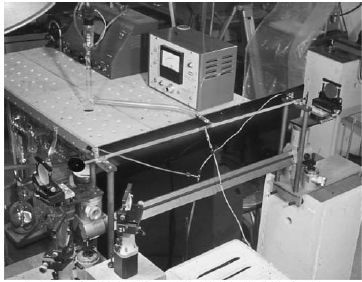
By the 1980s, several Hungarian research groups had devoted their efforts to study the medical, industrial, environmental and other possible applications of lasers.
Az 1980-as évekre több kutatócsoport is foglalkozott Magyarországon a lézerek orvosi, ipari, környezetvédelmi és egyéb lehetséges felhasználásaival.
Referencia
[1] Magyar laser a Központi Fizikai Kutató Intézetben; Magyar Nemzet 1963. dec. 15.
[2] Bakos J., Csillag L., Kántor K., Varga P.: Ezüsttükrös nagyfrekvenciás gerjesztésű He-Ne laser; KFKI Közl. 13 (1965), 195–197.
[3] Donkó Z.: Gázlézerek és gázkisülések; Fizikai Szemle 2005/7. 240.o.
[4] Csillag L.: Ötven éves az első magyar lézer; Fizikai Szemle 2013/6. 197.o.
References
[1] Magyar laser a Központi Fizikai Kutató Intézetben; Magyar Nemzet 1963. dec. 15.
[2] Bakos J., Csillag L., Kántor K., Varga P.: Ezüsttükrös nagyfrekvenciás gerjesztésű He-Ne laser; KFKI Közl. 13 (1965), 195–197.
[3] Donkó Z.: Gázlézerek és gázkisülések; Fizikai Szemle 2005/7. 240.o.
[4] Csillag L.: Ötven éves az első magyar lézer; Fizikai Szemle 2013/6. 197.o.
The 1964 Nobel Prize in Physics
Az 1964. évi fizikai Nobel-díj
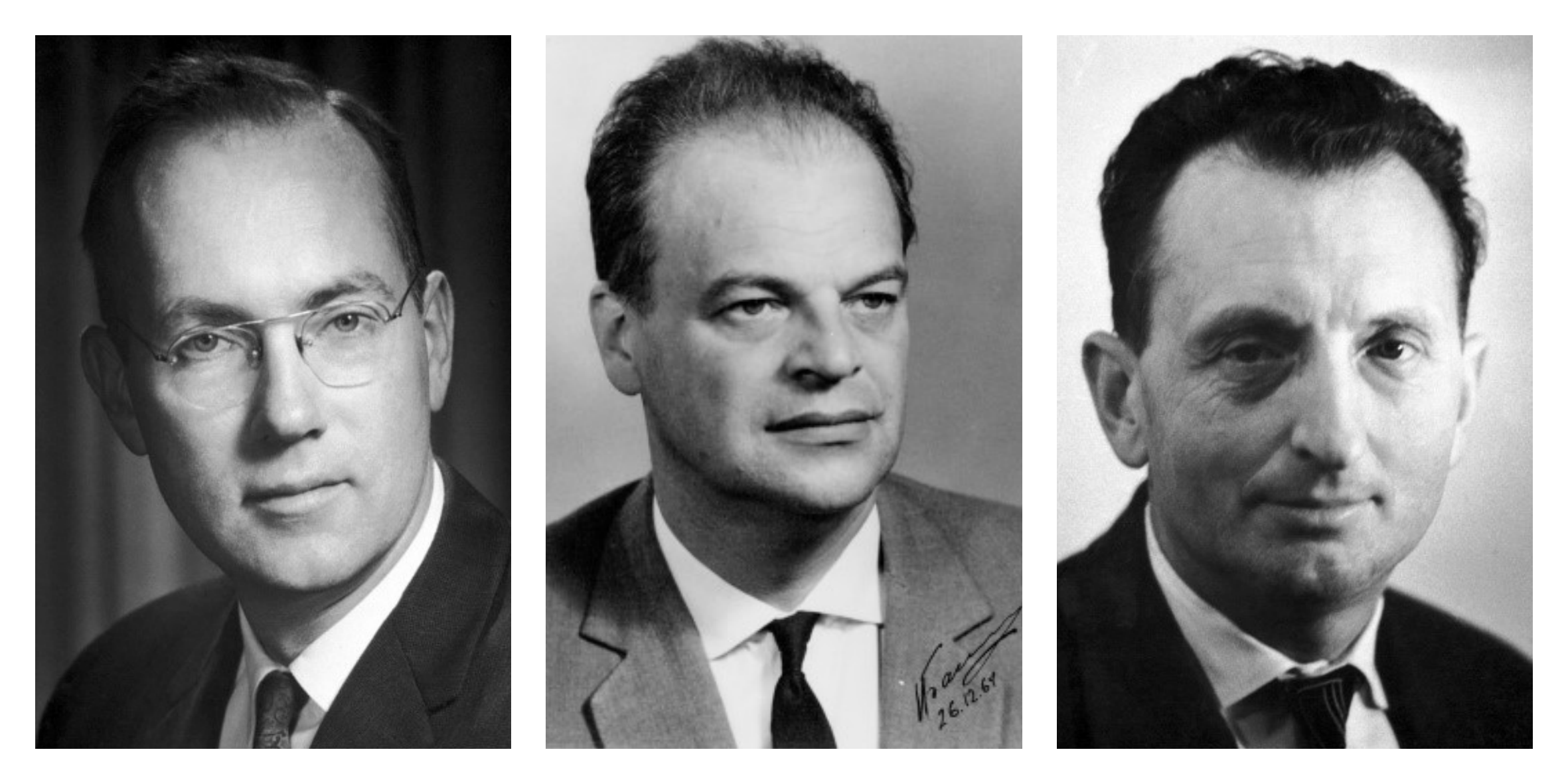
In 1964, the Nobel Prize in physics was awarded for fundamental work in the field of quantum electronics, which subsequently led to the construction of masers and lasers. The Prize was divided among Charles H. Townes, Nikolai G. Basov> and Alexander M. Prokhorov.
Az 1964-es fizikai Nobel-díjat a mézerek és lézerek megvalósításához vezető kvantumelektronikai alapkutatásokért ítélték oda. Az elismerést Charles H. Townes, Nyikolaj G. Baszov és Alekszandr M. Prohorov kapta megosztva.
According to the process of stimulated emission described by Einstein in 1917, the energy bunch – photon – interacting with the atom may stimulate the emission of another photon, identical with the original photon in terms of energy while returning to a lower energy state. This process creates the theoretical possibility for the amplification of radiation.
However, special conditions are required to observe and apply this process for practical purposes. Under normal conditions, the overwhelming majority of atoms in matter are in the ground state, wherefore the energy of incident photons excites atoms to higher energy states, and only a small fraction of electrons undergoes stimulated emission. Consequently, the ratio of atoms in the ground and excited state must be reversed: we need matter in which excited atoms prevail, i.e. where excitation is no longer induced by the irradiated photons. In this case incident photons force the relaxing atoms to emit identical photons, and they produce a large amount of coherent photons.
This means that the first step towards the implementation of radiation amplifying devices, i.e. masers (Microwave Amplification by Stimulated Emission of Radiation) and lasers (Light Amplification by Stimulated Emission of Radiation) was the creation of population inversion.
The first papers on masers were published in 1954 as a result of investigations carried out simultaneously but independently by Charles H. Townes ad co-workers at Columbia University in New York, and by a team led by Nikolai G. Basov and Alexander M. Prokhorov at the Lebedev Institute in Moscow. In the first maser (1954) stimulated emission occurred in ammonium gas. The subsequent years saw the birth of various maser types that applied ruby, hydrogen or rubidium as active medium. The accuracy of atomic clocks is maintained by hydrogen masers; to keep noise level to the minimum, masers are used as microwave amplifiers in radio telescopes, and masers also play a role in astrophysical research.
The history of the optical maser, i.e. the laser dates back to 1958, when Arthur L. Schawlow and Townes, as well as scientists at the Lebedev Institute began to investigate how the operating principle of the maser can be used in the optical range. Two years later they constructed the first operational laser.
The 100,000-fold growth in frequency from the microwave range to the region of visible light changes the operating conditions to a degree that justifies lasers to be regarded as a completely new invention. In order to achieve a high energy density required for the dominance of stimulated emissions, the active medium must be placed between two mirrors that force light to traverse the medium many times. During this process, a cascade of stimulated emissions continues as long as all atoms have released their energy. For the result of the process it is essential that the stimulated and the stimulating radiation have the same phase and frequency. Due to resonance, waves coming from all parts of the active medium are combined to form a single, strong beam. The laser emits a so-called coherent light in contrast with other light sources where light is the result of atoms radiating independently of one another.
The inventors of the laser provided mankind with a tool the applications of which have multiplied in the past decades: it has gained widespread exploitation not only in science, but also in the industry, medicine, cosmetics, in micro- and nanotechnology, military technology, and we see more and more everyday devices that operate with lasers.
A kényszerített emisszió Einstein által 1917-ben leírt folyamata szerint az atommal kölcsönhatásba kerülő energiacsomag – foton – hatására az atom gerjesztett elektronja alacsonyabb energiaszintre való visszatérés közben az eredetivel azonos energiájú fotont bocsáthat ki. Ez a folyamat elméleti lehetőséget teremt sugárzás erősítésére.
Ahhoz, hogy ez a folyamat megfigyelhető, illetve gyakorlati célra felhasználható legyen, különleges körülmények szükségesek. Szokásos viszonyok között az anyaghalmazokban az atomok túlnyomó többsége alapállapotú, ezért a besugárzott fotonok energiája főleg ezen atomok gerjesztését okozza, és csak elenyésző hányadban hozza létre a kényszerített emissziót. El kell tehát érni, hogy az alap- és gerjesztett állapotú atomok aránya megforduljon: olyan anyaghalmazra van szükség, amelyben a gerjesztett atomok vannak többségben, vagyis a gerjesztést már nem a besugárzott fotonoknak kell elvégezni. Ilyenkor a besugárzott fotonok önmagukkal azonos fotonok kisugárzására kényszerítik a relaxálódó atomokat, nagy mennyiségű koherens fotont eredményezve.
A sugárzást erősítő eszközök – mézerek (Microwave Amplification by Stimulated Emission of Radiation) és lézerek (Light Amplification by Stimulated Emission of Radiation) – elkészítéséhez vezető út első lépése tehát a populációinverzió létrehozása.
A mézerrel kapcsolatos első közlemények 1954-ben jelentek meg, amikor egymástól függetlenül, de egy időben a New York-i Columbia Egyetemen Charles H. Townes és munkatársai, valamint a moszkvai Lebegyev Intézetben Nyikolaj G. Baszov és Alekszandr M. Prohorov ezirányú vizsgálatokat végeztek. Az első mézerben (1954) ammónium-gázban történt a kényszerített emisszió. Az ezt követő években számos, különböző típusú mézer készült: rubin, hidrogén, rubídium is megjelent médiumként. Az atomórák pontosságát hidrogénmézerek biztosítják, az alacsony zajszint érdekében mézereket használnak rádiótávcsövek mikrohullámú erősítőjeként, és asztrofizikai kutatásokban is szerepet játszanak a mézerek.
Az optikai mézer, azaz a lézer története 1958-ra nyúlik vissza, amikor Arthur L. Schawlow és Townes, valamint a Lebegyev Intézet munkatársai is vizsgálni kezdték, miként alkalmazható a mézer működési elve az optikai tartományban. Két évvel később megalkották az első működő lézert.
A mikrohullámú tartomány és a látható fény tartománya közötti százezerszeres frekvencianövekedés olyan változásokat eredményez a működési feltételekben, hogy a lézer teljesen új találmánynak tekinthető. Ahhoz, hogy a kényszerített emisszió dominanciájához szükséges magas energiasűrűséget elérjük, az aktív anyagot két tükör közé kell helyezni, amelyek arra kényszerítik a fényt, hogy sokszor áthaladjon az anyagon. E folyamat során a kényszerített sugárzás lavinaszerűen nő mindaddig, amíg az összes atom le nem adta az energiáját. A folyamat eredménye szempontjából szükséges, hogy a stimulált és a stimuláló sugárzás azonos fázisú és frekvenciájú legyen. A rezonanciának köszönhetően az aktív közeg minden részéből összeadódnak a hullámok, és egyetlen erős nyalábot hoznak létre. A lézer úgynevezett koherens fényt bocsát ki, ellentétben más fényforrásokkal, amelyeknek a fényét az egyes atomok egymástól függetlenül lejátszódó folyamatai eredményezik.
A lézer feltalálói olyan eszközt adtak az emberiség kezébe, amelynek alkalmazási területei az elmúlt évtizedek során megsokszorozódtak: a tudományos kutatások mellett használatuk elterjedt az iparban, alkalmazásuk ismert a gyógyászatban, a kozmetikában, a mikro- és nanotechnológiában, harcászatban és mindennapi életünkben is egyre több olyan eszköz jelenik meg, amelyben lézer működik.
Dye lasers
Festéklézerek
Soon after the first laser was presented (1960, Theodore Maiman), scientists proved that many different materials are capable of laser light production. The birth of the ruby laser was followed by the construction of solid-state lasers, such as the neodymium:glass laser, the YAG crystal laser or the gallium arsenide diode laser, the first laser with a semiconductor as active medium. Within six months from the appearance of the ruby laser, scientists built the first gas laser, which used a gaseous mixture of helium and neon as an amplifying medium. The next milestone in laser development was the introduction of the carbon dioxide laser and the argon ion laser, which was the first laser capable of operating at several wavelengths (i.e. in several colours).
The first laser with a liquid amplifying medium was developed in 1966 almost concurrently, but independently by Peter P. Sorokin [1], an American physicist of Russian descent and his German counterpart, Fritz P. Schäfer [2]. They used organic dye solutions as optical amplifying medium which they excited in glass cuvettes with other lasers or a flashlamp. Acting as a resonator, the walls of the cuvette provided feedback to the amplifying medium.
Az első lézer bemutatását (1960, Theodore Maiman) követően a tudományos kutatások rövid időn belül különböző anyagok egész soráról bizonyították be, hogy alkalmasak lézerműködésre. A rubinlézer után olyan szilárdtest alapú lézereket állítottak elő, mint a neodímium-üveg lézer, a YAG-kristály lézer valamint az első félvezető anyagú gallium-arzenid dióda-lézert. A rubinlézer után alig fél évvel építették meg az első gázlézert, ami hélium és neon gázkeverék erősítő közegén alapult. Ezt a szén-dioxid és az első több hullámhosszon (azaz több színben) is működni képes argon-ion lézer követte.
Az első folyadék erősítő közegű lézert 1966-ban egymástól függetlenül, de szinte egyidőben Peter P. Sorokin [1] orosz származású amerikai és Fritz P. Schäfer [2] német fizikus fejlesztette ki. Optikai erősítő közegként szerves festékoldatokat használtak, amelyeket egy üveg küvettában más lézerekkel vagy villanólámpával gerjesztettek. A küvetta falai rezonátorként működve biztosították az erősítő közegbe való visszacsatolást.
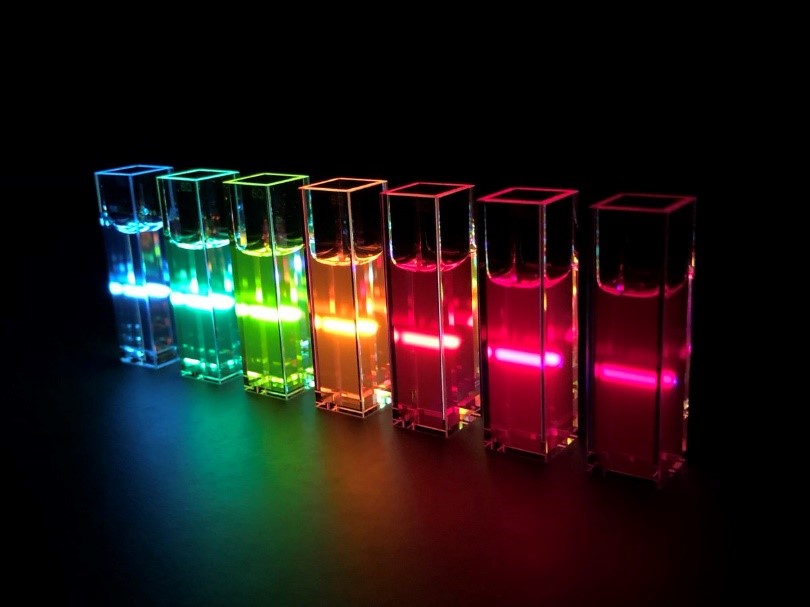
Fluorescent light of various dyes. [3] Különböző típusú festékek floureszcens fénye. [3]
An important property of these organic, often toxic dye solutions is that they are capable of optical amplification in a very broad wavelength range. For example, the rhodamine 6G dye can be used as a lasing medium from the red through the orange to the greenish yellow spectrum. Using different dyes, the entire spectral range (from ultraviolet to red), as well as the ultraviolet and the near infrared spectra can be accessed. This property makes them suitable for the production of wavelength tuneable lasers (or narrowband lasers in case a strong wavelength selection mechanism is used). Another advantage of a broad spectral range is that such lasers are outstanding for the generation of ultrashort light pulses, wherefore they enjoyed priority for ultrashort pulse lasers up to the early 1990s. Dye lasers were able to reach a pulse duration of 27 fs (femtosecond = 10
-15 s) already in the middle of the 1980s, which could then be further reduced to 6 fs by post-compression. This time duration is shorter than the time required for the fastest chemical reaction and equals the time an electron travels nearly 40 circular orbits in the hydrogen atom.
Ezeknek a gyakran toxikus, szerves festékoldatoknak fontos tulajdonsága, hogy nagyon széles hullámhossztartományban képesek optikai erősítésre. A rodamin 6G típusú festékkel például a pirostól a narancson át a zöldessárga színig lehet lézerműködést produkálni. Különböző festékekkel pedig az egész látható tartomány (az ibolyától a vörösig) valamint az ultraibolya és közeli infravörös tartomány is elérhető. E tulajdonságuk alkalmassá teszi őket hullámhossz szerint hangolható (és erős hullámhossz-szelekció esetén keskenysávú) lézerek gyártására. A széles spektrális tartomány másik nagy előnye, hogy kiválóan alkalmasak rövid fényimpulzusok generálására, ezért a rövid impulzusú lézerek területén egészen a 90-es évek elejéig vezető szerepet töltöttek be. A festéklézerek segítségével már a 80-as évek közepén 27 fs (femtoszekundum, 10
-15 s) rövid impulzusokat tudtak generálni, amit később utólagos kompresszióval sikerült 6 fs-ra rövidíteni. Ez az időtartam rövidebb, mint a leggyorsabb kémiai reakcióhoz szükséges idő és valamennyivel rövidebb, mint amennyi idő alatt az elektron a hidrogénatomban 40 körpályát megtesz.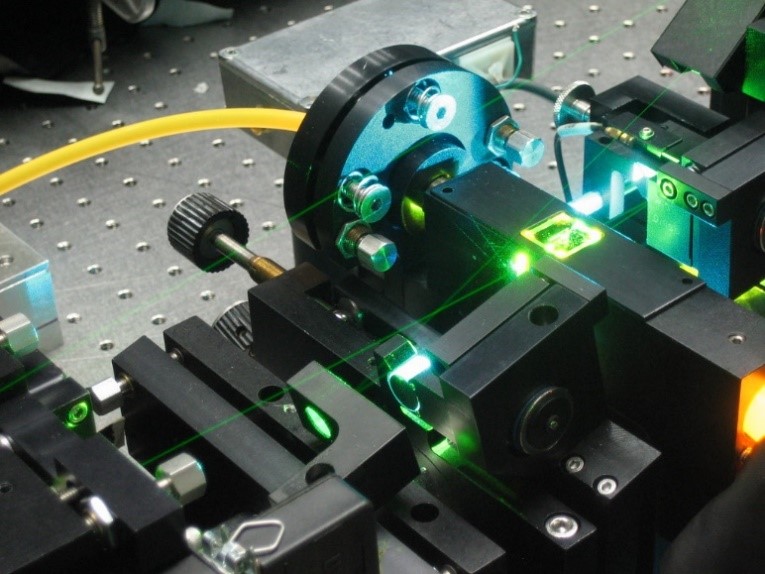
When excited with a blue argon ion pumping laser, rhodamine, an orange fluorescent dye, generates a laser beam in the green spectral region, which is then fed back into the amplifying medium with a ring resonator. [4] A csövekben narancssárgán fluoreszkáló rodamin festék a világoskék argon-ion pumpáló lézer hatására zöld színű lézersugárzást bocsát ki, amit egy gyűrűrezonátor segítségével vezetnek vissza az erősítőközegbe. [4]
Referencia
[1] P. P. Sorokin and J. R. Lankard: Stimulated emission observed from an organic dye, Chloro-aluminum Phtalocyanine; IBM J. Res. Develop. 10 (1966) 162
[2] F. P. Schafer, W. Schmidt, and J. Volze: Organic Dye solution laser; Appl. Phys. Letters 9 (1966) 306
[3] https://twitter.com/jonathangrimm/status/1062465313709678593
[4] https://www.flickr.com/photos/fatllama/42844367
References
[1] P. P. Sorokin and J. R. Lankard: Stimulated emission observed from an organic dye, Chloro-aluminum Phtalocyanine; IBM J. Res. Develop. 10 (1966) 162
[2] F. P. Schafer, W. Schmidt, and J. Volze: Organic Dye solution laser; Appl. Phys. Letters 9 (1966) 306
[3] https://twitter.com/jonathangrimm/status/1062465313709678593
[4] https://www.flickr.com/photos/fatllama/42844367
Erbium-doped fibre lasers
Erbium-adalékolt szálerősítők
One year after laser operation was first demonstrated (Theodore Maiman, 1960), the concept of using optical fibres as the active medium of lasers was developed (Elias Snitzer, 1961), and another three years later the completion of the first fibre laser was reported (Charles Koester, Elias Snitzer, 1964). The subsequent steps of technological development led to the construction of the first efficient fibre laser, the erbium-doped fibre laser (EDFA).
Erbium-doped fibre lasers [1, 2] are optical fibres whose core is doped with erbium ions, which allows for stimulated emission by a pumping light source having a suitable wavelength. The suitable wavelength is either 980 nm or 1480 nm, which is currently provided by semiconductor lasers. The operating principle of EDFAs is similar to that of ytterbium-doped fibre lasers invented earlier [3]. However, the operating wavelength is not around 1 μm, but around 1.5 μm, in the relatively broad spectral range of the so called telecommunication wavelength region [4]. This explains their significance: by being able to provide efficient optical amplification for the three (S, C and L) telecommunication bands [5,6], they have replaced electro-optical converters previously used for the regeneration of signals to be transmitted. At the same time, broadband operation makes this device suitable for use in short pulse fibre lasers too [7].
In 1970, continuous mode semiconductor lasers operating at room temperature and suitable for practical applications became commercially available, which contributed to the spread of fibre optic communication. Erbium-doped fibre lasers have been used in subsea optical transmission systems since 1996 [8]. In contrast with this, high power laser systems have adopted the enhanced versions of EDFAs: cladding pump and ytterbium co-doped fibres [9], as well as very-large-mode-area, erbium-doped fibre amplifiers [10].A lézerműködés első demonstrációja (Theodore Maiman, 1960) után egy évvel megszületett az a koncepció, amely szerint a lézer aktív közegeként optikai szálat lehet alkalmazni (Elias Snitzer, 1961), majd újabb három évvel később már az első szállézer elkészültét publikálták (Charles Koester, Elias Snitzer, 1964). Az ezt követő technológiai fejlesztések sora vezetett az első jól használható, hatékony szállézer, az erbium-adalékolt szállézer (erbium doped fibre laser, EDFA) megépítéséhez.
Az erbium-adalékolt szálerősítők [1, 2] olyan optikai szálak, amelyek magja erbiumionokkal szennyezett, lehetővé téve az indukált emissziót megfelelő hullámhosszú pumpáló fényforrás esetén. A megfelelő pumpáló hullámhossz 980 nm vagy 1480 nm, amelyet napjainkban félvezető lézerek szolgáltatnak. Az EDFA-k működési elve hasonlít a korábban megalkotott itterbium-adalékolt szálerősítőkéhez [3], ugyanakkor a működési hullámhossz nem az 1 μm körüli tartományban van, hanem az 1,5 μm körüli, úgynevezett telekommunikációs hullámhosszak környezetében, meglehetősen széles spektrális tartományban [4]. Jelentőségük ezért is növekedett meg kifejlesztésük után, hiszen a telekommunikációban használt három, S, C, és L telekommunikációs sáv mindegyikének optikai erősítésére nagyon jó hatásfokkal képesek [5, 6], kiváltva ezzel a továbbítandó jel újragenerálásához addig használt elektro-optikai átalakítókat. A szélessávú működés ugyanakkor lehetővé teszi e berendezéseknek a rövid impulzusú szállézerekben történő alkalmazását is [7].
1970-ben jól használható, folytonos üzemű, szobahőmérsékleten működő félvezető lézerek jelentek meg a piacon, ami hozzájárult a száloptikás kommunikáció térhódításához. Az erbium-adalékolt szállézerek 1996 óta részei a tenger alatti optikai átviteli rendszereinknek [8]. A nagy teljesítményű lézerrendszerek esetében pedig az EDFA-k továbbfejlesztett változatai, a köpenyben pumpált és itterbiummal mellékadalékolt szálak [9], illetve az extra nagy módusterületű erbium erősítő szálak terjedtek el [10].
Referencia
[1] R. J. Mears, L. Reekie, S. B. Poole, and D. N. Payne: Low-threshold tunable CW and Q-switched fibre laser operating at 1.55 μm; Electronics Letters 22 (1986) 159-160
[2] E. Desurvire, J.R. Simpson, and P.C. Becker: High-gain erbium-doped traveling-wave fiber amplifier; Optics Letters 12 (1987) 11
[3] C. J. Koester and E. Snitzer: Amplification in a fiber laser; Applied Optics 3 (1964) 1182
[4] E. Desurvire: Erbium-doped fiber amplifiers for new generations of optical communication systems; Optics and Photonics News 2 (1991) 6-
[5] E. Desurvire, C. R. Giles, J. R. Simpson, and J. L. Zyskind: Efficient erbium-doped fiber amplifier at a 1.53-μm wavelength with a high output saturation power; Optics Letters 14 (1989) 1266-1268
[6] T. Kashiwada, M. Shigematsu, T. Kougo, H. Kanamori, and M. Nishimura: Erbium-doped fiber amplifier pumped at 1.48 mu m with extremely high efficiency; IEEE Photonics Technology Letters 3 (1991) 721-723
[7] J. D. Kafka, T. Baer, and D. W. Hall: Mode-locked erbium-doped fiber laser with soliton pulse shaping; Optics Letters 14 (1989) 1269-1271
[8] S. Ash: Happy Birthday EDFA; https://atlantic-cable.com/Article/SA/57/index.htm
[9] J. D. Minelly, W. L. Barnes, R. I. Laming, P. R. Morkel, J. E. Townsend, S. G. Grubb, and D. N. Payne: Diode-array pumping of Er3+/Yb3+ co-doped fibre lasers and amplifiers; IEEE Photonics Technology Letters, 5 (1993) 301-303
[10] J. C. Jasapara, M. J. Andrejco, A. DeSantolo, A. D. Yablon, Z. Várallyay, J. W. Nicholson, J. M. Fini, D. J. DiGiovanni, C. Headley, E. Monberg, and F. V. DiMarcello: Diffraction-limited fundamental mode operation of core-pumped very-large-mode-area Er fiber amplifiers; IEEE Journal of Selected Topics in Quantum Electronics 15 (2009) 3-11
References
[1] R. J. Mears, L. Reekie, S. B. Poole, and D. N. Payne: Low-threshold tunable CW and Q-switched fibre laser operating at 1.55 μm; Electronics Letters 22 (1986) 159-160
[2] E. Desurvire, J.R. Simpson, and P.C. Becker: High-gain erbium-doped traveling-wave fiber amplifier; Optics Letters 12 (1987) 11
[3] C. J. Koester and E. Snitzer: Amplification in a fiber laser; Applied Optics 3 (1964) 1182
[4] E. Desurvire: Erbium-doped fiber amplifiers for new generations of optical communication systems; Optics and Photonics News 2 (1991) 6-
[5] E. Desurvire, C. R. Giles, J. R. Simpson, and J. L. Zyskind: Efficient erbium-doped fiber amplifier at a 1.53-μm wavelength with a high output saturation power; Optics Letters 14 (1989) 1266-1268
[6] T. Kashiwada, M. Shigematsu, T. Kougo, H. Kanamori, and M. Nishimura: Erbium-doped fiber amplifier pumped at 1.48 mu m with extremely high efficiency; IEEE Photonics Technology Letters 3 (1991) 721-723
[7] J. D. Kafka, T. Baer, and D. W. Hall: Mode-locked erbium-doped fiber laser with soliton pulse shaping; Optics Letters 14 (1989) 1269-1271
[8] S. Ash: Happy Birthday EDFA; https://atlantic-cable.com/Article/SA/57/index.htm
[9] J. D. Minelly, W. L. Barnes, R. I. Laming, P. R. Morkel, J. E. Townsend, S. G. Grubb, and D. N. Payne: Diode-array pumping of Er3+/Yb3+ co-doped fibre lasers and amplifiers; IEEE Photonics Technology Letters, 5 (1993) 301-303
[10] J. C. Jasapara, M. J. Andrejco, A. DeSantolo, A. D. Yablon, Z. Várallyay, J. W. Nicholson, J. M. Fini, D. J. DiGiovanni, C. Headley, E. Monberg, and F. V. DiMarcello: Diffraction-limited fundamental mode operation of core-pumped very-large-mode-area Er fiber amplifiers; IEEE Journal of Selected Topics in Quantum Electronics 15 (2009) 3-11
The 1971 Nobel Prize in Physics
Az 1971-es fizikai Nobel-díj
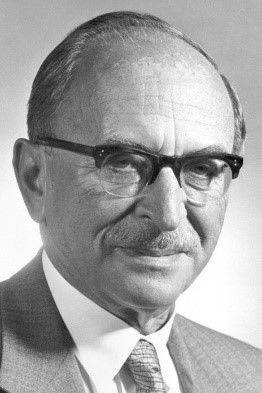
>The 1971 Nobel Prize in Physics was awarded to Dénes Gábor (Dennis Gabor) for his invention and development of the holographic method.
The British engineer-physicist of Hungarian descent developed the theory of a technique that provides a perfect 3D image of the structure of the object to be captured. His method is based on the wave nature and interference of light.
Az 1971-es fizikai Nobel-díjat a holografikus módszer feltalálásáért és kifejlesztéséért Gábor Dénesnek ítélték oda.
A magyar származású, brit állampolgárságú mérnök-fizikus egy olyan képalkotási eljárás elvét alkotta meg, amely tökéletes térhatású leképezést ad a rögzítendő tárgyak struktúrájáról. Módszere a fény hullámtermészetén, a fényhullámok interferenciáján alapul.
Dénes Gábor
(Source: the archives of the Nobel Foundation)Gábor Dénes
(Forrás: a Nobel Alapítvány archívuma)Traditional photography records only the colour and intensity of the light waves, while holography is also able to record their phase, and thus stores depth information in the “image”.
When a hologram is made, a change in phase is encoded as a change in intensity, i.e. it is made detectable. Encoding can be implemented through interference, but in addition to the light wave originating from the object to be captured, the process requires another, coherent light source – a laser – that is able to interfere. A light source (a multitude of electromagnetic waves) is coherent if the electric field of the individual light beams vibrates in the same phase. This creates interference during which at different points in space the waves with a constant phase strengthen or weaken one another to varying extents. Consequently, the intensity fluctuation of the final image also depends on the phase difference of the interfering light waves. When suitably illuminated, the developed holographic plate “reconstructs” – through the bending or diffraction of light – both the intensity and phase distribution of the light scattered from the object, and therefore a 3D image is produced.
A hagyományos fotográfia csupán a fényhullámok színét és intenzitását, míg a holográfia azok fázisát is képes rögzíteni, és ezzel mélységinformációt tárol a „képben”.
Hologram készítésekor a fázisváltozást intenzitásváltozásként kódoljuk, vagyis a detektor számára érzékelhetővé tesszük. A kódolás megvalósítására az interferencia jelensége alkalmas, ehhez viszont a rögzítendő tárgyról kiinduló fényhullámon kívül egy másik, nagy koherenciájú, következésképpen interferenciaképes fényforrásra – lézerre – is szükség van. Egy fényáram (mint elektromágneses hullámok sokasága) akkor koherens, ha az egyes fénynyalábok elektromos tere azonos fázisban rezeg. Ilyenkor interferencia alakul ki, amelynek során a tér különböző pontjain az állandó fáziskülönbségű hullámok egymást eltérő mértékben erősítik vagy gyengítik. Az eredő kép intenzitásingadozása tehát az interferáló fényhullámok fáziskülönbségétől is függ. Megfelelő megvilágítással a kidolgozott hologramlemez a fényelhajlás (idegen szóval diffrakció) révén „rekonstruálja” a tárgyról szórt fény intenzitás- és fáziseloszlását, így a látvány térbelivé válik.
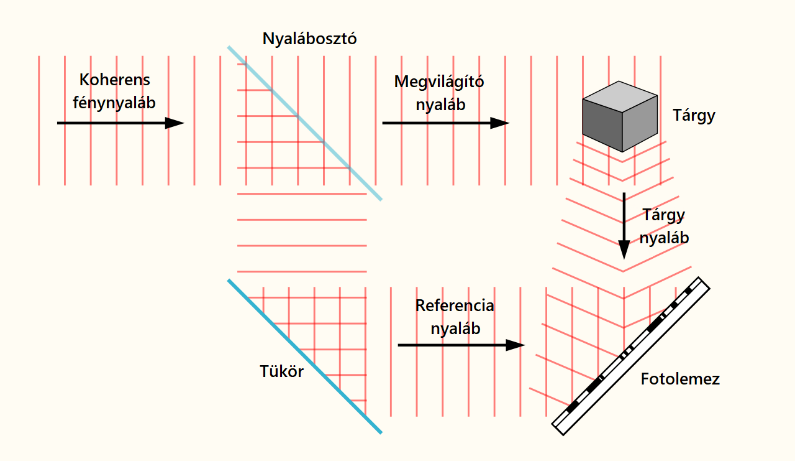
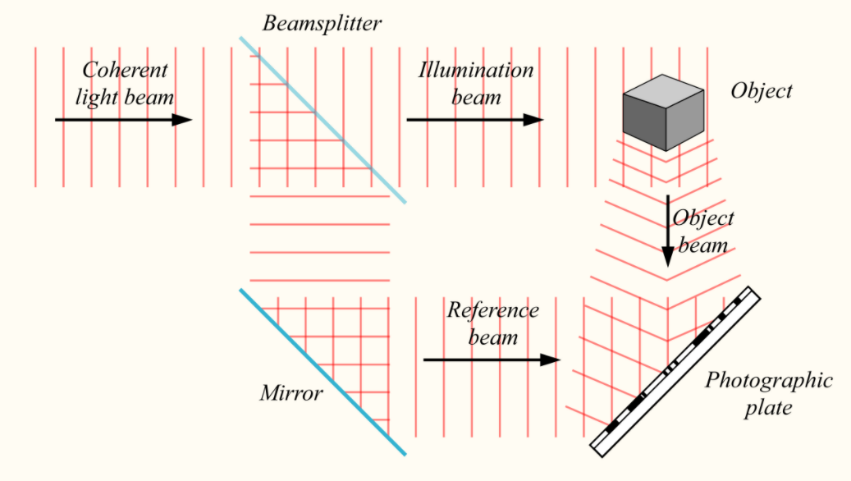
Holografikus kép rögzítésének elrendezési elve
(Forrás: Wikipedia)Optical setup for recording a hologram
(Source: Wikipedia)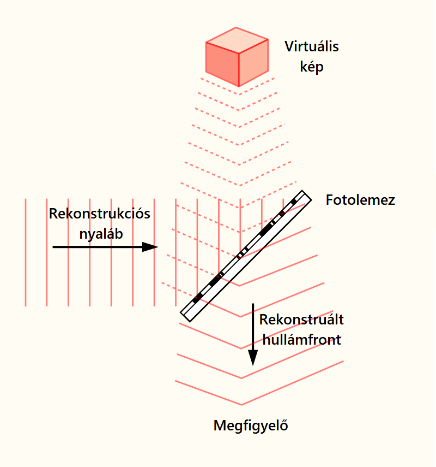
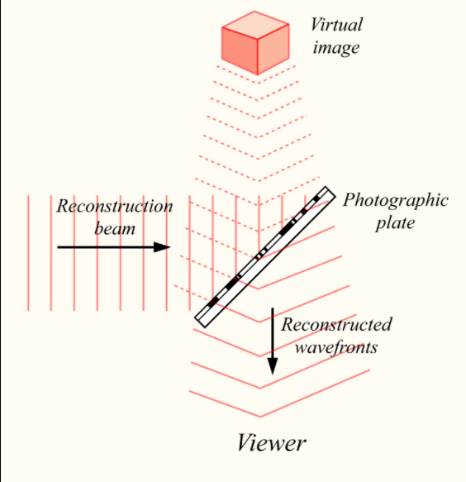
Holografikus kép rekonstruálásának elrendezési elve
(Forrás: Wikipedia)Optical setup for the reconstruction of a holographic image Although the theory of holography was developed already in 1947, it could only be translated into reality in 1961 (after lasers became available), because earlier light sources were not sufficiently coherent to produce interference.
The most common application of holography is in the form of security hologram stickers (e.g. on banknotes, credit/debit cards, CDs), but its use ranges from information storage through interference experiments to holographic filming.
Bár a holográfia elvét Gábor Dénes már 1947-ben megalkotta, a megvalósításra egészen 1961-ig (a lézerek elérhetővé válásáig) kellett várni. Korábban ugyanis nem állt rendelkezésre olyan fényforrás, amely az interferencia előállításához szükséges koherenciát biztosítani tudta volna.
A holográfia alkalmazási formái közül leggyakrabban a biztonsági azonosító jelekkel találkozhatunk (például papírpénzeken, bankkártyákon, CD-ken), de felhasználási területei az információtárolástól az interferencia-kísérleteken át a holografikus filmezésig terjednek.
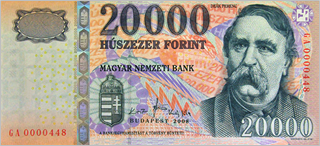
Hologram foil strips are incorporated into Hungarian banknotes too,
to the left from the denomination and other words
(Source: mnb.hu)Hologramfólia-csík található a magyar bankjegyeken is,
a középső feliratoktól balra
(Forrás: mnb.hu)
Referencia
[1] Gábor Dénes: Holography, 1948-1971; Nobel lecture, 1971.
[2] Gábor Dénes: Holográfia, 1948-1971; Fizikai szemle 2000/6. 181.o.
References
[1] Gábor Dénes: Holography, 1948-1971; Nobel lecture, 1971.
[2] Gábor Dénes: Holográfia, 1948-1971; Fizikai szemle 2000/6. 181.o.
The 1981 Nobel Prize in Physics
Az 1981-es fizikai Nobel-díj
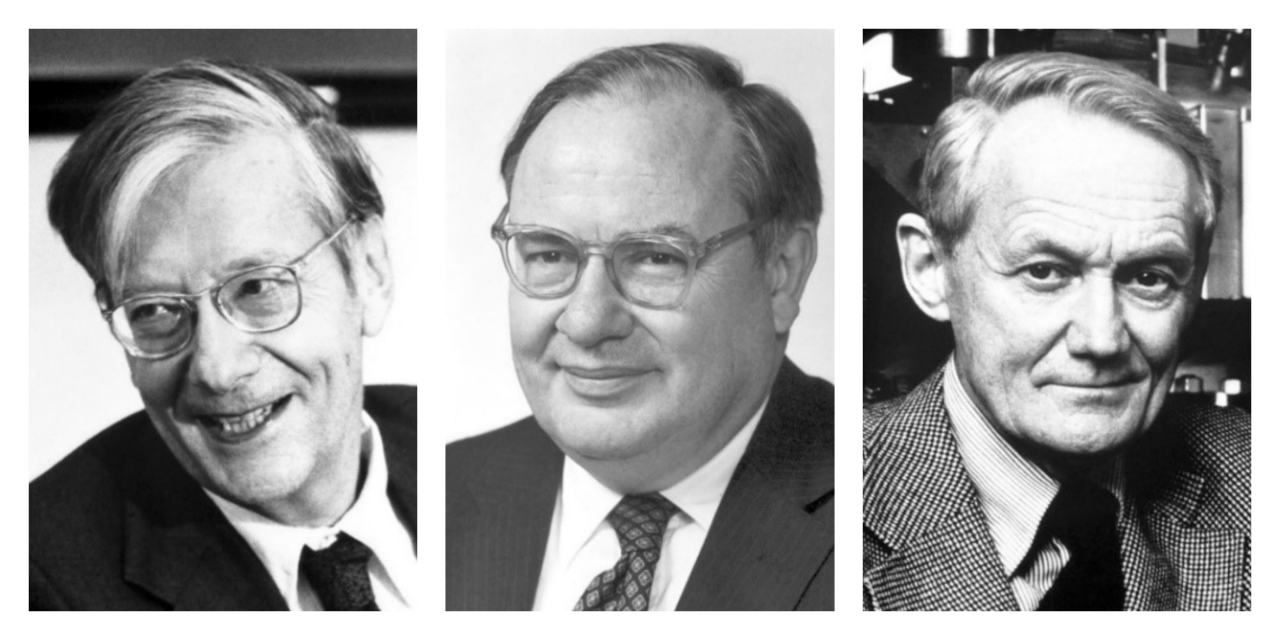
The Nobel Prize in Physics 1981 was divided, with one half awarded jointly to Nicolaas Bloembergen and Arthur L. Schawlow "for their contribution to the development of laser spectroscopy" and the other half to Kai M. Siegbahn "for his contribution to the development of high-resolution electron spectroscopy."
Az 1981-es fizikai Nobel-díjat a lézerspektroszkópia és a nagyfelbontású elektronspektroszkópia területén elért úttörő eredményekért ítélték oda. Az elismerést megosztva Nicolaas Bloembergen és Arthur L. Schawlow, illetve Kai M. Siegbahn kapta.
The concept of quantum mechanics made it possible to understand that the electrons of atoms and molecules can only exist at well-defined energy levels. When excited, i.e. by taking on a photon’s energy (absorption), electrons may get into a higher energy level from where they can return to the ground (or a lower) energy state spontaneously or upon stimulation. During this, they release a photon (emission). As the energy levels are constant, the energy of the photon absorbed or emitted in the transitions (the difference between the two energy levels) is also constant.
In spectroscopic studies, the chemical compositions of samples can be determined through the mapping of these transitions, by identifying the spectroscopic lines belonging to the transitions.
Schawlow developed a procedure which utilized the high intensity of laser light to eliminate the broadening of the spectral lines due to the motion of the atoms. This significantly improved the accuracy of spectroscopic measurements, and the energy levels of hydrogen – as the simplest element – could be measured with an unprecedented degree of precision. Thanks to the procedure, the value of the Rydberg constant, one of the most fundamental constants, could also be determined with higher precision.
Bloembergen invented and implemented a procedure in which three different laser lights were mixed to produce a fourth one. The wavelength of this new light was significantly outside the wavelength range of lasers built before, as a result of which spectroscopic studies could be conducted in a significantly broader frequency range. Spectroscopic studies using such lasers were applied in diverse fields ranging from the optimization of internal combustion engines to the analysis of the transport processes of biological samples.
With sufficient excitation, an electron can even be removed from the atom or the molecule. Since the energy of the detached electron equals the difference between the photon energy and the electron’s binding energy, the electron’s binding energy inside the atom can be determined by measuring the energy of the detached electrons – with the so-called electron spectroscopy method, if the experiment is conducted with monochromatic light (i.e. with photons having the same energy). The further development of electron spectroscopy has allowed scientists to identify not only the atoms included in a sample, but also to determine in which chemical environment these atoms exist.
Through systemic studies carried out at the end of the 1950s, Siegbahn and co-workers determined the binding energies of electrons in chemical elements. Their work significantly influenced the development of the electron spectroscopy method, and their measurements form an important database.
A kvantummechanikai tárgyalásmód lehetővé tette annak megértését, hogy az atomok és molekulák elektronjai csak jól meghatározott energiájú állapotokat vehetnek fel. Az elektronok gerjesztés – foton felvétele (abszorpció) – hatására magasabb energiájú állapotba kerülhetnek, és onnan spontán vagy kényszer hatására visszakerülhetnek az alap (vagy alacsonyabb) energiájú állapotba egy foton kibocsátásával (emisszió). Mivel az energiaszintek meghatározottak, ezért a közöttük lévő átmenetben elnyelt illetve kisugárzott foton energiája (a két szint közti energiakülönbség) is jól definiált.
A spektroszkópiai vizsgálatokban ezen átmenetek feltérképezése révén ismerhető meg a minták kémiai összetétele, azonosítva a színképben az átmenetekhez tartozó vonalakat.
Schawlow olyan eljárást fejlesztett ki, amelyben a lézerfény alkalmazásával – annak nagy intenzitása révén – ki tudta küszöbölni a spektrumvonalak atomok mozgásából eredő kiszélesedését. Ez jelentősen növelte a spektroszkópiai mérések pontosságát, és így rendkívüli precizitással mérhetővé váltak a hidrogén – mint legegyszerűbb elem – energiaszintjei. A kísérlet végeredményeként az egyik legalapvetőbb atomi konstans, a Rydberg-állandó értékét is pontosíthatták.
Bloembergen egy olyan eljárást dolgozott ki és valósított meg, amelyben három lézerfény keverésével egy negyediket lehet előállítani. Ennek a hullámhossza messze kívül esett az addig megvalósítható lézerfények tartományától, így a spektroszkópiai vizsgálatok lényegesen szélesebb frekvenciatartományban váltak elvégezhetővé. Az ilyen lézerekkel történő spektroszkópiai vizsgálatok igen változatos területeken jelentek meg, a belsőégésű motorok működésének optimalizálásától egészen a biológiai szövetminták transzportfolyamatainak vizsgálatáig.
Megfelelő gerjesztéssel az elektron le is szakítható az atomról vagy molekuláról. Mivel a leválasztott elektron energiája a foton energiájának és az elektron kötési energiájának különbsége, monokromatikus fénnyel (azaz azonos energiájú fotonokkal) végezve a kísérletet, a leválasztott elektronok energiájának mérésével – úgynevezett elektronspektroszkópiával - meghatározható azok atombeli kötési energiája. Az elektronspektroszkópia továbbfejlesztésével nemcsak az állapítható meg, hogy egy mintában milyen atomok találhatók, hanem az is, hogy ezek milyen kémiai környezetben vannak.
Siegbahn és munkatársai az 50-es évek végén szisztematikus kutatásaikkal kémiai elemek elektronjainak kötési energiáit határozták meg. Munkájuk nagy hatással volt az elektronspektroszkópiai módszer fejlődésére, és mért eredményeik fontos adatbázist alkotnak.
Referencia
https://www.nobelprize.org/prizes/physics/1981/summary/
References
https://www.nobelprize.org/prizes/physics/1981/summary/
The First Sub 100 Femotosecond Laser
Az első 100 fs alatti lézerimpulzusok
>The peak power of laser pulses can be enhanced in two ways: either by increasing the energy of the laser pulse, or by shortening the pulse in time. Until the mid 1970s, the latter effect was mostly achieved by chopping the laser beam by mechanical or electrical means. However, due to the speed constraints of these processes, the pulse length could only be reduced to the sub-nanosecond range.
To achieve an even shorter length, the process itself had to be shortened (in a passive manner). To this end, we need to go back to the fundamental laws of physics, more precisely to the Heisenberg uncertainty principle. Because the shorter the desired light pulse, i.e. the more accurate the time measurement is, the less “accurately” we are able to define the colour of the light pulse, wherefore the spectrum of the light pulse becomes wider and wider. The dye lasers that first appeared in the 1970s and 1980s exploited this phenomenon. Excited dyes can emit light in a wide spectrum due to their complex molecule structure. Since the opposite of the former statement is also true, the broader the spectrum in which light can be emitted, the shorter the light pulse one can achieve by means of compression.
Apart from coherence caused by stimulated emission, another precondition for compression is that the light waves of different colours, emitted by the laser, should meet in the same phase. This happens if they travel their circular path in the resonator within the same time.
In matter (e.g. glass or air) the light rays of the component colours travel at different velocities. Yet, to achieve a short light pulse, the component colours must “see” the same optical path, i.e. the product of the refractive index and the geometric length must be identical. This can be achieved by inserting into the resonator optical elements with proper (often negative) dispersion, such as a prism (pair), a grating (pair), a chirped mirror (invented later). This process is called mode-locking.
The first laser pulse below 1 ps was achieved with such a passively mode-locked dye laser in 1974 [1]. The next significant step was the development of the colliding pulse mode-locked (CPM) laser in 1981 [2], which was able to generate the first sub-100 fs light pulse.
In a CPM laser, two pulses travelling in opposite directions (clockwise and anti-clockwise) meet (collide) in the saturable absorber, so the saturation loss for the two pulses is lower, hence light amplification in the dye is more efficient. The interaction between the pulses propagating opposite each other create a temporary grating in the multitude of absorbing molecules, which mode-locks, stabilizes and shortens the pulses propagating in both directions.
The laser is arranged in a ring configuration (see figure), because pulse collision must be very accurate, and in contrast with a straight resonator the pulses that travel opposite each other mode-lock themselves, there is no need for the active stabilization of timing.
A lézerimpulzusok csúcsteljesítménye kétféleképpen fokozható: vagy a lézerimpulzus energiájának növelésével, vagy pedig időbeli hosszának rövidítésével. Az utóbbit a hetvenes évek derekáig főleg a lézerműködés mechanikai vagy elektromos szaggatásával érték el, de e folyamatok sebességkorlátai miatt maximum szub-nanoszekundum nagyságrendig sikerült az impulzushosszt csökkenteni.
Ha ennél rövidebbre szeretnénk jutni, valamiképpen magát a folyamatot önmagában (passzívan) kell rábírni arra, hogy rövid legyen. Ehhez a fizika alaptörvényeihez, egész pontosan a Heisenberg-féle határozatlansági relációig is le kell nyúlni. Mert minél rövidebb időbeli felvillanást szeretnénk elérni, azaz minél pontosabban akarunk időt mérni, annál „pontatlanabbul” tudjuk meghatározni a fényimpulzus színét; szükségképpen a fényimpulzus színképe (spektruma) egyre szélesebbé válik. A 70-es és 80-as években megjelent festéklézerek pontosan ezt a jelenséget használták ki. A gerjesztett festékek összetett molekulaszerkezetük miatt széles spektrumban képesek fényt kibocsátani. Mivel az előző állítás fordítva is igaz, minél szélesebb spektrumban vagyunk képesek fényt kibocsátani, annál rövidebb fényimpulzussá tudjuk azt összenyomni.
A kényszerített emisszió okozta koherencián túl az összenyomás további feltétele, hogy a lézer által kibocsátott különböző színű fényhullámok azonos fázisban találkozzanak. Ez akkor teljesül, ha ezek a rezonátorban ugyanannyi idő alatt járnak körbe.
Anyagokban (például üvegben, levegőben) terjedve a fény különböző színű összetevőinek más és más a sebessége. Ennek ellenében egy rövid fényimpulzus előállításához azt kell elérni, hogy a fény színei azonos optikai úthosszt lássanak, azaz a törésmutató és a térbeli hossz szorzata állandó legyen. Ez a lézer rezonátorába helyezett megfelelő (sok esetben negatív) diszperziójú optikai elemek, például prizma(pár), rács(pár), illetve a később feltalált csörpölt tükör segítségével érhető el. Ezt a folyamatot nevezzük módusszinkronizációnak.
Az első pikoszekundumnál rövidebb lézerimpulzust 1974-ben [1] is ilyen passzívan módusszinkronizált festéklézerrel sikerült elérni. A következő jelentős lépés az ütköző impulzusokkal módusszinkronizált (angolul colliding pulse mode-locked, rövidítve CPM) lézer kifejlesztése volt 1981-ben [2], amellyel 100 fs-nál valamivel rövidebb impulzusokat állítottak elő.
A CPM lézerben két, egymással szemben haladó impulzus a telíthető fényelnyelőben találkozik („ütközik”), így a két impulzusra nézve kisebb az elnyelés telítésére fordított veszteség, ami hatékonyabb fényerősödéshez vezet a festékben. A két szemben terjedő impulzus közötti kölcsönhatás egy ideiglenes rácsot hoz létre az abszorber molekulák sokaságában, amely módusszinkronizálja, stabilizálja és lerövidíti a mindkét irányba terjedő impulzusokat.
A lézer elrendezése az ábrának megfelelően gyűrű alakú, ugyanis az impulzusütköztetésnek nagyon pontosnak kell lennie, és egy egyenes rezonátorhoz képest itt az egymással szemben haladó impulzusok „önmaguktól” szinkronizálódnak, nincs szükség az időzítés aktív stabilizálásra.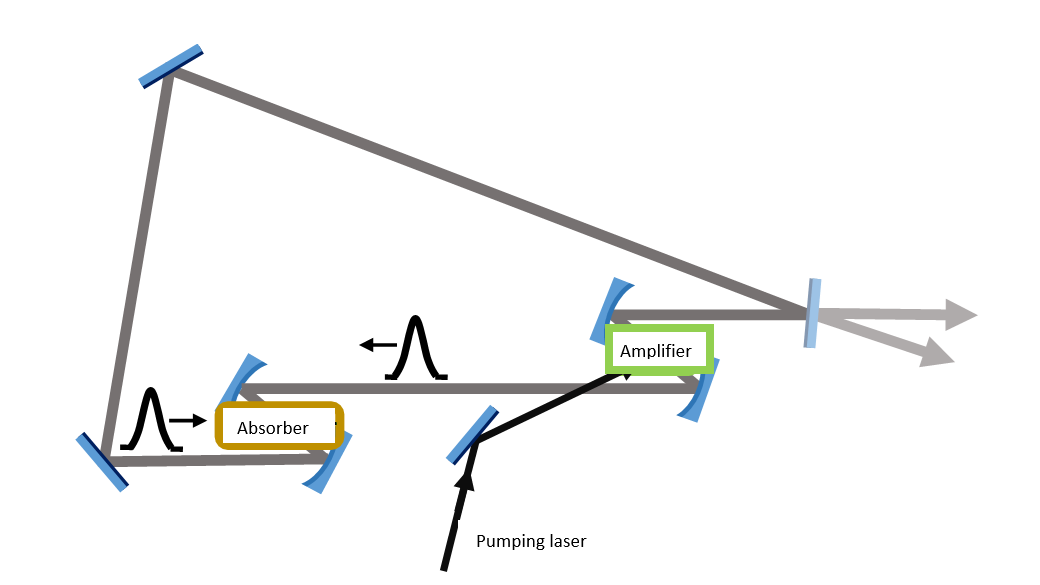
Configuration of a ring CPM dye laser
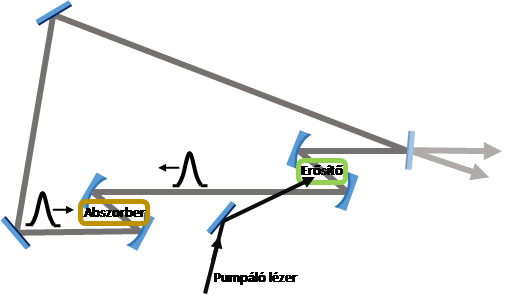
Gyűrűs elrendezésű CPM festéklézer felépítése
Referencia
[1] C. V. Shank, E. P. Ippen: Subpicosecond kilowatt pulses from a mode-locked cw dye laser; Appl. Phys. Lett. 24 (1974) 373
[2] R. L. Fork, B. I. Greanl, C. V. Shank: Generation of optical pulses shorter than 0.1 psec by colliding pulse mode locking;
Appl. Phys. Lett. 38 (1981) 671
References
[1] C. V. Shank, E. P. Ippen: Subpicosecond kilowatt pulses from a mode-locked cw dye laser; Appl. Phys. Lett. 24 (1974) 373
[2] R. L. Fork, B. I. Greanl, C. V. Shank: Generation of optical pulses shorter than 0.1 psec by colliding pulse mode locking;
Appl. Phys. Lett. 38 (1981) 671Observation of high-order harmonics created in a plasma
Magasharmonikus-keltés plazmában
Albert Einstein was the first to predict the frequency up-conversion of light by reflection from a mirror, moving near light speed, as early as in 1905 [1]. Although the concept of relativistic surfaces seemed promising, it could not be implemented before the advent of intense ultrashort lasers (2018 Nobel Prize in Physics) which can generate plasma surfaces moving at light speed. This is a key element for modern day laser plasma interactions. The first laboratory demonstration of high-order harmonics generation, which is the basis for any attosecond pulse generation, was performed in high intensity laser interactions with surface plasma by scientists of Los Alamos Scientific Laboratory during 1980–1981 [2]. Carman et al (Gemini Laser Facility, UK) focused high power carbon dioxide laser pulses with duration of ~ 1 ns during an inertial confinement fusion experiment on a plastic and metal coated glass micro-balloon targets. As a result of the laser plasma interaction, high-order harmonics generation was observed up to the 29th order in the back-scattered direction. A carbon dioxide laser has a wavelength of 10 µm. Hence, the generated high-order harmonics are in the visible spectrum of the electromagnetic radiation. Few months later, the experiment was repeated using another carbon dioxide laser with a laser pulse duration of < 200 ps. This time high-order harmonics generation was observed up to the 46th order [3]. These two experiments are widely recognized as the first demonstration of high-order harmonic generation from a surface plasma. However, another experiment published by N.H. Burnettat et. al., in 1977 demonstrated the first harmonics generation up to 11th order of a high power carbon dioxide laser [4] and deserve honourable mention in this context.
Later, in 1987, high-order harmonics generation was demonstrated from a gas target. At this time, scientists were already able to generate electromagnetic pulses of attosecond (10–18> second) duration, which allows for the investigation of ultrafast processes e.g. in condensed matter or biological samples at molecular or atomic scale.
Presently, there are several laboratories around the world that show interest in attosecond light pulse generation by the above mentioned technique. Among several beamlines, which are being developed under the Secondary Sources Division at ELI ALPS, there are two attosecond beamlines (SHHG-SYLOS and SHHG-HF) [6,7] which will take advantage of attosecond pulse generation by the high-intensity interaction of laser with surface plasma, and are expected to set new directions in attosecond research and particle acceleration as well as provide for user experiments [5].
Albert Einstein volt az első, aki felvetette – már 1905-ben –, hogy a közel fénysebességgel haladó tükörről visszaverődő fény frekvenciája felkonvertálódik. Bár a relativisztikus felületek koncepciója ígéretesnek tűnt, kísérleti megvalósításuk a fénysebességgel haladó plazmafelület létrehozására képes nagy teljesítményű, ultrarövid lézerek megjelenéséig váratott magára [2]. Laboratóriumi körülmények között a Los Alamos Scientific Laboratory kutatói 1980-81-ben demonstrálták az attoszekundumos impulzusok előállításához szükséges magasharmonikus-keltést lézerfény és felületi plazma nagy intenzitású kölcsönhatásával [2]. Carman és munkatársai nagy energiájú széndioxid lézer segítségével ~ 1 ns hosszúságú lézerimpulzusokat műanyag és fémbevonatú üveg mikrogömb céltárgyakra fókuszálták inertial confinement fúziós (IFC) kísérletekben. A lézer-plazma kölcsönhatás eredményeként a visszaszórásban még a 29. felharmonikuskeltés is megfigyelhető volt. A széndioxid lézer hullámhossza 10 mikron, ezért a keltett magasharmonikusok az elektromágneses sugárzás látható tartományába esnek. A kísérletet néhány hónappal később megismételték egy másik széndioxid-lézer < 200 ps hosszúságú lézerimpulzusaival. Ez alkalommal a 46-ik rendig figyeltek meg magasharmonikus keltést [3]. Ezt a két kísérlet széles körben a felületi plazmából történő magasharmonikus-keltés első demonstrációjának tartják. Ugyanakkor fontos megemlítenünk, hogy N.H. Burnettat és munkatársai 1977-ben egy másik kísérletről számoltak be, amelyben a 11-ik rendig demonstrálták a magasharmonikus-keltést nagy teljesítményű széndioxid-lézerrel [4].
Később, 1987-ben, gáz céltárgyon demonstrálták a magasharmonikus-keltést. Ekkor a tudomány már attoszekundum (10–18 másodperc) hosszúságú elektromágneses impulzusok előállítására is képes volt, ami lehetővé teszi ultragyors folyamatok molekuláris vagy atomi szintű tanulmányozását pl. kondenzált anyagokban és biológiai mintákban.
Jelenleg több laboratórium érdeklődik a fenti technikával történő attoszekundumos impulzuskeltés iránt világszerte. Az ELI ALPS Másodlagos Források Osztályán fejlesztés alatt álló sugárforrások között két attoszekundumos sugárforrás (SHHG-SYLOS és SHHG-HF) [6, 7] is van, amelyek kihasználják az attoszekundumos impulzusok és a felületi plazma nagy intenzitású kölcsönhatását, és várhatóan új irányokat jelölnek ki az attoszekundumos kutatások és a részecskegyorsítás területén, valamint kísérletek végzését teszik lehetővé külső felhasználók részére. E kutatások jelentik az ELI ALPS Felületi Plazma Attoforrások Csoport (Surface Plasma Attosources – SPA) kísérleti tevékenységének központi elemét.
Referencia
[1] Einstein, A. Zur Elektrodynamik bewegter Körper (German). Annalen der Physik 322 (1905) 891–921
[2] R. L. Carman, D. W. Forslund, and J. M. Kindel; Phys. Rev. Lett. 46 (1981) 29
[3] R. L. Carman, C. K. Rhodes, and R. F. Benjamin; Phys. Rev. A 24 (1981) 2649
[4] N. H. Burnett, H. A. Baldis, M. C. Richardson, and G. D. Enright; Appl. Phys. Lett. 31 (1977) 172
[5] S. Mondal, et al; J. Opt. Soc. Am. B 35 (2018) A93
References
[1] Einstein, A. Zur Elektrodynamik bewegter Körper (German). Annalen der Physik 322 (1905) 891–921
[2] R. L. Carman, D. W. Forslund, and J. M. Kindel; Phys. Rev. Lett. 46 (1981) 29
[3] R. L. Carman, C. K. Rhodes, and R. F. Benjamin; Phys. Rev. A 24 (1981) 2649
[4] N. H. Burnett, H. A. Baldis, M. C. Richardson, and G. D. Enright; Appl. Phys. Lett. 31 (1977) 172
[5] S. Mondal, et al; J. Opt. Soc. Am. B 35 (2018) A93
Chirped pulse amplification
Fázismodulált impulzuserősítés
From the invention of lasers [1] up to the early 1970s, the peak power of short laser pulses grew exponentially, but then this trend came to a halt and it seemed that the output of mode-locked laser systems could not be increased beyond a focused intensity of 1014> W/cm2.
The main reason behind this was the phenomenon of self-focusing [2, 3] on the optical elements or in the amplifying medium of the laser. Self-focusing is a nonlinear optical effect as a result of which the medium has a higher refractive index in the more intense part (centre) of the laser beam, and a lower refractive index towards the outer (less intense) parts of the beam. Therefore, the medium practically turns into a focusing lens that may focus the laser beam to an intensity which can damage the medium by filamentation.
A similar problem occurred in the field of radar technology, which also required short and high intensity pulses, but the electrical circuits were unable to handle this intensity. In the case of radars, the issue was solved by sending the pulse through a positive dispersion delay line before amplification and transmission. The return, or echo pulse, would then regain the shape of the original pulse in a negative dispersion delay line [4] (stretching, re-compression). The same technique was used by Donna Strickland and Gérard Mourou for the amplification of intense laser pulses [5], for which they were awarded a shared Nobel Prize in 2019.
This technique has contributed to the rapid growth of laser power, and by now we have surpassed the focused laser intensity of 1025 W/cm2. This technique, in combination with the method of parallel amplification [6], has made it possible to construct the most powerful laser systems of the world at ELI.
A lézerek felfedezésétől [1] az 1970-es évek elejéig exponenciálisan nőtt a rövid lézerimpulzusok csúcsteljesítménye. Ekkor azonban megtorpant ez a tendencia, és úgy tűnt, hogy a 1014 W/cm2-es fókuszált intenzitástartomány fölé már nem emelhető a módusszinkronizált lézerrendszerek teljesítménye.
Ennek fő oka az optikai elemeken vagy a lézer erősítő közegében fellépő nemlineáris önfókuszálódás volt [2, 3]. Ez egy olyan nemlineáris optikai jelenség, amelynek hatására a nyaláb intenzívebb (középső) részén nő, míg a kevésbé intenzív keresztmetszeti területein (szélein) csökken a közeg törésmutatója. Emiatt a közeg fókuszáló lencseként viselkedik, ami a lézernyalábot olyan intenzitásúra fókuszálhatja, hogy az kisülési jelenségeken keresztül roncsolhatja a közeget.
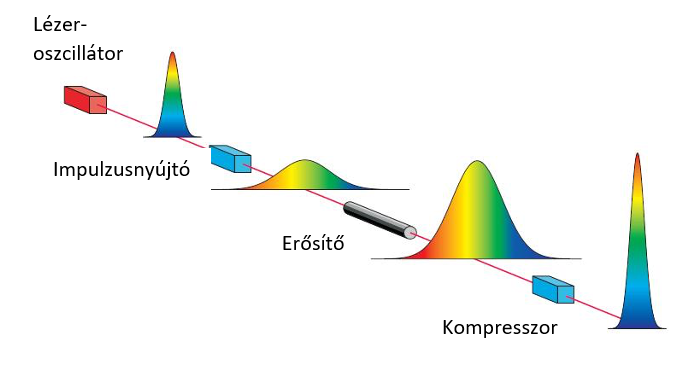
Hasonló probléma merült fel a radartechnológia területén is, ahol szintén rövid és nagy teljesítményű impulzusokra volt szükség a feloldás növeléséhez, de az áramkörök nem tudták kezelni ezt a teljesítményt. A radarok esetén az a megoldás született, hogy erősítés és továbbítás előtt az impulzust egy pozitív diszperzióval bíró késleltető vonalon küldték át. A visszavert hang az eredeti impulzus alakját egy negatív diszperziós késleltető vonalon keresztül nyerte vissza [4] (széthúzás, összenyomás). Ugyanezt a technikát alkalmazta Donna Strickland és Gérard Mourou intenzív lézerimpulzusok erősítésére [5], amiért megosztott Nobel-díjat vehettek át 2018-ben. A lézerek teljesítménye ezzel a technikával rohamos növekedésnek indult és mára már átléphettük a 1025 W/cm2 fókuszált lézerintenzitást is. E technikának és a párhuzamos erősítés módszerének kombinálásával [6] ma a világ legintenzívebb lézerrendszerei működhetnek az ELI-ben.
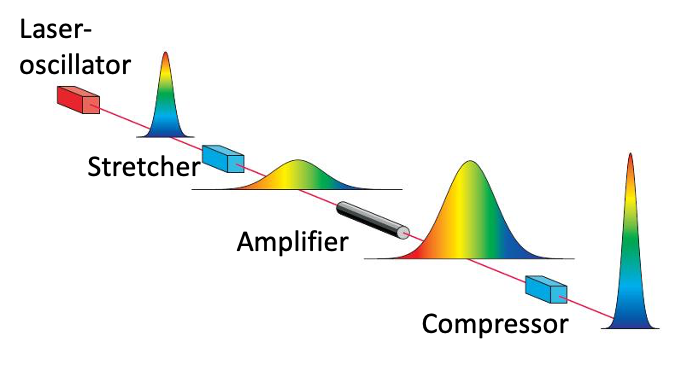
Chirped pulse amplification (CPA) was first demonstrated [5] by transmitting the Nd:YAG laser pulse to be amplified (150 ps, 5 W, 82 MHz, 0.06 mJ) through a 1.4 km long, single-mode optical fibre with a core diameter of 9 μm. The positive dispersion of this fibre stretched the pulses to 300 ps (this is the phase modulation device) and at the same time, considerably reduced the peak power. After that, the pulses, measured to have a power of 2.3 W at the output of the fibre, were amplified to ~160 W (~2 mJ) in a Nd:glass regenerative amplifier, and finally these pulses were compressed in a double-grating compressor to a pulse width of ~1.5 ps. This method proved suitable to generate pulses with a peak intensity that was unattainable with any amplifier without stretching the pulses and thus avoiding nonlinear self-focusing inside the amplifier.
A fázismodulált impulzusok erősítését (chirped pulse amplification – CPA) legelőször úgy sikerült demonstrálni [5], hogy az erősítendő Nd:YAG lézer impulzust (150 ps, 5 W, 82 MHz, 0,06 mJ) egy 1,4 km hosszúságú, 9 μm magátmérőjű, egymódusú optikai szálon vitték át, amelynek pozitív diszperziója az impulzusokat 300 ps-ra szélesítette ki (ez a fázismoduláló eszköz), és egyben a csúcsteljesítményt lényegesen csökkentette. Majd egy Nd:üveg regeneratív erősítőben a szál kimenetén mért 2,3 W-os impulzusokat ~160 W-ra erősítették (~2 mJ), végül ezeket az impulzusokat egy kétrácsos kompresszorban 1,5 ps körüli impulzusszélességre nyomták össze. Ezzel olyan csúcsteljesítményű impulzusokat állítottak elő, amelyeket erősítőkből nem lehetett volna kinyerni, ha azokat erősítés előtt nem nyújtják ki és nem szüntetik meg a nemlináris önfókuszálódás esélyét.
Referencia
[1] G. A. Mourou, C. L. Labaune, M. Dunne, N. Naumova and V. T. Tikhonchuk: Relativistic laser-matter interaction: from attosecond pulse generation to fast ignition; Plasma Phys. Control. Fusion 49 (2007) B667–B675
[2] P. L. Kelley: Self-focusing of optical beams; Physical Review Letters 15 (1965) 1005–1008
[3] P. Lallemand and N. Bloembergen, Self-focusing of laser beams and stimulated Raman gain in liquids; Physical Review Letters 15 (1965) 1010
[4] E. Brookner: Phased-array radars; Scientific American 252 (1985) 94–103
[5] D. Strickland and G. Mourou: Compression of amplified chirped optical pulses; Opt. Commun., 56 (1985) 219-221
[6] S. Hädrich, M. Kienel, M. Müller, A. Klenke, J. Rothhardt, R. Klas, T. Gottschall, T. Eidam, A. Drozdy, P. Jójárt, Z. Várallyay, E. Cormier, K. Osvay, and A. Tünnermann, J. Limpert: Energetic sub-2-cycle laser with 216 W average power; Optics letters 41 (2017) 4332-4335
References
[1] G. A. Mourou, C. L. Labaune, M. Dunne, N. Naumova and V. T. Tikhonchuk: Relativistic laser-matter interaction: from attosecond pulse generation to fast ignition; Plasma Phys. Control. Fusion 49 (2007) B667–B675
[2] P. L. Kelley: Self-focusing of optical beams; Physical Review Letters 15 (1965) 1005–1008
[3] P. Lallemand and N. Bloembergen, Self-focusing of laser beams and stimulated Raman gain in liquids; Physical Review Letters 15 (1965) 1010
[4] E. Brookner: Phased-array radars; Scientific American 252 (1985) 94–103
[5] D. Strickland and G. Mourou: Compression of amplified chirped optical pulses; Opt. Commun., 56 (1985) 219-221
[6] S. Hädrich, M. Kienel, M. Müller, A. Klenke, J. Rothhardt, R. Klas, T. Gottschall, T. Eidam, A. Drozdy, P. Jójárt, Z. Várallyay, E. Cormier, K. Osvay, and A. Tünnermann, J. Limpert: Energetic sub-2-cycle laser with 216 W average power; Optics letters 41 (2017) 4332-4335
Generation of high-order harmonics in gas targets
Magas lézerharmonikusok keltése gázokban
In the 20th century, physics took a great leap forward in the investigation of atomic (microscopic) processes. It was revealed that the interaction between electrons in atoms plays a significant role in the structure of molecules, solids and liquids. This interaction induces a temporal change in the spatial distribution (movement) of electrons inside matter. To capture the movement of electrons we need a “camera” with a temporal resolution of 10-18 s (attosecond), i.e. one that is able to take “snapshots” in a billionth of a billionth second.
Taking pictures in such a short timescale is not comparable to taking selfies: the reaction time of traditional cameras is by orders of magnitude longer than needed. Here images are recorded with the so called pump-probe method: the target is illuminated with a flash of light, i.e. a “light pulse”, which changes the target’s optical properties, e.g. the light absorption ability.
A XX. század fizikája nagyot lépett előre az atomi (mikroszkopikus) folyamatok megismerésében. Kiderült, hogy az atomok elektronjai között működő kölcsönhatás fontos szerepet játszik a molekulák, szilárd testek és folyadékok felépítésében. E kölcsönhatás az elektronok eloszlásának időbeli változását (elektronok mozgását) idézi elő az anyagon belül. Az elektronmozgás megörökítéséhez egy olyan „fényképezőgépre” van szükségünk, ami képes 10–18 s-os (attoszekundumos) időbeli felbontásra, azaz a másodperc milliárdod részének milliárdod része alatt „pillanatfelvételt” készíteni.
Ilyen rövid időskálán a fényképezést nem egy egyszerű szelfiként kell elképzelni: a hagyományos fényképezési technikák a szükségesnél nagyságrendekkel lassabban reagálnak. A képfelvétel itt az úgynevezett pumpa-próba módszerrel történik: a vizsgált tárgyat egy rövid fényfelvillanással (más néven „fényimpulzussal”) világítjuk meg, ami megváltoztatja a vizsgált minta optikai tulajdonságait, például a fényelnyelő képességét.
This change is measured by a well-timed, second light pulse, i.e. as a function of the delay between the first and second pulse reaching the target. The revealed temporal changes in optical properties can then be used to deduce what processes have occurred at microscopic level. The (temporal) resolution of the procedure depends on the duration of the light pulses used. For the investigation of ultrafast processes – such as the movement of electrons within the atoms – pulse duration must be in the attosecond range.
Ezt a változást egy jól időzített második fényimpulzus méri meg annak függvényében, hogy mennyivel később érkezik a vizsgált tárgyhoz az első fényimpulzushoz képest. Az optikai tulajdonságok így felderített időbeli változásából következtetünk aztán arra, hogy mikroszkopikus szinten milyen folyamatok játszódtak le. Az eljárás (időbeli) felbontóképességét az alkalmazott fényimpulzusok hossza határozza meg. Ultragyors folyamatok vizsgálatához – mint amilyen az atomon belüli elektronmozgás is – az impulzushossznak az attoszekundumos tartományba kell esnie.
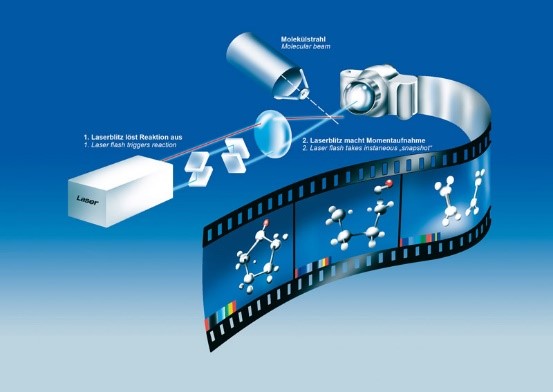
The modification in the sample is caused and then measured by two light pulses arriving from the laser with a certain time delay (@DESY) A lézerből érkező két fényimpulzus időben eltolva idézi elő a mintában a változást, majd méri meg annak mértékét (@DESY)
The development of lasers eventually made it possible to generate extremely short, femtosecond (1 fs = 10-15 s) laser pulses, but unfortunately, the generation of even shorter pulses was theoretically hindered by the lasers’ operating wavelengths. Lasers operate in the infrared and visible range, but for theoretical reasons, attosecond pulses seem achievable in the extreme ultraviolet (XUV) and the x-ray range. Yet, traditional sources (such as medical x-ray devices) working in these ranges cannot even reach the femtosecond timescale.
In the late 1980s, the research teams of Charles Rhodes (University of Illinois) and Anne L’Huillier (CEA-SPAM) focused – independently of each other – high intensity, short laser pulses into gas jets in vacuum. They noticed that in the interaction of light with the gas atoms new wavelengths appeared in addition to the laser wavelength. The frequency of the new radiation was the odd multiple of the laser’s frequency, and the new wavelengths appeared as discrete lines in the spectrum. Therefore, they named the process high-order harmonic radiation. These high harmonics fall into the extreme ultraviolet (XUV) range.
A lézerek fejlődésével valósággá vált a nagyon rövid, femtoszekundumos (1 fs = 10–15 s) lézerimpulzusok előállítása, de sajnos azok működési hullámhossza elvi akadályt állított az ennél rövidebb impulzusok keltésének útjába. A lézerek az infravörös és a látható tartományban üzemelnek, attoszekundumos impulzusok viszont – elvi okok miatt – az extrém ultraibolya (XUV) és a röntgentartományban képzelhetők el. Az e tartományokban működő hagyományos források (például az orvosi röntgenberendezések) azonban még a femtoszekundumos időtartomány megközelítésére sem képesek.
Az 1980-as évek végén Charles Rhodes (University of Illinois) és Anne L’Huillier (CEA-SPAM) kutatócsoportjai – egymástól függetlenül – nagy intenzitású, rövid impulzusú lézereket fókuszáltak vákuumban lévő gázsugarakba. Észrevették, hogy a gázatomokkal való kölcsönhatás eredményeként nemcsak az alkalmazott lézer hullámhossza volt detektálható, hanem mellette diszkrét vonalakként annak magas, páratlan rendű felharmonikusai is megjelentek, ezért a jelenséget magasrendű felharmonikus sugárzásnak (high-order harmonic radiation) nevezték el. Ezek a magasharmonikusok az extrém-ultraibolya tartományba estek.
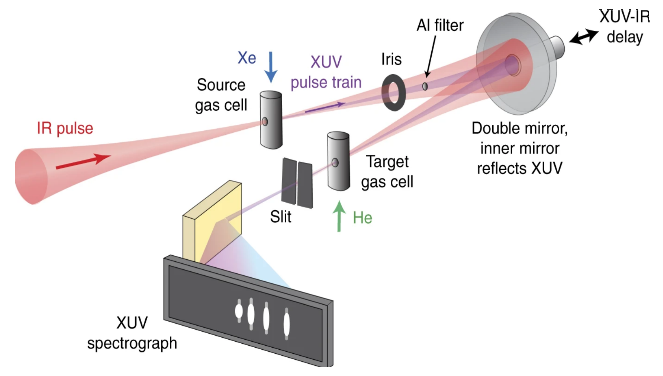
Schematic view of the generation of high-order harmonics.
On the spectrograph, the high-order harmonics appear separated in spaceMagasharmonikus-keltés sematikus ábrázolása.
A felharmonikusok a spektrográfon térben elválasztva jelennek meg.
This phenomenon can be explained with the following process: due to the presence of a strong laser field, the electrons tunnel ionize from the atoms of the gas medium and they are pulled away by the electric field of the laser pulse. Then they quickly return to the core when the field turns around. Near the atomic core, the electron is likely to recombine by emitting a photon, due to the extra energy received from the laser field. Because the tunnel exists only in a fraction of the period of the laser field, the length of the resulting electron bunch falls within the range of a few attoseconds. After the mechanism of high-order harmonics generation in the XUV frequency range had been revealed, scientists realized that they had discovered a potential attosecond light source. However, the fact that the resulting XUV radiation indeed consists of attosecond pulses, could not be experimentally verified before the early 2000s because of technical difficulties. Research in this field, and the measurement of the first isolated attosecond pulse, can be largely credited to the Hungarian born physicist Ferenc Krausz and his team at Max Planck Institute of Quantum Optics.
For the time being, attosecond pulses are mainly used in fundamental research. They help us obtain more accurate knowledge about the atomic world and play an important role in the improvement of physical models used for that purpose. Attosecond pulses have given us a “camera” with which we can capture images of the electron structure of molecules, or watch – in a time-resolved manner – how an electron is pulled away from an atom. Hopefully, in the future we will be able to use these ultrashort pulses and techniques not only for taking snapshots of electrons moving between atoms, but also for controlling these movements.
A jelenség a következő folyamattal magyarázható: az erős lézertér jelenléte miatt a gázközeg atomjaiból alagúteffektus révén kiszökő elektronokat a lézerimpulzus elektromos tere eltávolítja, majd a tér fordultával felgyorsítva visszairányítja az atomtörzshöz. Az atomtörzs közelében az elektron bizonyos valószínűséggel befogódik, és a lézertértől nyert többletenergiáját egy foton kibocsátásával veszíti el. Mivel az alagút csak a lézertér periódusának töredékében létezik, a létrejövő elektroncsomag időbeli hossza a pár száz attoszekundumos tartományba esik. Miután felismerték az XUV frekvenciatartományba eső felharmonikusok keltésének mechanizmusát, a kutatók rájöttek, hogy egy potenciális attoszekundumos fényforrást találtak. Annak kísérleti igazolására, hogy a keletkező XUV-sugárzás valóban attoszekundumos impulzusokból áll, egészen a 2000-es évek elejéig kellett várni. Az erre irányuló kutatásokban nagy szerepe volt a magyar származású Krausz Ferenc csoportjának (Max Planck Institute of Quantum Optics).
Jelenleg az attoszekundumos impulzusokat főként az alapkutatásban használjuk. Az atomi világ pontosabb megismeréséhez szükségesek, az ott használatos fizikai modelljeink tökéletesítésében játszanak fontos szerepet. Segítségükkel egy olyan „fényképezőgép” birtokába jutottunk, amellyel például felvételt készíthetünk a molekulák elektronszerkezetéről, vagy időben felbontva nézhetjük, ahogy az atomokból kiszakítunk egy-egy elektront. Remélhetőleg a jövőben ezekkel az ultrarövid impulzusokkal és technikákkal nemcsak lefényképezni leszünk képesek az atomok közötti elektronok mozgását, hanem irányítani is tudjuk azt.
Referencia
[1] Krausz F.: Atomok és elektronok mozgásban; Fizikai Szemle 52/01 (2002)
[2] Varjú K.: Attoszekundumos impulzusok; Fizikai Szemle – 58/03 (2008)
[3] Farkas Gy.: Attoszekundum időtartamú fényimpulzusok; Fizikai Szemle 56/12 (2006)
[4] F. Krausz, M. Ivanov: Attosecond physics; Reviews of Modern Physics 81 (2009)
[5] A. McPherson et al.: Studies of multiphoton production of vacuum-ultraviolet radiation in the rare gases; Journal of the Optical Society of America B: 4 (1987) 4, 595-601
[6] M. Ferray et al.: Multiple-harmonic conversion of 1064 nm radiation in rare gases; Journal of Physics B: Atomic, Molecular, and Optical Physics 21 (1988) 3, L31-L35
References
[1] Krausz F.: Atomok és elektronok mozgásban; Fizikai Szemle 52/01 (2002)
[2] Varjú K.: Attoszekundumos impulzusok; Fizikai Szemle – 58/03 (2008)
[3] Farkas Gy.: Attoszekundum időtartamú fényimpulzusok; Fizikai Szemle 56/12 (2006)
[4] F. Krausz, M. Ivanov: Attosecond physics; Reviews of Modern Physics 81 (2009)
[5] A. McPherson et al.: Studies of multiphoton production of vacuum-ultraviolet radiation in the rare gases; Journal of the Optical Society of America B: 4 (1987) 4, 595-601
[6] M. Ferray et al.: Multiple-harmonic conversion of 1064 nm radiation in rare gases; Journal of Physics B: Atomic, Molecular, and Optical Physics 21 (1988) 3, L31-L35
Femtosecond Ti:Sa laser
Femtoszekundumos Ti:Sa lézer
Titanium-Sapphire (Ti:Sa) lasers have attracted strong interest since the invention of solid-state lasers. As the name suggests, the active medium used for optical gain is a Ti:Sa crystal (Ti:Al2O3). Thanks to its excellent thermal, optical and spectroscopic properties – such as broad bandwidth, tuneability in a wide wavelength range – this material is well suited for the generation and amplification of ultrashort pulses. The most widely used solid-state laser for this purpose is currently the Ti:Sa laser.
Up to 1990, the shortest pulse that researchers could directly generate using a Ti:Sa laser was 300 fs long. In 1991, David E. Spence and coworkers [1] reported the generation of 60 fs pulses with a technique called mode-locking. The novelty was that the cavity, which consisted of two mirrors and a titanium-sapphire crystal, also contained a prism pair with which dispersion could be directly compensated for. Dispersion stretches pulses in time, and without compensation only a pulse duration of around 2 ps could have been achieved. However, with compensation, the pulses observed were nearly 20 times shorter and measured less than 100 fs. After leaving the cavity, the beam also travelled through a compressor comprising of an optical fibre and a prism. This further reduced the pulse duration, which was eventually measured to be less than 50 fs. At that time, using a Ti:Sa laser, this experimental setup was capable of generating laser pulses with the shortest ever duration and the highest ever peak power.
A szilárdtest-lézerek feltalálásának pillanatától nagy érdeklődés mutatkozott a titán-zafír lézerek iránt. Ahogy a neve is mutatja, az aktív anyag, amelyben az erősítés történik, egy titán-zafír kristály (Ti:Al2O3). Kiváló termális, optikai és spektroszkópiai tulajdonságainak köszönhetően (például nagy sávszélesség vagy a széles hullámhossz-tartományban való hangolhatóság) ez az anyag remekül használható az ultrarövid impulzusok előállítására és erősítésére. E célokra jelenleg az egyik legelterjedtebb szilárdtest-lézer a titán-zafír lézer.
1990-ig a titán-zafír lézerrel közvetlenül előállított legrövidebb impulzus 300 fs hosszú volt. 1991-ben D. E. Spence és munkatársai [1] arról számoltak be, hogy 60 fs-os impulzusokat sikerült előállítaniuk a módusszinkronizációnak nevezett technikával. Az újítás abban állt, hogy a rezonátoron belül, amelyet két tükör és a titán-zafír kristály alkotott, elhelyeztek egy prizmapárt is, amelynek segítségével közvetlenül kompenzálták a diszperziót. A diszperzió az impulzusokat időben megnyújtja, és kompenzáció nélkül csak 2 ps körüli impulzusidőt tudtak volna elérni, így viszont ennél mintegy 20-szor rövidebb, 100 fs alatti impulzusokat tudtak megfigyelni. A rezonátor után a nyaláb még egy optikai szálból és prizmából álló kompresszoron is keresztülhaladt, így tovább csökkent az impulzushossz, amit végül kevesebb, mint 50 fs-nak mértek. Abban az időben ezzel a kísérleti elrendezéssel a legrövidebb impulzusidejű és a legnagyobb csúcsteljesítményű lézerimpulzusokat sikerült Ti:Sa lézerrel előállítani.
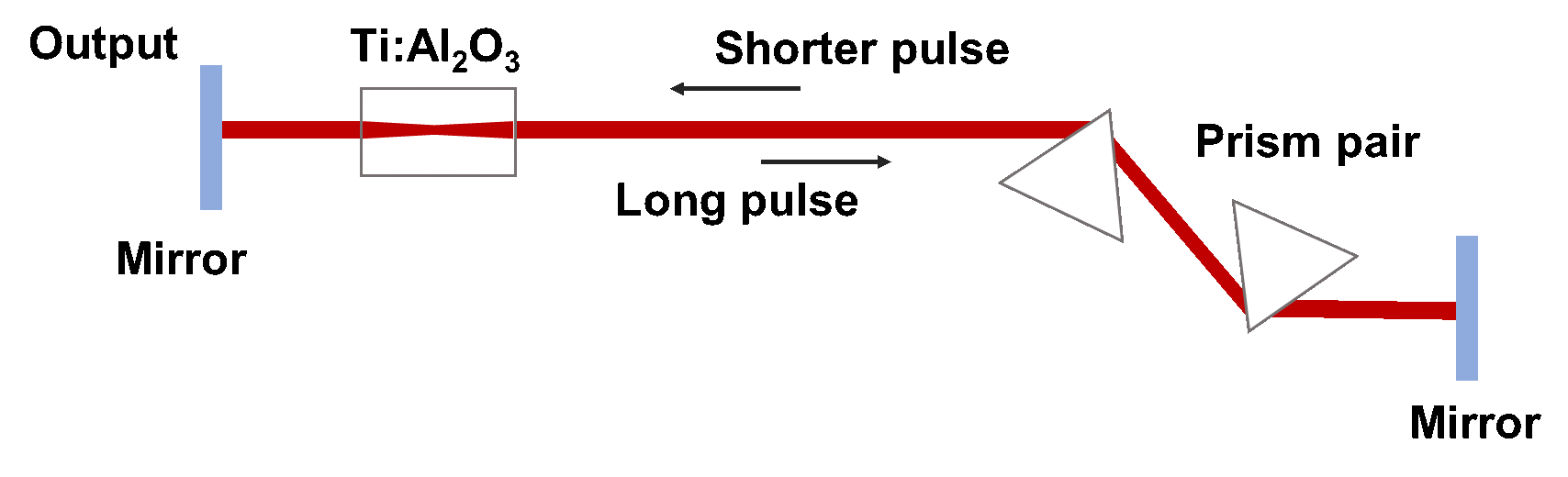
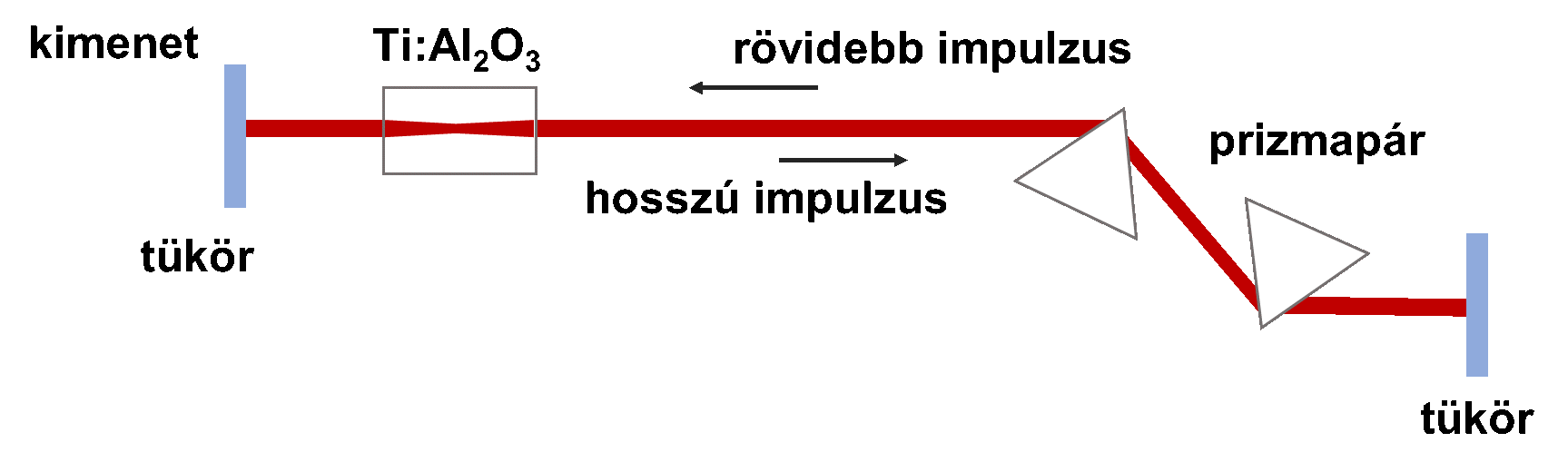
An interesting point of the new technique was that upon external impact, e.g. when one of the mirrors was touched, self-mode-locking appeared or disappeared. At that time, researchers were unable to provide an explanation, but a paper published soon afterwards [2] showed that the underlying cause is a nonlinear phenomenon called Kerr-lens. Kerr-lens mode-locking soon became an established passive mode-locking technique, and allowed for the construction of Ti:Sa lasers capable of generating 5 fs laser pulses in the early 2000s.
Az új technika érdekessége volt, hogy külső behatásra, például az egyik tükör megérintésével, a módusszinkronizáció magától létrejött vagy eltűnt. Erre a kutatók akkor nem tudtak magyarázatot adni, ám rövid időn belül egy másik tanulmányban [2] sikerült megmutatni, hogy a Kerr- lencsének nevezett nemlineáris jelenség áll a háttérben. A Kerr-lencsével történő módusszinkronizáció hamar elterjedt mint passzív módusszinkronizációs technika, és a 2000-es évek elején már 5 fs-os lézerimpulzusokat generáló titán-zafír lézerek megépítését tette lehetővé.
Referencia
[1] D. E. Spence, P. N. Kean, W. Sibbett: 60-fsec pulse generation from a self-mode-locked Ti:sapphire laser; Opt. Lett. 16 (1991) 1, 42
[2] F. Salin et al.: Modelocking of Ti:sapphire lasers and self-focusing: a Gaussian approximation; Opt. Lett. 16 (1991) 21, 1674
References
[1] D. E. Spence, P. N. Kean, W. Sibbett: 60-fsec pulse generation from a self-mode-locked Ti:sapphire laser; Opt. Lett. 16 (1991) 1, 42
[2] F. Salin et al.: Modelocking of Ti:sapphire lasers and self-focusing: a Gaussian approximation; Opt. Lett. 16 (1991) 21, 1674
Method proposed for the generation of attosecond pulses
Attoszekundumos impulzusok előállítására javasolt módszer
When high harmonic generation during the interaction of noble gas atoms and short, femtosecond (10-15 second) laser pulses was first demonstrated experimentally by research teams in France and the US in 1987, the aim was to take the lead in the race for high harmonics generation and the development of light sources with the broadest possible spectrum [1, 2].
It was not until five years later that the results of those experiments – i.e. that the odd numbered high harmonics of the generating beam appear with the same amplitude across a broad spectral range – made Győző Farkas and Csaba Tóth realize the breakthrough opportunity offered by this process and the generated “light source”. In 1992, they pointed out [3] that in a manner analogous to “frequency combs” produced in laser oscillators, the novel light source could be used for the generation of light pulses in the attosecond (10-18 second) range. This recognition was based on the fact that the spectrum emitted by a laser oscillator is composed of a comb of regularly spaced frequencies (see figure), and (pursuant to Fourier’s work) the generation of short pulses can be attributed to the orderliness of these light components in relation to one another (the light components are in phase, i.e. wave crests meet wave crests for all wave components at certain intervals).
Amikor 1987-ben francia és amerikai kutatócsoportok először demonstrálták kísérleti úton a nemesgáz atomok és rövid – femtoszekundumos (10-15 másodperc) – lézerimpulzusok kölcsönhatása során létrejövő magasharmonikus-keltést, még csak a magasabb rendű felharmonikusok keltésének és az addigi legszélesebb spektrumú fényforrások létrehozásának versenyében próbáltak minél jobb eredményeket elérni [1, 2].
Az akkori kísérleti eredmények alapján– azaz, hogy a sugárzásban a keltő lézerfény páratlan rendű felharmonikusai egy széles spektrális tartományon azonos amplitúdóval jelennek meg – csak közel öt évvel később ismerte fel Farkas Győző és Tóth Csaba, milyen áttörő lehetőséget kínál ez a folyamat és az így létrejövő „fényforrás”. A két magyar kutató 1992-ben rámutatott arra [3], hogy a lézeroszcillátorokban létrejövő „frekvenciafésűkkel” teljesen analóg módon egy ilyen fényforrás attoszekundumos (10-18 másodperc) fényimpulzusok létrehozását teheti tehetővé.
A felismerés alapját az adta, hogy a rövid lézerimpulzusokat előállító lézeroszcillátorokban a kialakuló spektrum fésűs szerkezetet mutat (lásd ábra), és a rövidimpulzusok létrejötte annak köszönhető (Fourier tétele értelmében), hogy ezen fénykomponensek egymáshoz képest egyfajta rendezettséget mutatnak (egymáshoz viszonyítva rendezett fázissal rendelkeznek, azaz bizonyos időközönként hullámhegy hullámheggyel találkozik az összes hullámkomponensre).
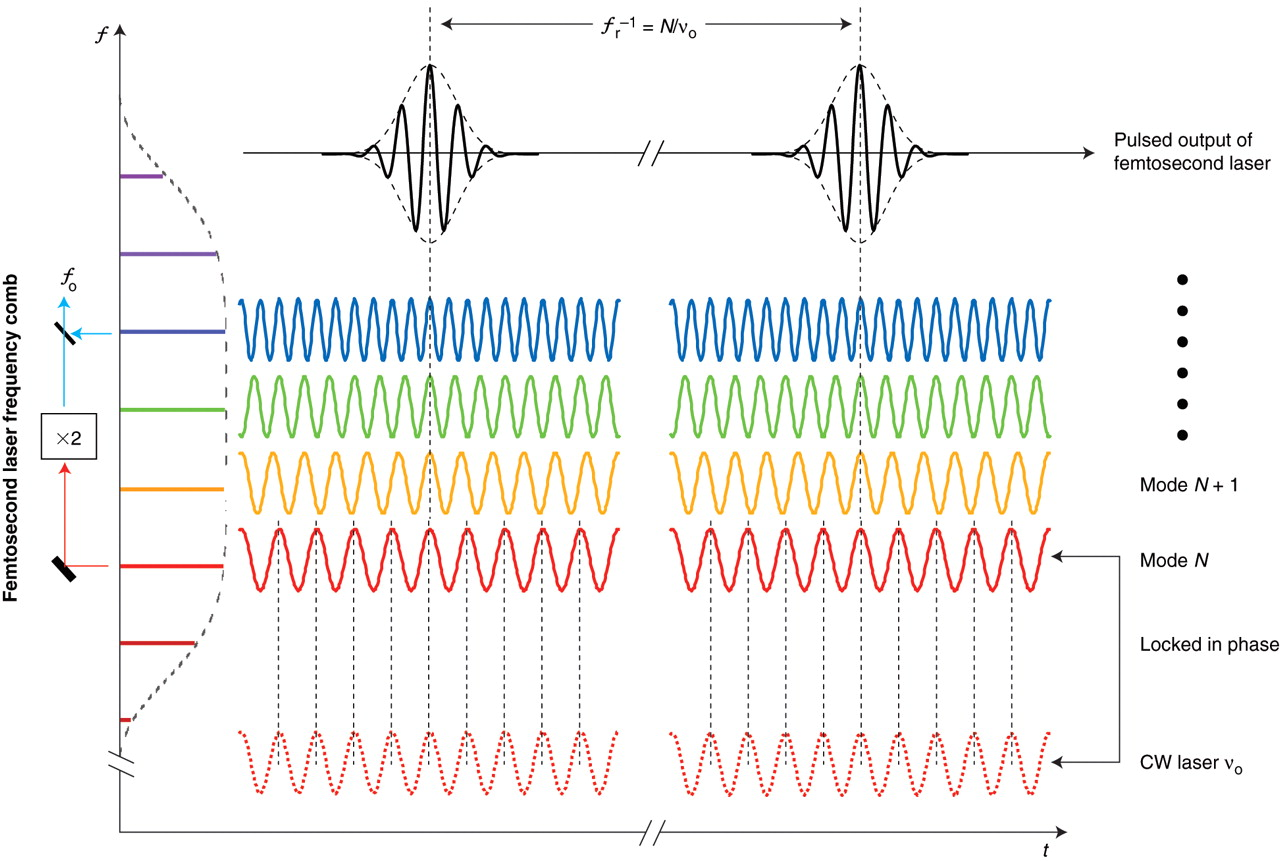
The experiments conducted in 1987 revealed the comb-like structure, so the Hungarian scientists only had to assume that high order harmonics have an ordered phase too. This assumption led to the realization of the theoretical possibility of attosecond pulse production during the generation of high-order harmonics, since in contrast with laser light (which is not suitable for the direct generation of light pulses in the sub-femtosecond regime) high order harmonics emit extreme ultraviolet (XUV) radiation.
Although the orderliness of the phase was experimentally shown only a few years later, Győző Farkas and Csaba Tóth’s work had already paved the way for the birth of attosecond physics (or attophysics in short).
Az 1987-es kísérletekben a „fésűs” szerkezet megléte megmutatkozott, így a magyar kutatóknak már csak feltételezniük kellett, hogy a magasrendű harmonikusok rendezett fázisúak is. Ez a feltételezés vezetett arra az eredményre, hogy a magasharmonikus-keltés során elméletileg akár attoszekundumos impulzusok is létrejöhetnek, hiszen a lézerfénnyel ellentétben (amellyel a femtoszekundumnál rövidebb fényfelvillanás közvetlenül nem hozható létre) a magasharmonikusok nem látható fényt, hanem extrém-ultraibolya tartományba eső sugárzást jelentenek.
Bár a fázis rendezettségének kísérleti megmutatása még néhány évet váratott magára, Farkas Győző és Tóth Csaba munkája már ekkor megalapozta az attoszekumundumos fizika (vagy röviden attofizika) létrejöttét.
Referencia
[1] Farkas Győző: Attoszekundum időtartamú fényimpulzusok; Fizikai Szemle 56/12 (2006)
[2] Varjú Katalin: Attoszekundumos impulzusok; Fizikai Szemle 58/3 (2008)
[3] Gy. Farkas, Cs. Tóth: Proposal for attosecond light pulse generation using laser induced multiple-harmonic conversion processes in rare gases; Physics Letters A 168 (1992) 5–6, 447-450
References
[1] Farkas Győző: Attoszekundum időtartamú fényimpulzusok; Fizikai Szemle 56/12 (2006)
[2] Varjú Katalin: Attoszekundumos impulzusok; Fizikai Szemle 58/3 (2008)
[3] Gy. Farkas, Cs. Tóth: Proposal for attosecond light pulse generation using laser induced multiple-harmonic conversion processes in rare gases; Physics Letters A 168 (1992) 5–6, 447-450
Semi-classical interpretation of high harmonic generation
Magasharmonikusok keltésének szemiklasszikus értelmezése
In the 1980s and early 1990s, experiments conducted with chirped pulse amplification led to the surprising observation that a suitable medium (typically a low density noble gas) illuminated with a sufficiently intense infrared laser beam is able to convert part of the laser light into radiation (ultraviolet or soft x-ray) having a frequency higher by at least two orders of magnitude [1]. This spectrum, which consists of odd harmonics in atomic systems, has a unique shape: it forms a wide plateau with a constant spectral intensity and a sharp cut-off (Figure 1). With the nonlinear optical models available at that time this experimental observation could not be explained.
A csörpölt impulzusú erősítés segítségével az 1980-as években és az 1990-es évek elején elvégzett kísérletek arra a meglepő eredményre vezettek, hogy megfelelően intenzív, infravörös lézersugárral meglőve egy alkalmas közeg (jellemzően alacsony sűrűségű nemesgáz) képes a lézerfény egy részét akár két nagyságrenddel nagyobb frekvenciájú (ultraibolya, lágy röntgen) sugárzássá alakítani [1]. Az így megfigyelt, atomi rendszereknél a páratlan rendű harmonikusokból álló spektrumnak jellegzetes alakja van: széles, állandó spektrális intenzitással rendelkező ún. plató-tartománnyal, valamint azt követő éles levágással rendelkezik (1. ábra). Ezt a kísérleti megfigyelést az akkori nemlineáris optikai modellek nem tudták megmagyarázni.
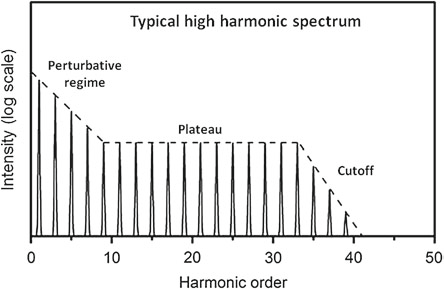
Figure 1: Schematic of a high harmonic spectrum [4] 
1.ábra: Magasrendű harmonikus spektrum sematikus ábrája [4]
However, the surprisingly simple model introduced by Paul B. Corkum [2] and independently by Kenneth C. Kulander and co-workers [3] successfully reproduced the experimental results, at least qualitatively. At atomic level, this model consists of the following three steps (Figure 2): within one optical period (1) the electron distances itself from the atomic or molecular core due to a laser induced process, generally optical tunnelling (2) after which, as a result of the laser field, it first escapes from the “parent ion”, then accelerates, i.e. gains surplus kinetic energy (3) returns to the “parent ion”, and recombines with it with a certain probability. As a result of this recombination, the surplus energy is radiated in the form of ultraviolet photons.
In this model, the classical motion of the escaped electron is enclosed by the two quantum mechanical processes, i.e. tunnelling and recombination, which moves only under the influence of the laser field, which is why it is called semi-classical method.
A Paul B. Corkum [2] és tőle függetlenül Kenneth C. Kulander és munkatársai [3] által bevezetett meglepően egyszerű modell azonban – legalább kvalitatív módon – sikerrel reprodukálta a kísérleti eredményeket.
Ez a modell atomi szinten három lépésből áll (2. ábra): az elektron egy optikai perióduson belül (1) egy lézer által indukált folyamat, általában optikai alagúteffektus révén eltávolodik az atom- vagy molekulatörzstől, ezután (2) a lézertér hatására előbb eltávolodik, majd felgyorsulva, azaz többlet mozgási energiával rendelkezve (3) visszatér „szülő ionjához”, és bizonyos valószínűséggel rekombinálódik vele, amelynek eredményeképpen a többletenergiáját ultraibolya fotonok formájában kisugározza.
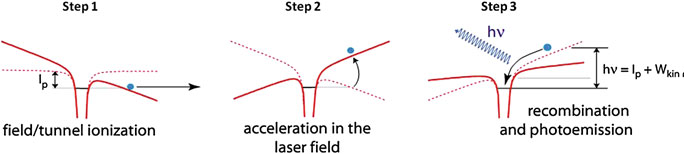
Figure 2: Schematic of the “three-step” process of high harmonic generation [4] 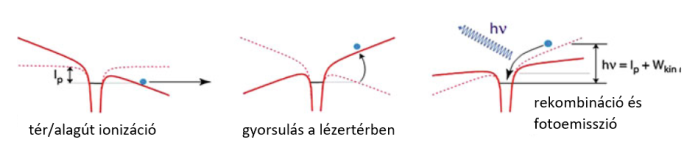
2. ábra: A magasharmonikus-keltés „háromlépéses” folyamatának sematikus ábrázolása [4]
This model is suitable not only for making predictions in line with the experimental results, but we can also visualize the process of high harmonic generation. Furthermore, it can be used to connect the similar, so called above-threshold ionization and the non-sequential double ionization.
The “three step model” is still a widely used approximation principle to describe the generation of high harmonics in gases at atomic level. This is one reason why the clarification of the principle, the development of novel, even quantum mechanical models is an actively researched field of science within attosecond physics.
A modellben két kvantummechanikai folyamat, az alagúteffektus és a rekombináció közrefogja a kiszabadult, csupán a lézertér hatása alatt mozgó elektron klasszikusnak tekintett mozgását, ezért nevezik szemiklasszikus elméletnek.
E modell segítségével nemcsak a kísérleti eredményekkel összhangban lévő jóslatokat tehetünk, hanem a magasharmonikus-keltés folyamatáról is szemléletes képet alkothatunk. Továbbá összekapcsolhatjuk ezt a hasonló módon lejátszódó ún. küszöb feletti ionizációval illetve a nem-szekvenciális kétszeres ionizációval.
A „háromlépesés” modell a mai napig széles körben alkalmazott közelítő elmélet a gázban atomi szinten történő magasharmonikus-keltés leírására. Az elmélet pontosítása, az ezen alapuló újszerű, akár kvantummechanikai modellek fejlesztése aktívan művelt és kutatott tudományterület az attoszekundumos fizikán belül.
A magasharmonikus-keltés megértését alapvetően meghatározó és így az attoszekundumos fényimpulzusok kialakulását is megmagyarázó háromlépéses modell jelentőségének elismeréseképpen 2022-ben Paul Corkum –- Krausz Ferenccel és Anne L’Huillier-vel megosztva – megkapta az emberiség javát szolgáló, kiemelkedő tudományos teljesítményért évente adományozott rangos Wolf-díjat.
In recognition of the importance of the three-step model, which is fundamental to our understanding of high harmonic generation and thus explains the formation of attosecond light pulses, in 2022, Paul Corkum – together with Ferenc Krausz and Anne L'Huillier – was awarded the prestigious Wolf Prize awarded every year to honour outstanding achievements for the betterment of humanity.
References
[1] A. Huillier and P. Balcou: High-order harmonic generation in rare gases with a 1-ps 1053-nm laser; Phys. Rev. Lett. 70 (1993) 774; J. J. Macklin, J. D. Kmetec, and C. L. Gordon: High-order harmonic generation using intense femtosecond pulses; Phys. Rev. Lett. 70 (1993) 766
[2] P. B. Corkum: Plasma perspective on strong field multiphoton ionization; Phys. Rev. Lett. 71 (1993) 1994-1997
[3] K. J. Schafer, B. Yang, L. F. DiMauro, and K. C. Kulander, Above threshold ionization beyond the high harmonic cutoff; Phys. Rev. Lett. 70 (1993) 1599–1602
[4] C. Winterfeldt, C. Spielmann, G. Gerber: Colloquium: optimal control of high-harmonic generation; Rev. Mod. Phys. 80 (2008) 117–140
References
[1] A. Huillier and P. Balcou: High-order harmonic generation in rare gases with a 1-ps 1053-nm laser; Phys. Rev. Lett. 70 (1993) 774; J. J. Macklin, J. D. Kmetec, and C. L. Gordon: High-order harmonic generation using intense femtosecond pulses; Phys. Rev. Lett. 70 (1993) 766
[2] P. B. Corkum: Plasma perspective on strong field multiphoton ionization; Phys. Rev. Lett. 71 (1993) 1994-1997
[3] K. J. Schafer, B. Yang, L. F. DiMauro, and K. C. Kulander, Above threshold ionization beyond the high harmonic cutoff; Phys. Rev. Lett. 70 (1993) 1599–1602
[4] C. Winterfeldt, C. Spielmann, G. Gerber: Colloquium: optimal control of high-harmonic generation; Rev. Mod. Phys. 80 (2008) 117–140
Thin Disc Lasers
Vékonykorong lézerek
In parallel with the development of lasers, user requirements have also grown steadily: the appearance of new fields of application – either in research or industry – generates rising demand for better and better operating parameters. The thin disk is a concept that allows for the operation of diode-pumped solid-state lasers at high average power, increased efficiency and excellent beam quality. Thin disk lasers may operate either in continuous or pulse mode, and the latter has gained profound significance both in industrial and scientific applications since it was first demonstrated experimentally (A. Giesen, 1993, Stuttgart) [1, 2].
The main point of the design is that the lasing medium is a few hundred-micrometre-thick disk with a diameter ranging from a few millimetres to a few centimetres, and is cooled via one of its flat surfaces. The same surface is coated with a highly reflective layer, as a result of which the lasing medium acts as an active mirror (see figure).
A lézerek fejlődésével a felhasználási igények is folyamatosan növekednek: az újabb és újabb – akár kutatási, akár ipari – felhasználási területek megnyílásával egyre javuló működési paraméterekre van szükség. A vékonykorong olyan koncepció, amely a diódapumpált szilárdtest-lézerek működését teszi lehetővé nagy átlagteljesítmény, magas hatásfok, valamint kiváló nyalábminőség mellett. Folytonos és impulzusüzemű működést is lehetővé tesz, amelyek közül az utóbbi óriási jelentőséget nyert mind ipari, mind pedig tudományos területeken első kísérleti demonstrációja óta (A. Giesen, 1993, Stuttgart) [1, 2].
A kialakítás lényege, hogy a lézeraktív közeget néhányszor száz mikrométer vastagságú, több millimétertől néhány centiméterig terjedő átmérőjű vékony korong alakban használjuk fel, és azt az egyik lapos felületén keresztül hűtjük. Ugyanezen a hűtött felületen egy magas reflexiójú réteg révén a lézerközeg aktív tükörként működik.

Design of the thin disk laser head. HCM – highly conductive material, HR – highly reflective layer, AR – anti reflection coating, TD – think disk active medium [3, 4] 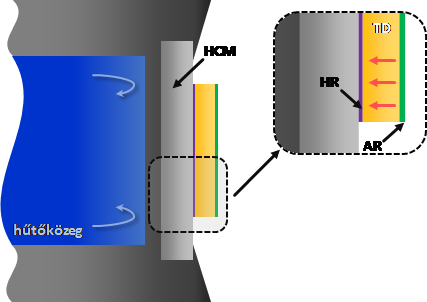
Vékonykorong lézerfej kialakítása. HCM – magas hővezetésű anyag, HR – magas reflexiójú réteg, AR – alacsony reflexiójú réteg, TD – vékonykorong lézeraktív közeg [3, 4]
In this setup, the heat dissipated in the active medium due to optical pumping is coupled out longitudinally, i.e. in the direction of the laser beam (red arrows in the figure), which provides highly efficient cooling. This, in turn, results in a low thermal gradient in the lasing medium, by which the beam suffers minimum distortion during the operation of the laser. The lasing medium is attached to a water cooled heat exchanger, where good thermal connectivity is most often ensured by a synthetic diamond (HCM, figure).
The rapid development of the thin disk laser architecture can first of all be attributed to the invention of the Yb:YAG laser crystal, whose excellent thermal conductivity and mechanical properties made it suitable for achieving an average power of several kilowatts. In addition, thanks to its emission properties, the crystal is suitable for the generation of about 1 picosecond long pulses at a wavelength of around 1030 nm. Due to this latter property, thin disk laser oscillators and amplifiers have gained great interest both in industrial and scientific applications. In science they serve as excellent pumping lasers in parametric amplifier systems, but in combination with nonlinear post-compression they are also used to generate THz pulses or high-order harmonics [4].
Az így kialakított elrendezés segítségével az aktív közegben az optikai pumpálás miatt disszipálódott hőt longitudinális, azaz a lézernyalábbal azonos irányban csatoljuk ki (piros nyilak az ábrán), amelynek köszönhetően rendkívül nagy hatásfokú hűtés érhető el. A kiváló hűtés a lézerközegben alacsony hőmérsékleti gradienst, és így minimális nyalábtorzulást eredményez a lézer működése során. A lézerközeget egy vízhűtéses hőcserélőn rögzítik, amellyel a jó termikus kapcsolódást leggyakrabban szintetikus gyémánt segíti (HCM az ábrán).
A vékonykorong lézer architektúra rohamos fejlődését legfőképpen az Yb:YAG lézerkristály tette lehetővé, amely kiváló hővezetési és mechanikai tulajdonságai révén alkalmas volt az akár több kilowatt átlagteljesítményű működésre. Ezen felül emissziós karakterisztikája 1 pikoszekundum körüli időbeli hosszúságú impulzusok előállítását teszi lehetővé 1030 nm körüli hullámhosszon. Ez utóbbi tulajdonság miatt a vékonykorong lézeroszcillátorok és erősítők mind az ipari, mind a tudományos alkalmazásokban teret hódítottak. Tudományos területen kiemelkedő a parametrikus erősítőrendszerek pumpalézerként való felhasználása, de utólagos, nemlineáris időbeli összenyomással kombinálva terahertzes impulzusok forrásaként, valamint magasharmonikusok keltésére is használják ezeket [4].
Referencia
[1] A. Giesen et al: Scalable concept for diode-pumped high-power solid-state lasers, Appl. Phys. B 58 (1994)365-372
[2] A. Giesen et al: Fifteen years of work on thin-disk lasers: results and scaling laws, IEEE J. of Sel. Top. in Q. El. 13 (2007) 598-609
[3] H. Fattahi et al: Third-generation femtosecond technology, Optica 1 (2014) 45-63
[4] R. S. Nagymihály: Ultrarövid impulzusok erősítése következő generációs titán-zafír lézerrendszerekben, Doktori disszertáció (2018).
References
[1] A. Giesen et al: Scalable concept for diode-pumped high-power solid-state lasers, Appl. Phys. B 58 (1994)365-372
[2] A. Giesen et al: Fifteen years of work on thin-disk lasers: results and scaling laws, IEEE J. of Sel. Top. in Q. El. 13 (2007) 598-609
[3] H. Fattahi et al: Third-generation femtosecond technology, Optica 1 (2014) 45-63
[4] R. S. Nagymihály: Ultrarövid impulzusok erősítése következő generációs titán-zafír lézerrendszerekben, Doktori disszertáció (2018).
Chirped mirrors
Csörpölt tükrök
In the 1990s, the research, development and application of lasers emitting pulses in the femtosecond range (1 fs = 10–15 s) was one of the most dynamically developing fields of physics. The generation of pulses of such a short duration requires a broad spectral bandwidth on the one hand, but on the other hand, components of various wavelengths must be in phase at a certain point of space and time (see Figure 1). Simply put, the shorter the desired light pulse length, the more “colours” we need to add together in a way that the maxima coincide.
Az 1990-es években a lézerfizika egyik legdinamikusabban fejlődő területe a femtoszekundumos (1 fs = 10–15 s) időtartományba eső impulzusokat kibocsátó lézerek kutatása, fejlesztése és alkalmazása volt. Az ilyen rövidségű impulzusok létrejöttéhez egyrészt nagy spektrális sávszélesség szükséges, másrészt az is elengedhetetlen, hogy a különböző hullámhosszú komponensek a tér egy adott pontjában egy adott időpillanatban azonos fázisban legyenek (1. ábra). Egyszerűen megfogalmazva: minél rövidebb fényimpulzust akarunk, annál több „színt” kell összeadni oly módon, hogy a maximumok egybeessenek.
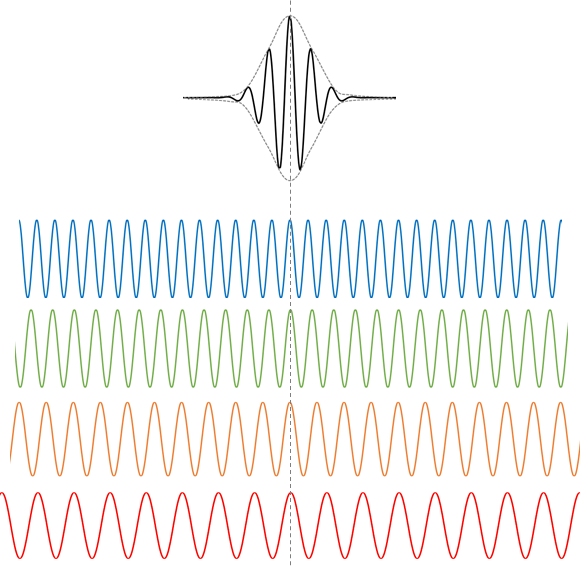
Figure 1: The generation of short pulses requires the phase-correct addition of many light components of different wavelengths 1. ábra: Rövid impulzus előállításához sok különböző hullámhosszú fénykomponens fázishelyes összegzésére van szükség
However, generating a short pulse is not enough: the pulse must remain short as long as it reaches the place of the experiment. Yet, while the pulse travels, the following problem occurs due to the broad spectrum:
The optical properties of materials depend on the wavelength (this phenomenon is called dispersion), as a result of which components of different wavelengths propagate at different speeds in a medium. In the case of colours constituting the pulses of the most common, near-IR lasers, the materials used (lenses, waveplates) most often exhibit positive dispersion, which means that they have less effect on long- than short-wavelength components. As a result, the redder components travel through the medium faster than those in the visible range (Figure 2). Consequently, short laser pulses lengthen in time during propagation through matter.
Nem elég azonban előállítani a rövid impulzust, annak rövidnek is kell maradnia egészen addig, amíg a kísérlet helyszínére eljut. Eközben azonban a széles spektrum miatt a következő probléma merül fel:
Az anyagok optikai tulajdonságai függnek a hullámhossztól (ez a diszperzió jelensége), ami miatt a különböző hullámhosszú komponensek nem egyforma sebességgel terjednek az anyagban. A leggyakoribb, közeli infravörös tartományban működő lézerek impulzusait alkotó színek esetén az alkalmazott anyagok (lencsék, hullámlemezek) leggyakrabban pozitív diszperzióval jellemezhetők, azaz a hosszabb hullámhosszú komponensekre kisebb hatást gyakorolnak, mint a rövidekre. Ez azt eredményezi, hogy a vörösebb komponensek gyorsabban végighaladnak az anyagon, mint a látható tartományba esők (2. ábra). Emiatt a rövid lézerimpulzusunk az anyagon történő áthaladás során időben megnyúlik.
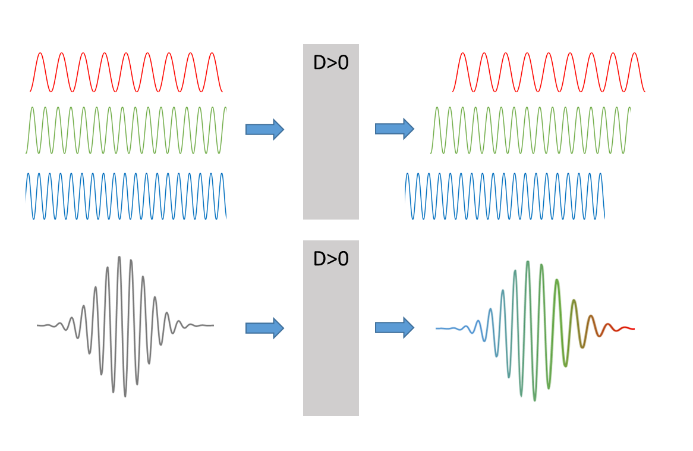
Figure 2: In materials with positive dispersion (D>0) longer-wavelength components travel faster than shorter-wavelength components, which results in the lengthening of the laser pulse 2. ábra: Pozitív diszperzióval jellemezhető anyagban (D>0) a hosszabb hullámhosszú komponensek gyorsabban haladnak, mint a rövidebb hullámhosszú komponensek, ami a lézerimpulzus időbeli megnyúlását eredményezi
Therefore, the time delay between the components must be compensated for. A suitable device for this purpose is the “chirped” mirror developed by Róbert Szipőcs in 1993 [1]. It consists of several layers of varying thicknesses and materials, and is designed to ensure that the pulse components of different wavelengths are reflected from different depths (Figure 3). Therefore, the different components cover different optical paths inside the device: longer-wavelengths components usually travel longer optical paths (negative dispersion), and thus compensate for the positive dispersion caused by other optical elements (and the concomitant temporal lengthening).
Szükség van tehát egy olyan eszközre, amely a komponensek között fellépő időkésést kompenzálja. Ilyen a Szipőcs Róbert által 1993-ban kifejlesztett „csörpölt” tükör [1], amely több, különböző vastagságú és anyagú rétegből áll, és úgy van megtervezve, hogy az impulzus különböző hullámhosszú komponensei különböző mélységekből verődjenek vissza (3. ábra). Így az egyes komponensek által az eszközben megtett optikai úthossz különböző lesz: általában a hosszabb hullámhosszú komponensekre nagyobb (negatív diszperzió), így kompenzálva az egyéb optikai elemek miatt fellépő pozitív diszperziót (és a diszperzió okozta időbeli megnyúlást).
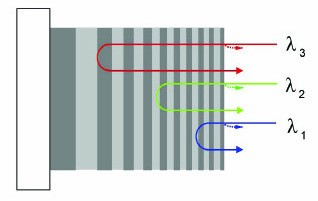
Figure 3: Due to the optimized system of alternating layers constituting the chirped mirror, components of different wavelengths penetrate the mirror to different depths and thus compensate for dispersion [2] 3. ábra: A csörpölt tükröket alkotó, megfelelően optimalizált rétegrendszernek köszönhetően a különböző hullámhosszúságú komponensek különböző mélységig hatolnak be a tükör szerkezetébe, így biztosítva a diszperzió kompenzálását [2]
The appearance of chirped mirrors brought about significant development in femtosecond laser physics, and led, among other things, to the generation of an unprecedented short pulse duration (4.5 fs) at Groningen University (the Netherlands) in 1997 [3]. The invention – dispersive laser mirrors and Ti:Sapphire lasers compensated for dispersion with the former – enjoys patent protection in Hungary and the USA (Hungarian Pat. No.: 214 659, US Pat. No. 5,734, 503; inventors: Róbert Szipőcs [70%] and Ferenc Krausz [30%]), and is used in several commercially available laser systems [4].
A csörpölt tükrök megjelenése jelentős fejlődést hozott a femtoszekundumos lézerfizika területén, és többek között az addigi legrövidebb (4,5 fs) fényimpulzus előállításához vezetett 1997-ben a Groningeni Egyetemen (Hollandia) [3]. A találmány – ami a diszperzív lézertükrökre, illetve a velük diszperziókompenzált titán-zafír lézerekre vonatkozik – szabadalmi védettséget élvez Magyarországon és az USA-ban (Lajstromszám: 214 659, illetve US Pat. No. 5,734, 503; feltalálók: Szipőcs Róbert [70%] és Krausz Ferenc [30%]), és számos kereskedelmi forgalomban elérhető lézerrendszerben is alkalmazzák azt [4].
Referencia
[1] R. Szipőcs, K. Ferencz, C. Spielmann, F. Krausz: Chirped multilayer coatings for broadband dispersion control in femtosecond lasers; Optics Letters 19 (1994) 201-203.
[2] P. Dombi, V. S. Yakovlev, K. O’Keeffe, T. Fuji, M. Lezius, and G. Tempea: Pulse compression with time-domain optimized chirped mirrors; Optics Express 13 (2005) 26, 10888-10894
[3] A. Baltuska, Z. Wie, M. S. Pshenichnikov, D. A. Wiersma, R. Szipőcs, Applied Physics 65 (1997) 175-188
[4] Szipőcs Róbert: Femtoszekundumos lézer- és parametrikus oszcillátorok femtobiológiai alkalmazásokhoz; Magyar Tudomány 2005/12, 1535
References
[1] R. Szipőcs, K. Ferencz, C. Spielmann, F. Krausz: Chirped multilayer coatings for broadband dispersion control in femtosecond lasers; Optics Letters 19 (1994) 201-203.
[2] P. Dombi, V. S. Yakovlev, K. O’Keeffe, T. Fuji, M. Lezius, and G. Tempea: Pulse compression with time-domain optimized chirped mirrors; Optics Express 13 (2005) 26, 10888-10894
[3] A. Baltuska, Z. Wie, M. S. Pshenichnikov, D. A. Wiersma, R. Szipőcs, Applied Physics 65 (1997) 175-188
[4] Szipőcs Róbert: Femtoszekundumos lézer- és parametrikus oszcillátorok femtobiológiai alkalmazásokhoz; Magyar Tudomány 2005/12, 1535
The 1999 Nobel Prize for Chemistry
Az 1999. évi kémiai Nobel-díj
In 1999, the Nobel Prize for chemistry was awarded to Ahmed Zewail for his pioneering work in the field of femtochemistry. According to the Nobel Committee, Zewail, who was a native of Egypt, but conducted research in the United States of America, earned the award for showing how the kinetics of atoms composing molecules can be examined with ultrashort, femtosecond (10-15 second) laser pulses during chemical reactions [1].
Az 1999-es kémiai Nobel-díjat Ahmed Zewail vehette át a femtokémia területén végzett úttörő munkásságáért. A Nobel Bizottság indoklása szerint az egyiptomi születésű – de kutatásait az Amerikai Egyesült Államokban végző – vegyész az elismerést azzal érdemelte ki, hogy megmutatta, hogyan vizsgálható a molekulákat alkotó atomok mozgása kémiai reakciók során ultrarövid, femtoszekundumos (10-15 másodperc) lézerimpulzusokkal [1].
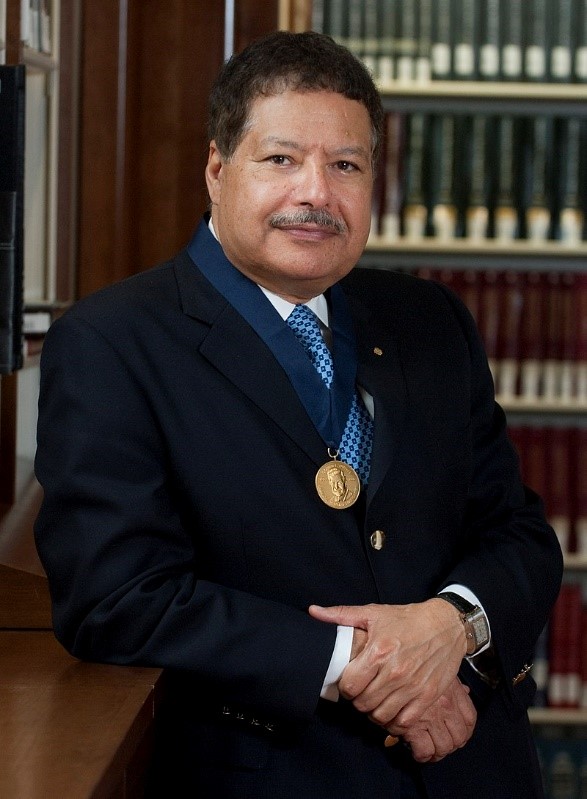
It was back in the 1930s that Henry Eyring and Michael Polanyi, a Hungarian-born scientist formulated the theory, according to which molecules can go through so-called transition states. Already this first theory suggested that these transition states can only exist on the timescale that applies to molecular vibrations, however the techniques necessary for their examination were not available then. By now we have learnt that the smaller a physical/chemical/biological object, the faster it moves and the faster the characteristic changes occur. Ahmed Zewail realized that the laser technology of the early 1990s, which was capable of generating laser pulses of few tens of femtoseconds, could help him observe these transition states. To this end, he used a method named ‘femtosecond spectroscopy’. In this pump-probe procedure, the pumping femtosecond laser pulse induces the transition state in the sample, and the existence of this state is justified by the change in the characteristics of the probing pulse when it travels through the sample. During one of his first experiments, Zewail examined the reaction between hydrogen atoms and carbon dioxide molecules. This chemical reaction occurs naturally both in the atmosphere of the Earth and during the combustion of fuels. The end products of the reaction are carbon monoxide and a hydroxyl radical (H + CO2 → CO + OH), but during the experiments Zewail noticed the presence of a “HOCO” complex for around 1000 fs (a millionth of a millionth of a second). This and similar experiments meant the birth of a research area called femtochemistry, which gives us more in-depth knowledge of many chemical reactions that occur in our environment on an everyday basis, and an ability to control and utilize these reactions.
Henry Eyring és a magyar származású Polányi Mihály tollából már az 1930-as években megszületett az elmélet, miszerint a kémiai reakciók során a molekuláknak kialakulhatnak úgynevezett átmeneti állapotai. Ez az első elmélet azt jósolta, hogy ezen állapotok csupán a molekulák rezgéseinek tipikus időskáláján létezhetnek, de a vizsgálatukhoz szükséges technika akkoriban még nem állt rendelkezésre. Ma már ismert, hogy minél kisebb egy-egy fizikai/kémiai/biológiai objektum, mozgásuk és a rájuk jellemző változások annál gyorsabbak. Ez alapján Ahmed Zewail felismerte, hogy a 90-es évek elejének lézertechnológiája, amely már néhány tíz femtoszekundumos impulzusok előállítására volt képes, segítheti őt ezen átmeneti állapotok megfigyelésében.
Az általa használt vizsgálati módszer az úgynevezett femtoszekundumos spektroszkópia volt. Ez egy olyan pumpa-próba eljárást jelent, ahol a pumpát jelentő femtoszekundumos lézerimpulzus hozza létre az átmeneti molekulaállapotot a mintában, és annak létrejöttéről a próbaimpulzus jellemzőiben a mintán való áthaladáskor bekövetkező változás tanúskodik. Zewail egyik első ilyen kísérletében például hidrogénatomok és szén-dioxid molekulák reakcióját vizsgálta, amely mind a Föld légkörében, mind tüzelőanyagok égetése során lezajló kémiai folyamat. A reakció végterméke szén-monoxid és egy hidroxilgyök (H + CO2 → CO + OH), de Zewail kísérleteiben megfigyelte, hogy a reakció során körülbelül 1000 femtoszekundumig (azaz a másodperc milliomod részének milliomod részéig) egy HOCO vegyjelű komplex is létezik. Ezzel és hasonló kísérleteivel indította útjára a femtokémia tudományterületét, aminek köszönhetően ma már sokkal alaposabban ismerjük a környezetünkben mindennap lezajló kémiai folyamatok egy részét, és ezáltal lehetőségünk nyílik ezeket irányítani, előnyünkre fordítani.
References:
[1] https://www.nobelprize.org/prizes/chemistry/1999/press-release/
[2] Eyring, H.; Polanyi, M. (2013-11-01). "On Simple Gas Reactions". Zeitschrift für Physikalische Chemie. 227 (11): 1221–1246, https://doi.org/10.1524%2Fzpch.2013.9023Referencia:
[1] https://www.nobelprize.org/prizes/chemistry/1999/press-release/
[2] Eyring, H.; Polanyi, M. (2013-11-01). "On Simple Gas Reactions". Zeitschrift für Physikalische Chemie. 227 (11): 1221–1246, https://doi.org/10.1524%2Fzpch.2013.9023Carrier Envelope Phase (CEP) stablization
A vivő-burkoló fázis (CEP) stabilizálása
In pulse-mode lasers, the transported energy is compressed to temporally short pulses, wherefore a higher peak intensity can be achieved than with continuous mode lasers. The momentary change in the field strength of a laser pulse can be written as the product of the envelope and the periodically oscillating carrier wave of the pulse. The phase difference between the envelope and the carrier, which can change from pulse to pulse, is called carrier-envelope phase or CEP for short. If the laser pulse is sufficiently short, i.e. it consists only of a few cycles, the CEP value significantly determines the shape of the pulse (see figure), and consequently, the outcome of extreme nonlinear optical processes. Therefore, monitoring the temporal changes in the CEP value and the CEP stabilization of the laser system is essential in these experiments.
Az impulzusüzemű lézereknél a szállított energia időben rövid impulzusokba tömörül össze, így nagyobb csúcsintenzitás érhető el, mint a folytonos üzemű lézereknél. Egy lézerimpulzus térerősségének időbeli eloszlása az impulzus burkolójának és a periodikusan oszcilláló vivőhullámnak a szorzataként írható le. A burkoló és a vivőhullám közötti fáziskülönbséget, ami impulzusról impulzusra változhat, vivő-burkoló fázisnak, röviden CEP-nek (carrier-envelope phase) nevezzük. Ha a lézerimpulzus kellően rövid (néhány ciklusnyi hosszúságú), akkor a CEP-érték döntően befolyásolja az impulzus alakját (lásd az ábrát), következésképpen az extrém nemlineáris optikai folyamatok kimenetelét. Emiatt e kísérleteknél nélkülözhetetlen a CEP-érték időbeli változásának nyomon követése, illetve a lézerrendszer CEP-stabilizálása.
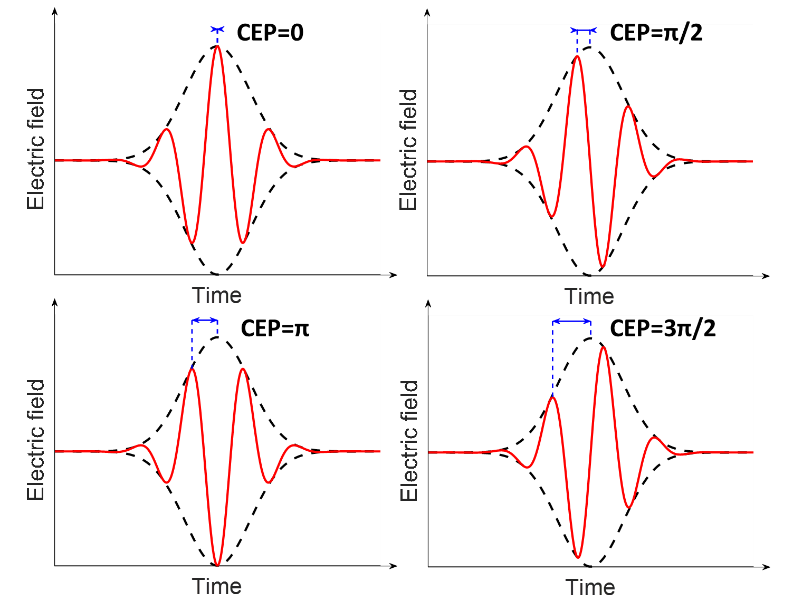
Temporal changes in the electrical field of a laser pulse at different CEP values Egy lézerimpulzus elektromos térerősségének időbeli változása különböző CEP értékeknél
In the past two decades several methods have been developed to measure changes in the CEP value. The most frequently used methods, such as the f-to-2f and the 0-to-f methods, are based on nonlinear interferometry [1]. The essence of these techniques is that frequency and phase shifted pulse replicas are created, and the change in CEP can be determined by measuring the interference between the original pulse and the replica.
Measuring the change in CEP can also be used for the CEP stabilization of the laser system. A typical stabilization technique is the so called feedback method, when CEP is stabilized from pulse to pulse by making fast changes in the laser oscillator, e.g. by modulating the pump intensity. The disadvantage of this technique is the inherent possibility for the destabilization of laser operation. Techniques that stabilize the CEP value outside the oscillator are called feed-forward methods [2]. Stabilization can be achieved in an acousto-optic modulator (AOM) by diffracting the laser beam. The CEP value can also be stabilized without feedback, merely by means of a optical effect, i.e. by difference frequency generation (DFG) [3]. In the laser systems at ELI-ALPS, high CEP stability could be achieved by the combination of these methods, hence stable conditions are available for attosecond experiments.A CEP-érték változásának mérésére számos módszert fejlesztettek ki az elmúlt két évtizedben. A gyakorlatban leggyakrabban alkalmazott módszerek, mint például az f-to-2f, és a 0-to-f, amelyeket H. R. Telle és kutatócsoportja 1999-ben megjelent cikkében javasolt [1], nemlineáris interferometrián alapulnak. Ezek lényege, hogy frekvenciában és fázisban eltolt impulzus-replikákat hozunk létre, majd az eredeti impulzus és a replika közötti interferencia mérésével a CEP változása meghatározható.
A CEP változásának mérését a lézerrendszer CEP-stabilizálására is fel lehet használni. Egy tipikus stabilizálási technika az úgynevezett feedback, vagy visszacsatolásos módszer. Ennek során maga a lézeroszcillátor működésében végrehajtott gyors változtatásokkal, például a pumpateljesítmény modulálásával stabilizálják a CEP impulzusról impulzusra történő változását. A technika hátránya, hogy magában hordozza a lézerműködés destabilizálásának lehetőségét. Azon technikákat, amelyek az oszcillátoron kívül stabilizálják a CEP-értéket, feed-forward módszereknek nevezzük [2]. Ez például egy akuszto-optikai modulátorban (acousto-optic modulator, AOM) a lézer diffraktálásával valósítható meg. A CEP értéke visszacsatolás nélkül, pusztán optikai effektussal (DFG keltéssel) is stabilizálható [3]. Az ELI-ALPS lézerrendszereinél e módszerek kombinálásával sikerült nagyfokú CEP-stabilitást elérni, így biztosítva az attoszekundumos kísérletek számára a stabil körülményeket.
Referencia
[1] H. R. Telle, et.al.: Carrier-envelope offset phase control: A novel concept for absolute optical frequency measurement and ultrashort pulse generation; Applied Physics B 69 (1999) 4, 327–332
[2] S. Koke et.al.: Direct frequency comb synthesis with arbitrary offset and shot-noise-limited phase noise; Nature Photonics 4 (2010) 7, 462-465
[3] A. Baltuškaius, et.al.: Controlling the carrier-envelope phase of ultrashort light pulses with optical parametric amplifiers; Physical Review Letters 88 (2002) 13, 133901
References
[1] H. R. Telle, et.al.: Carrier-envelope offset phase control: A novel concept for absolute optical frequency measurement and ultrashort pulse generation; Applied Physics B 69 (1999) 4, 327–332
[2] S. Koke et.al.: Direct frequency comb synthesis with arbitrary offset and shot-noise-limited phase noise; Nature Photonics 4 (2010) 7, 462-465
[3] A. Baltuškaius, et.al.: Controlling the carrier-envelope phase of ultrashort light pulses with optical parametric amplifiers; Physical Review Letters 88 (2002) 13, 133901
Petawatt-class lasers
Petawattos lézerek
In the last years of the 20th century, ultrafast optical research, the investigation of the extreme states of matter and high-energy experiments required laser pulses of increasing intensities. In the 1990s, the millionfold amplification of ultrashort laser pulses became a routine procedure, as a result of which the attainable peak power was in the terawatt or even the petawatt range. By focusing petawatt pulses, light intensity over 1020 W/cm2 can be acheived, i.e. the equivalent of the entire solar radiation reaching Earth and concentrated on a pinhead.
The technological breakthrough in increasing the power of ultrashort (fs range) pulses was achieved by the invention of Chirped Pulse Amplification (CPA). It was in 1985 that D. Strickland and G. Mourou published their experiments during which they first stretched a short laser pulse — and thus reduced its peak power —, then amplified it, and finally compressed it to the original length, while keeping its energy. This technique circumvents the use of intensities that would damage materials used during amplification, i.e. it improves the damage threshold.
The first-ever petawatt laser, a Ti:Sa and Nd:glass hybrid laser, was reported in 1999 [1]. It was constructed at the California-based Lawrence Livermore National Laboratory, and achieved a peak power of 1.5 PW with a pulse duration of 440 fs, and delivered 680 J energy per pulse.
In the first decade of the 21th century, the development of large laser systems gained momentum. The “Vulcan” laser at Rutherford Appleton Laboratory (United Kingdom) was made available for users, the OMEGA-EP laser became operational at the Laboratory for Laser Energetics (USA), and the commissioning of other petawatt class lasers started in North America, Europe and Asia. In line with their planned applications, these lasers represent unique combinations of peak power (a few petawatts), pulse energy (energies up to the megajoule range) and pulse durations (nano-, pico- and femtosecond). The use of lasers is necessary and promising especially in fusion experiments, in research related to plasma-based particle acceleration and the extreme states of matter. Other development projects – multi-beam petawatt lasers, plasma accelerators – aim to further increase peak power and develop exawatt class lasers.
High peak-power lasers play a key role in the ELI project too: each of the three ELI facilities has at least one petawatt class laser.
A XX. század utolsó éveiben folyó ultragyors optikai kutatások, az anyag extrém állapotainak tanulmányozása és a nagyenergiájú kísérletek egyre nagyobb intenzitású lézerimpulzusokat kívántak.
Az 1990-es években rutinszerű eljárássá vált az ultrarövid lézerimpulzusok energiájának milliószoros erősítése, így terawattos, vagy akár petawattos csúcsteljesítmények is elérhetők lettek. Ez utóbbi impulzusokat fókuszálva 1020 W/cm2–nél nagyobb fényintenzitás érhető el; ez akkora, mintha a Napból a Földre érkező teljes sugárzást egy tűhegyre koncentrálnánk. Az ultrarövid – femtoszekundumos tartományba eső – impulzusok teljesítményének növelésében a technológiai áttörést a fázismodulált impulzuserősítés (Chirped Pulse Amplification – CPA) felfedezése hozta. D. Strickland és G. Mourou 1985-ben publikálták kísérleteiket, amelyek során a rövid lézerimpulzust először megnyújtották – ezzel csökkentve csúcsteljesítményét –, majd erősítették, végül újra eredeti hosszúságára összenyomták, megtartva energiáját. Ezzel a technikával elkerülhető, hogy erősítés közben akkora intenzitás lépjen fel, amely az ott használt anyagokat roncsolná.
Az első petawattos lézer, egy Ti:Sa és Nd:üveg hibrid lézer működését 1999-ben publikálták [1]. A kaliforniai Lawrence Livermore National Laboratory-ban megépített eszköz 440 fs-os impulzushossz mellett 1,5 PW-os csúcsteljesítményt ért el és impulzusonként 680 J energiát szállított.
A XXI. század első évtizedében felgyorsult a nagy lézerrendszerek fejlesztése. A Rutherford Appleton Laboratory (Egyesült Királyság) „Vulcan” lézerét külső felhasználók számára is elérhetővé tették, üzembe helyezték a Laboratory for Laser Energetics (USA) OMEGA-EP lézerét, és további petawatt-osztályú lézerek működtetése kezdődött meg Észak-Amerikában, Európában és Ázsiában. Tervezett felhasználási területeiktől függően e lézerek a csúcsteljesítmény (néhány petawatt), az impulzusenergia (megajoule nagyságrendű energiákig) és az impulzushossz (nano-, piko- és femtoszekundumos) egyedi kombinációit képviselik. Felhasználásuk jellemzően a fúziós kísérletekben, a plazmás részecskegyorsítással kapcsolatos kutatásokban és az anyag extrém állapotainak vizsgálatában szükséges és ígéretes.
További fejlesztések – többnyalábos petawattos lézerek, plazmás erősítők – a csúcsteljesítmény további növelését, és ezzel exawattos kategóriájú lézerek kifejlesztését célozzák.
A nagy csúcsteljesítményű lézerek az ELI-projektben is kulcsszerepet játszanak: mindhárom ELI létesítmény rendelkezik legalább egy petawatt kategóriájú lézerrel.
The HF laser at ELI ALPS HF operates in the infrared spectrum (with a central wavelength of 800 nm), at the highest possible repetition rate (10 Hz) and with the shortest possible pulse duration (17 fs), and delivers over 34 J energy per pulse. It is used for driving the secondary sources connected to it, and thus creates an opportunity to study light-matter interactions at relativistic intensities, to generate surface high-order harmonics and to induce plasma-based particle acceleration.
Az ELI ALPS HF lézere az infravörös tartományban (800 nanométeres központi hullámhosszon), a lehető legnagyobb ismétlési frekvenciával (10 Hz) és a legrövidebb impulzushosszal (17 fs) működik, és impulzusonként 34 J feletti energiát szállít. Hozzákapcsolt másodlagos források meghajtására szolgál, lehetőséget teremtve fény-anyag kölcsönhatások relativisztikus intenzitások melletti tanulmányozására, felületi magasharmonikus-keltésre és plazmás részecskegyorsításra.
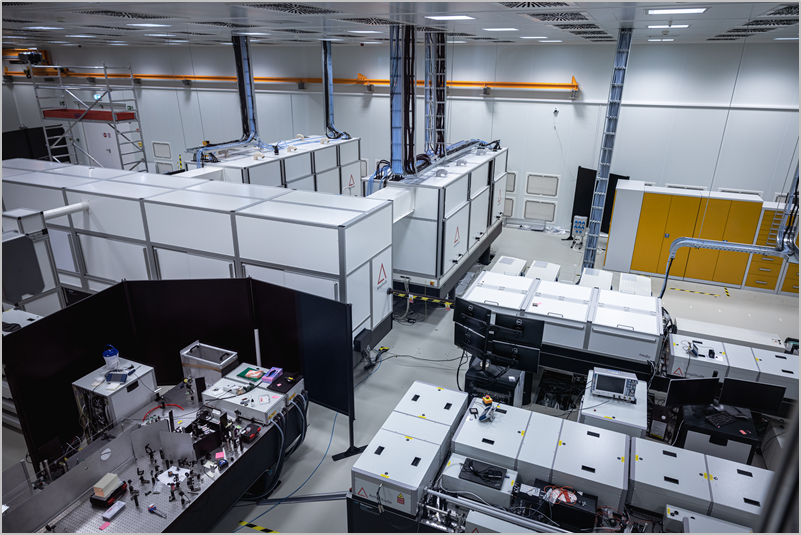
The HF laser in ELI ALPS Az ELI ALPS HF lézere
The largest laser system of ELI ALPS is designed and implemented by Amplitude Technologies. The system uses a state-of-the-art, optical parametric chirped pulse amplification based seed source [3] which is intended to support higher reliability in comparison to mode-locked oscillators. The next component is based on a chirped pulse amplification cascade [4]. The pulses are first stretched from the femtosecond to the nanosecond temporal range. Then their energy is boosted in seven Ti:sapphire laser amplifiers at 10 Hz repetition rate. The last amplifier stage is driven by two unique large-scale flash lamp-based pump lasers, which deliver a total pump energy of more than 100 J to the amplifier crystal. Then, a diffraction grating based vacuum compressor corrects the spectral phase of the amplified pulses, resulting in 2 PW peak-power pulses with 17 fs duration and 34 J energy. The 2 PW pulses are finally delivered through a vacuum beam transport line to drive the secondary sources and high intensity experiments.
Az ELI ALPS-nál a legnagyobb lézerrendszer tervezője és kivitelezője az Amplitude Technologies nevű cég. A rendszer korszerű OPCPA (Optical Parametric Chirped Pulse Amplification, azaz optikai parametrikus fázismodulált impulzuserősítés) fényforrást [3] használ, amely megbízhatóbb a módusszinkronizált oszcillátoroknál. A rendszer következő elemének alapját egy CPA-kaszkád [4] adja. Az impulzusokat először femtuszekundumosról nanoszekundumos hosszúságúra nyújtják, majd energiájukat hét darab Ti:zafír lézeres erősítőben, 10 Hz ismétlési frekvencián megnövelik. Az utolsó erősítési szakaszt két, kifejezetten e célra tervezett, nagyméretű, villanólámpa alapú pumpalézer hajtja meg, amely összesen több mint 100 J energiát képes az erősítő kristályhoz szállítani. Ezután egy diffrakciós rácsra épített vákuumkompresszor korrigálja az erősített impulzusok spektrális fázisát, amelynek eredeményeként 2 PW csúcsteljesítményű, 17 fs hosszúságú és 34 J energiájú impulzusok jönnek létre. A 2 PW-os impulzusok végül egy vákuumos nyalábtovábbító rendszeren keresztül jutnak el arra a pontra, ahol szükség van rájuk a másodlagos források meghajtásához és a nagyintenzitású kísérletek végzéséhez.
Referencia
[1] D. Strickland and G. Mourou: Compression of amplified chirped optical pulses, Optics Communications 56 (1985) 3 219
[2] M. D. Perry et al.: Petawatt laser pulses; Optics Letters 24 (1999) 3 160-162
[3] C. Danson et al.: Petawatt class lasers worldwide; High Power Laser Science and Engineering 3 (2015) e3
[4] N.Thiré, R. Maksimenka, B. Kiss, C. Ferchaud, P. Bizouard, E. Cormier, K. Osvay, and N. Forget: 4-W, 100-kHz, few-cycle mid-infrared source with sub-100-mrad carrier-envelope phase noise, Optics Express 25 (2017) 1505-1514
[5] C. Danson et al.: Petawatt and exawatt class lasers worldwide; High Power Laser Science and Engineering 7 (2019) e54
[6] https://eli-laser.eu/the-eli-project/
[7] ELI Whitebook, https://eli-laser.eu/media/1019/eli-whitebook.pdf
References
[1] D. Strickland and G. Mourou: Compression of amplified chirped optical pulses, Optics Communications 56 (1985) 3 219
[2] M. D. Perry et al.: Petawatt laser pulses; Optics Letters 24 (1999) 3 160-162
[3] C. Danson et al.: Petawatt class lasers worldwide; High Power Laser Science and Engineering 3 (2015) e3
[4] N.Thiré, R. Maksimenka, B. Kiss, C. Ferchaud, P. Bizouard, E. Cormier, K. Osvay, and N. Forget: 4-W, 100-kHz, few-cycle mid-infrared source with sub-100-mrad carrier-envelope phase noise, Optics Express 25 (2017) 1505-1514
[5] C. Danson et al.: Petawatt and exawatt class lasers worldwide; High Power Laser Science and Engineering 7 (2019) e54
[6] https://eli-laser.eu/the-eli-project/
[7] ELI Whitebook, https://eli-laser.eu/media/1019/eli-whitebook.pdf
Experimental observations of attosecond pulses
Az attoszekundumos impulzusok kísérleti megfigyelése
The first attosecond light pulses generated at the dawn of the millennium represented a technological breakthrough that made it possible to shift the temporal control and investigation of atomic and molecular systems from the molecular (femtosecond) timescale to the domain of electron dynamics (attosecond range).
Coherent radiation with broad spectral range and high photon energy serving as a basis for attosecond pulses was produced in laboratories already in the late 1980s (McPherson, Ferray et al. [1][2]) by the ionization of noble gas atoms in a strong laser field. The possibility of the creation of attosecond pulses from the process named “high-order harmonics generation” was raised by Hungarian physicists Győző Farkas and Csaba Tóth [3] in 1992, and within a year, Paul Corkum [4] developed the first theoretical model to describe the process. According to the model, in each half cycle of the laser light focused into a noble gas medium the changing intense electric field tears electrons away from the gas atoms, accelerates them, and while pulling them back it makes them collide with the generating atom. Each of these collisions may be accompanied by the extremely fast, flash-like emission of photons in the extreme ultraviolet (XUV) range.
After that, fundamental theoretical and experimental work (mainly performed by Anne L'Huillier and co-workers [5]) showed that high-order harmonic generation by a laser producing femtosecond pulses with many optical cycles results in the emission of attosecond light pulses with a repetition rate double the optical frequency of the laser.
The conclusive proof was provided by the experiment conducted by Paul, Agostini and co-workers [6]. Their experiment is still considered as a general method for the characterization of attosecond light pulses. In this experiment, the interaction of the driving ultrashort (infrared) laser pulse and the attosecond (XUV) pulses in a gaseous medium was used to measure the exceptionally short process in the absence of other, e.g. electronic methods.
In the experiment, the infrared driving pulse was divided into a so-called pump pulse used for the generation of extreme-ultraviolet (XUV) radiation, and a weak probe pulse. After they followed the same optical path (i.e. they were propagated collinearly), the two pulses were focused into a noble gas medium and the generated electrons were collected with a time-of-flight (ToF) detector. By the extremely fine control of the time delay between the pump and the probe pulses one pulse can be scanned by the other, and the spectral phase of the components of high-order harmonic radiation can be deduced. Based on the spectral phase and the amplitude, which can be also established from the ToF spectrum, one can determine the temporal shape of the XUV pulse, including the constituent pulses, the length of which was measured to be a mere 250 as in the experiment conducted by Paul and co-workers.
Az új évezred hajnalán előállított első attoszekundumos fényimpulzusok olyan technológiai ugrást jelentettek, amellyel lehetővé vált az atomi és molekuláris rendszerek időbeli szabályozásának, továbbá vizsgálatának a molekuláris rendszerek (femtoszekundomos) időskálájáról az elektronok dinamikájának (attoszekundumos) időskálájára való továbbfejlesztése.
Az attoszekundumos impulzusok alapjául szolgáló széles színképű, nagy energiájú sugárzást laboratóriumokban már az 1980-as évek végén megvalósították (McPherson, Ferray és munkatársaik [1], [2]) nemesgáz atomok intenzív lézertérben történő ionizációjával. A „magasharmonikus keltésnek” keresztelt folyamatból attoszekundumos impulzusok létrejöttének lehetőségét Farkas Győző és Tóth Csaba [3] magyar fizikusok vetették fel 1992-ben, majd mindössze egyetlen évvel később Paul Corkum [4] megalkotta az első elméleti modellt a folyamat leírására. Eszerint a nemesgáz közegre irányított lézerfény minden egyes optikai félciklusában a változó intenzív elektromos tér elektronokat szakít le a gázatomokról, ezeket felgyorsítja, majd visszahúzva őket ütközteti a keltő atommal. Minden egyes ilyen ütközés az extrém-ultraibolya (XUV) tartományba eső fotonok egy nagyon rövid ideig tartó, felvillanásszerű kibocsátásával járhat.
Ezt követően elméleti és kísérleti alapmunkák (amelyben jelentős szerep jutott Anne L'Huilliernek és munkatársainak [5]) kimutatták, hogy egy sok optikai ciklusból álló, femtoszekundumos impulzushosszú gerjesztő lézerrel végzett magasharmonikus-keltés olyan attoszekundumos fényimpulzusok kibocsátását eredményezi, amelyek időben a lézer optikai frekvenciájának kétszeresével ismétlődnek.
A perdöntő bizonyítékot végül Paul, Agostini és társaik kísérlete [6] szolgáltatta, amely azóta is általános módszer attoszekundumos impulzussorozatok karakterizálására. E kísérletben ennek a példátlanul rövid ideig tartó folyamatnak a megmérésére – a folyamat gyorsasága miatt más, pl. elektronikai módszerek híján – a keltő ultrarövid (infravörös) lézerimpulzus és az attoszekundumos (XUV) impulzusok gáz közegben történő kölcsönhatását használták fel.
A kísérletben az infravörös keltőimpulzust kettéosztották egy, az extrém-ultraibolya (XUV) sugárzás keltésére szolgáló, úgynevezett pumpa- és egy gyenge próbaimpulzusra. A két impulzust ugyanazon optikai út mentén való (kollineáris) terjedés után nemesgáz közegbe fókuszálták és a keltett elektronokat egy repülési idő spektrométerrel összegyűjtötték. A pumpa- és próbaimpulzusok közötti időbeli eltolásnak a nagyon finom szabályozásával az egyik impulzussal a másik letapogatható, és a magasharmonikus sugárzás alkotó komponensei közötti spektrális fázis visszafejthető. A spektrális fázis és a repülési idő spektrumból ugyancsak kinyerhető amplitúdó ismeretében meghatározható az XUV impulzus időbeli alakja, amelyből az alkotó impulzusok hossza Paul és társai kísérletében mindössze 250 as-nak adódott.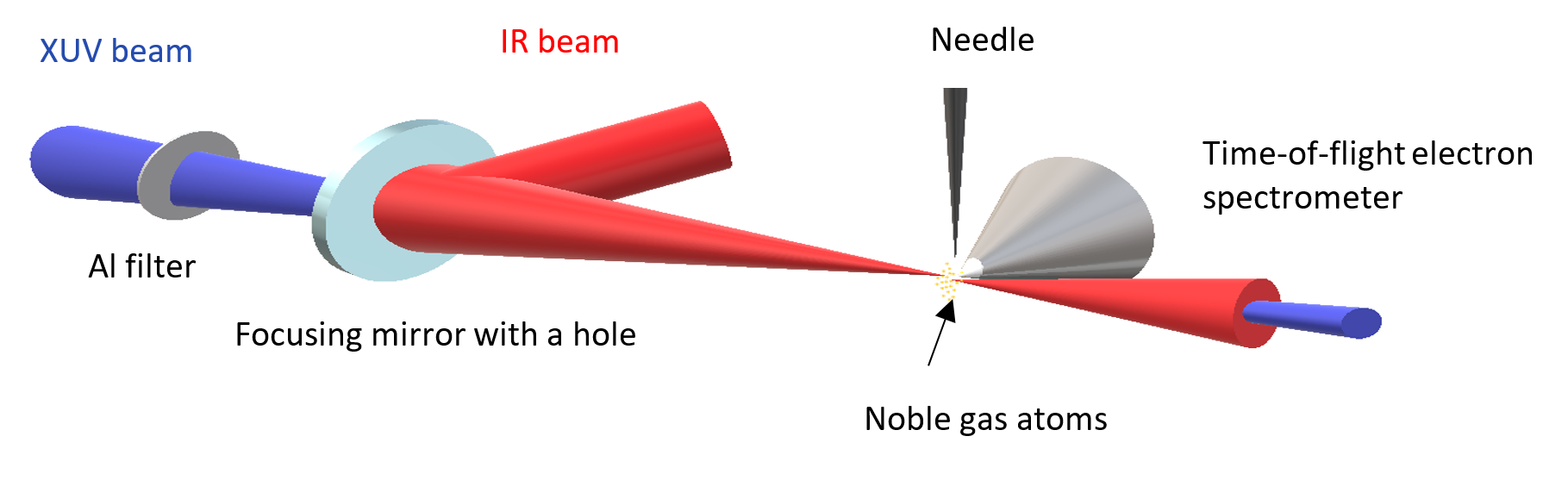
Schematic of an experimental setup for the observation of attosecond pulses 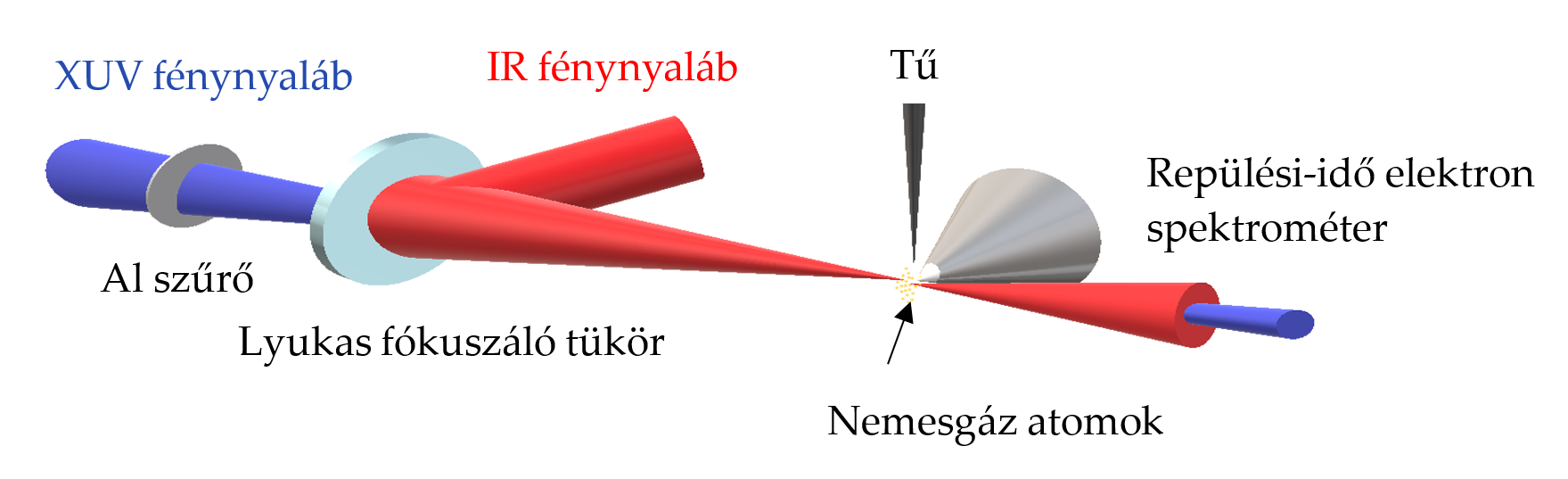
Attoszekundumos impulzusok megfigyelésére szolgáló kísérleti elrendezés sematikus rajza
The first train of attosecond pulses at ELI-ALPS was generated and observed in June 2019, where the individual pulses were measured to be approximately 400 as long.
Az ELI-ALPS-ban elsőként 2019 júniusában hoztak létre és figyeltek meg attoszekundumos impulzussorozatot, amelyben az egyes impulzusok hossza megközelítőleg 400 as volt.
Referencia
[1] A. McPherson et al.; JOSA B. 4 (1987) 4, 595
[2] M. Ferray et al.; J. Phys. B 21 (1988) 3, 31
[3] G. Farkas, Cs. Tóth; Phys. Lett. A 168 (1992) 447
[4] P. B. Corkum; Phys. Rev. Lett. 71 (1993) 1994
[5] P. Antoine, A. L'Huillier, M. Lewenstein; Phys. Rev. Lett. 77 (1996) 1234–1237
[6] Paul et al.; Science 292 (2001) 5522, 1689-92
References
[1] A. McPherson et al.; JOSA B. 4 (1987) 4, 595
[2] M. Ferray et al.; J. Phys. B 21 (1988) 3, 31
[3] G. Farkas, Cs. Tóth; Phys. Lett. A 168 (1992) 447
[4] P. B. Corkum; Phys. Rev. Lett. 71 (1993) 1994
[5] P. Antoine, A. L'Huillier, M. Lewenstein; Phys. Rev. Lett. 77 (1996) 1234–1237
[6] Paul et al.; Science 292 (2001) 5522, 1689-92
The 2005 Nobel Prize for Physics
A 2005-ös fizikai Nobel-díj
The Nobel Prize in Physics 2005 was divided, with one half awarded to Roy J. Glauber "for his contribution to the quantum theory of optical coherence", and the other half jointly to John L. Hall and Theodor W. Hänsch "for their contributions to the development of laser-based precision spectroscopy, including the optical frequency comb technique".
Az 2005-ös fizikai Nobel-díjat az optikai koherencia kvantumelméletének kidolgozásáért valamint a precíziós spektroszkópiában – különös tekintettel az optikai frekvenciafésű technika létrehozásában – elért eredményekért megosztva Roy J. Glauber, illetve John L. Hall és Theodor W. Hänsch kapta.
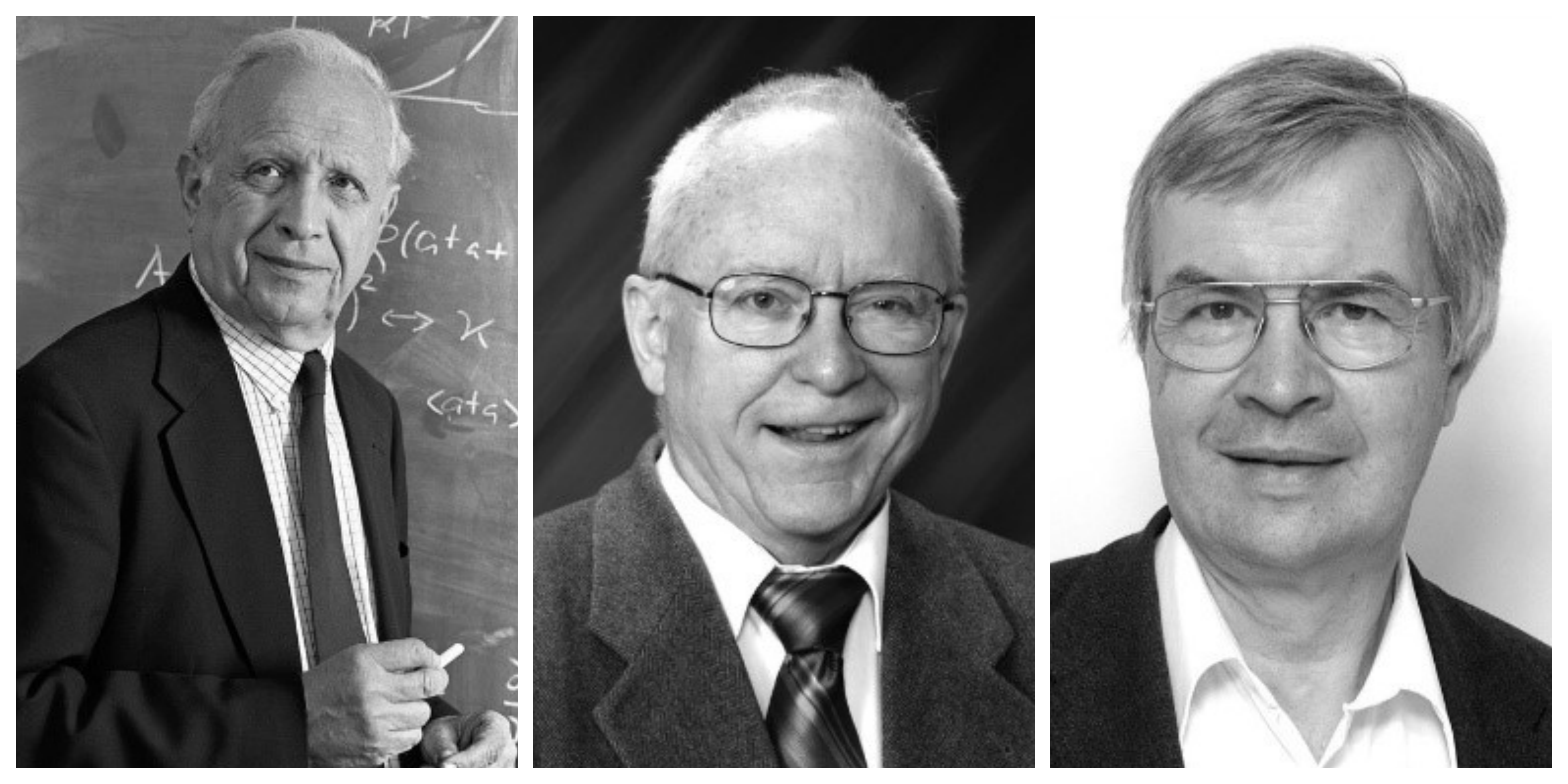
The description of light as electromagnetic wave is credited to James C. Maxwell, whose theory formulated in the middle of the 19th century paved the way for modern communications technologies such as the radio, the television and the mobile phone. In the early 20th century, the picture became even more complex when Einstein realized that the same light exists in quantum units he named photons.
It was Glauber, who laid down the foundations of quantum optics required to understand the dual nature of light, i.e. that it can be regarded both as a wave and a stream of particles. In his work, he pointed out the fundamental differences between blackbody radiation sources (i.e. sources emitting a mixture of frequencies and phases) – like a light bulb or our Sun – and lasers (emitting pulses with a specific frequency and phase).
Atomic processes can be understood via spectroscopy (the analysis of colour spectra) each tiny adjustment of which reveals more and more details of the microscopic world invisible to the human eye. Hänsch and Hall developed a procedure which allowed us to measure the frequency of light with a precision of 15 digits. The procedure is based on the fact that utilizing the extremely narrow frequency ranges of lasers we create a so-called frequency comb, which serves as a kind of a ruler.
The top row of the figure shows a series of high repetition light pulses that generate the multitude of sharp lines seen in the second row. The higher the repetition rate of the light pulse, the denser the comb formed by these lines.A fény, mint elektromágneses hullám leírása James C. Maxwell érdeme, aki a XIX. század derekán kidolgozott elméletével megalapozta a modern kommunikációs technológiákat – ideértve például a rádiót, a televíziót vagy a mobiltelefont. A XX. század elején a kép kiegészült Einstein felismerésével, miszerint ugyanez a fény az általa fotonoknak elnevezett egységekben, kvantumokban létezik.
E fény kettős természetének – azaz, hogy hullámnak és részecskék áramának is tekinthető – megértéséhez szükséges kvantumoptika alapjait Glauber fektette le. Munkájában rávilágított a feketetest-sugárzó (azaz széles frekvencia- és fázistartományt kibocsátó) források – mint amilyen egy izzó, vagy akár a Napunk is – és a lézerek (mint meghatározott frekvenciájú és fázisú források) alapvető különbségeire.
Az atomi folyamatok megértéséhez a spektroszkópián (színképelemzésen) keresztül vezet az út, amelynek minden apró finomítása egyre több részletet tár fel a számunkra láthatatlanul mikroszkopikus világból. Hänsch és Hall eredménye egy olyan eljárás kifejlesztése, amellyel a fény frekvenciája tizenöt számjegy pontossággal vált mérhetővé. Az eljárás alapja, hogy – kihasználva a lézerek rendkívül keskeny frekvenciatartományait – egy úgynevezett frekvenciafésűt hozunk létre, ami egyfajta vonalzóként működik.
Az ábra felső sorában a sűrűn ismétlődő fényjelek sorozata látszik, amik a második sorban megfigyelhető éles vonalak sokaságát hozzák létre. Minél sűrűbben követik egymást a fényimpulzusok, annál sűrűbb fogazatú fésű alakul ki a létrehozott vonalakból.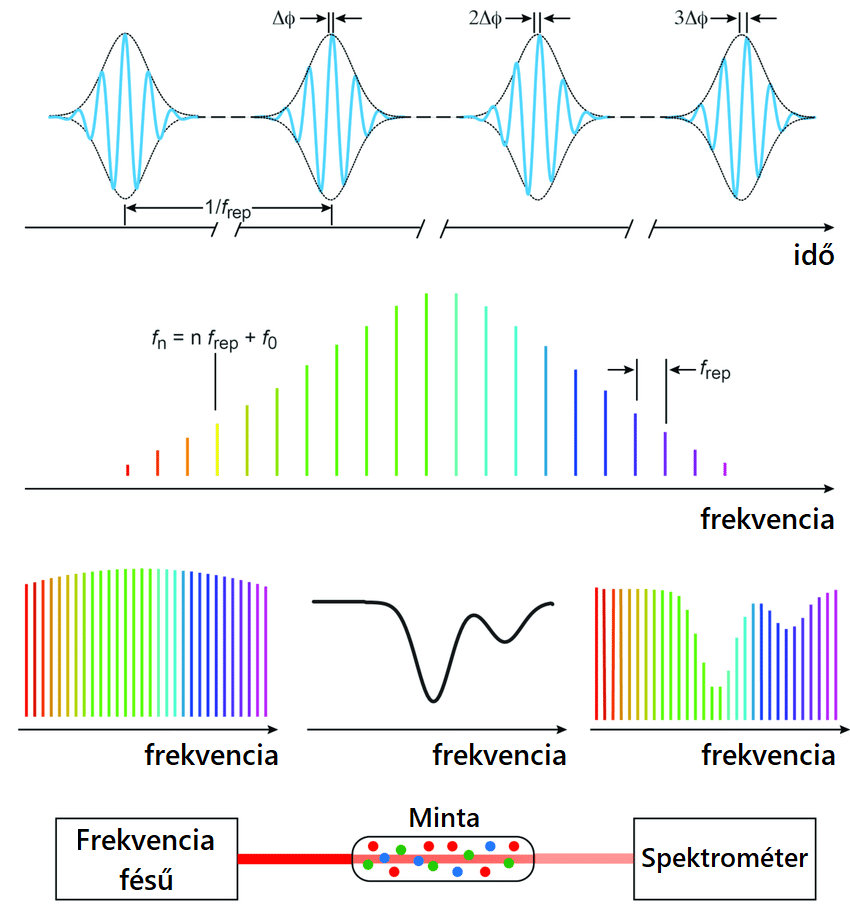
The bottom two rows of the figure depict a simple experiment: using the frequency comb as a source, light from this source is transmitted to a spectrometer through an absorbing sample. The spectrum of the light is shown above the scheme of the experimental setup: the spectral properties of the investigated material can be measured much more precisely along the sharp, regularly and densely spaced spectral lines. This technique has enabled scientists to investigate the temporal stability of natural constants, and to improve the accuracy of atomic clocks required for the development of the GPS technology.
Az ábra alsó két sora egy egyszerű kísérletet mutat be: forrásként használva a frekvenciafésűt, annak fényét egy elnyelő mintán keresztülhaladva juttatjuk egy spektrométerbe. A fény spektruma az elrendezés felett látható: az éles, szabályosan és sűrűn elhelyezkedő spektrumvonalak mentén a vizsgálandó anyag spektrális jellemzői jóval precízebben mérhetővé válnak. A technika segítségével többek között természeti állandók időbeli stabilitásának vizsgálata és a GPS technológia fejlődéséhez szükséges pontosabb atomórák váltak megvalósíthatóvá.
Referencia
[1] Roy J. Glauber: One hundred years of light quanta; Nobel lecture, 2005.
[2] John L. Hall: Defining and measuring optical frequencies: the optical clock opportunity – and more; Nobel lecture, 2005.
[3] Theodor W. Hänsch: Passion for precision; Nobel lecture, 2005.
[4] N. Picqué, T. W. Hänsch: Frequency comb spectroscopy; Nature Photonics 13 (2019) 146
References
[1] Roy J. Glauber: One hundred years of light quanta; Nobel lecture, 2005.
[2] John L. Hall: Defining and measuring optical frequencies: the optical clock opportunity – and more; Nobel lecture, 2005.
[3] Theodor W. Hänsch: Passion for precision; Nobel lecture, 2005.
[4] N. Picqué, T. W. Hänsch: Frequency comb spectroscopy; Nature Photonics 13 (2019) 146
Proposal for a European Extreme Light Infrastructure (ELI)
Előterjesztés az európai ELI létrehozására
In the second half of the 20th century, research into photonics gained momentum: the development of newer and newer light sources and the elaboration of experiment techniques opened previously unexplored areas of research. However, the required tools became more and more costly, maintenance and operation required growing expertise, and the host facilities had to meet specific requirements. By the end of the 20th century, the international community had formulated the need for a European laser research centre for shared use where state-of-the-art lasers and other experimental equipment driven by the former would be installed in special conditions and run by competent researchers to provide opportunities for photonic experiments requiring cutting edge equipment.
A XX. század második felében lendületet vettek a fotonikai kutatások: újabb és újabb fényforrások előállításával és kísérleti technikák kidolgozásával sorra nyíltak meg addig felderítetlen kutatási területek. A szükséges eszközök azonban egyre költségesebbé váltak, fenntartásuk és működtetésük egyre nagyobb szakértelmet, elhelyezésük különleges körülményeket igényelt. A nemzetközi kutatói közösségben a XX. század végére megfogalmazott igénnyé vált egy olyan, közös európai használatú lézeres kutatóközpont létrehozása, ahol a speciális körülmények között elhelyezett csúcslézereket és az általuk meghajtott további kísérleti berendezéseket hozzáértő kutatók üzemeltetik, lehetőséget biztosítva így élvonalbeli technológiát igénylő fotonikai kísérletek elvégzésére.
Upon the 2005 initiative of ESFRI (European Strategy Forum on Research Infrastructures) set up by the European Commission, top researchers proposed the implementation of a European extreme light infrastructure. The proposal won the approval of the Commission on the condition that the facility should be set up at three locations in three of the then new EU member states – Hungary, the Czech Republic and Romania.
Az Európai Bizottság által létrehozott ESFRI (European Strategy Forum on Research Infrastructures – Európai Kutatási Infrastruktúrák Stratégiai Fóruma) 2005-ös felhívására élvonalbeli kutatók pályázatot adtak be egy európai extrém fényberendezés létrehozására. A pályázat elnyerte a Bizottság támogatását azzal a kitétellel, hogy ezt az intézményt nem egy helyszínen kell létrehozni, hanem három, az Európai Unióhoz akkor újonnan csatlakozott ország – Magyarország, Csehország és Románia – területén.
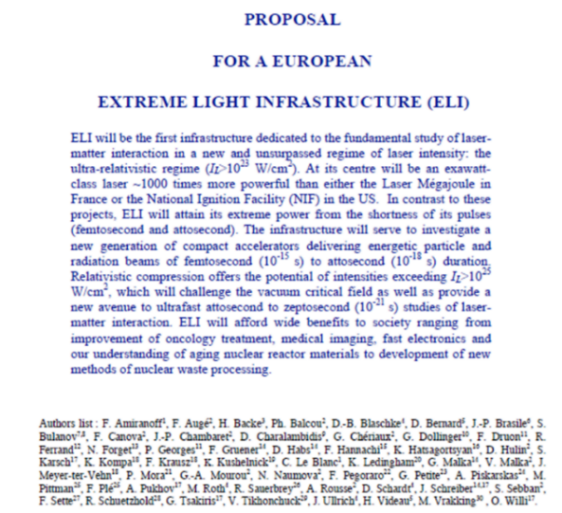
As a result, ELI has become one of the 44 pan-European research infrastructures included in the strategic plan of ESFRI. Being an integrated European research infrastructure, ELI will first of all serve fundamental research primarily aimed at the investigation of light-matter interactions at high intensities. The research infrastructure of ELI provides high power, ultrashort light pulses at high repetition rates, and delivers particle beams. As such, ELI will create new experimental opportunities in several areas of research, and is expected to have a significant impact on the development of materials science, medicine and environmental protection. The project may pave new roads in physics or serve as a foundation for new technological developments such as relativistic microelectronics or compact (desktop) laser particle accelerators.
>Az ELI ezzel az ESFRI stratégiai tervében szereplő 44 páneurópai kutatási nagyberendezés egyike lett. Integrált európai kutatási nagyberendezésként elsősorban olyan alapkutatásokat szolgál, amelyek fő célja a fény és az anyag kölcsönhatásainak vizsgálata nagy intenzitások mellett. Az ELI kutatási berendezései nagyenergiájú, ultrarövid fényimpulzusokat szolgáltatnak nagy ismétlési frekvenciával, illetve részecskesugárzásokat állítanak elő. Ezzel számos tudományterület számára teremtenek új kísérleti lehetőségeket, ami várhatóan jelentős hatással lesz majd az anyagtudomány, az orvostudomány és a környezetvédelem fejlődésére. A projekt új utakat nyithat meg a fizikában, továbbá új technikai fejlesztéseket is megalapozhat, mint például a relativisztikus mikroelektronika és a kompakt (asztali méretű) lézeres részecskegyorsítók.
The preparatory phase of the project commenced in 2007 and concluded in 2011 with the publication of the Whitebook, i.e. the scientific description of the research infrastructure to be implemented. The document was edited by Gérard Mourou, Georg Korn, Wolfgang Sandner and John L. Collier, but it was compiled with the involvement of internationally acclaimed researchers of the areas concerned.
A projekt előkészítő szakasza 2007-ben kezdődött, amelynek eredményeként 2011-ben Gérard Mourou, Georg Korn, Wolfgang Sandner és John L. Collier szerkesztésében, az egyes szakterületek nemzetközi tekintélyű kutatóinak közreműködésével elkészült a létrehozandó kutatóintézet tudományos leírása, a Whitebook.
ELI with three sites
ELI három telephellyel
It was early on that Hungary realized the unique opportunity hidden in the implementation of a large-scale international research centre through European cooperation, wherefore it joined international negotiations and proposal procedures aimed at the selection of the future site of ELI in 2008.
As several countries applied to host the facility, in October 2009 the decision was made that the entire ELI-project should be implemented as so-called shared infrastructure distributed at three sites in Hungary, the Czech Republic and Romania, primarily with funding from the Structural Funds available for these countries.
Magyarország korán felismerte azt az egyedülálló lehetőséget, amelyet egy nagyszabású nemzetközi kutatóközpont európai együttműködésben történő megvalósítása rejt magában, ezért már 2008-tól részt vett az ELI leendő helyszínének kiválasztását célzó nemzetközi tárgyalásokon és pályázatokon.
Mivel több ország is jelentkezett az ELI befogadására, 2009 októberében az a döntés született, hogy a teljes ELI-program magyar, cseh és román helyszíneken, úgynevezett osztott infrastruktúraként valósuljon meg, elsősorban az egyes országok rendelkezésére álló Strukturális Alapok finanszírozásával.The three pillars in Szeged (ELI ALPS – ELI Attosecond Light Pulse Source), in Dolní Břežany (ELI Beamlines) and in Măgurele (ELI Nuclear Physics) are tasked to conduct complementary research.
The primary goal of ELI ALPS is to construct unique attosecond (10–18) equipment that provides developers and users with the shortest pulses at the largest repetition rate in a frequency range from terahertz to x-ray radiation.
In Hungary, Szeged was chosen for the implementation of the ELI ALPS project, because the University of Szeged is in the front line of laser research and education domestically, and has achieved internationally acclaimed results in the field of applied laser science. The facility is located on the site of former Soviet military barracks, where the University of Szeged is planning to set up a science park. This will create favourable conditions to attract other research facilities, as well as state-of-the-art and R&D businesses into the city and the region.A Szegeden (ELI-ALPS – ELI Attosecond Light Pulse Source/Attoszekundumos Fényimpulzus Forrás/), a Dolní Břežanyban (ELI Beamlines), valamint a Măgurele-ben (ELI Nuclear Physics) megépülő három pillér feladata egymást kiegészítő lézeres kutatások folytatása.
Az ELI ALPS elsődleges célja, hogy olyan egyedülálló attoszekundumos (10–18) berendezést hozzon létre, amely a fejlesztők és felhasználók számára a lehető legnagyobb ismétlési frekvenciával biztosítja a lehető legrövidebb impulzusokat a terahertztől a röntgensugárzásig terjedő frekvenciatartományban.
Az ELI ALPS projekt megvalósításához azért esett a választás Szegedre, mert a Szegedi Tudományegyetem a lézerkutatás és -oktatás élvonalában helyezkedik el hazai viszonylatban, továbbá nemzetközileg elismert eredményeket tud felmutatni az alkalmazott lézertudomány területén. A létesítmény egy volt szovjet katonai laktanya területén helyezkedik el, körülötte a Szegedi Tudományegyetem egy tudományos park létrehozását tervezi. Ez kedvező feltételeket biztosít majd ahhoz, hogy egyéb kutatási létesítmények, csúcstechnológiai és K+F üzletágak települjenek a városba és a régióba.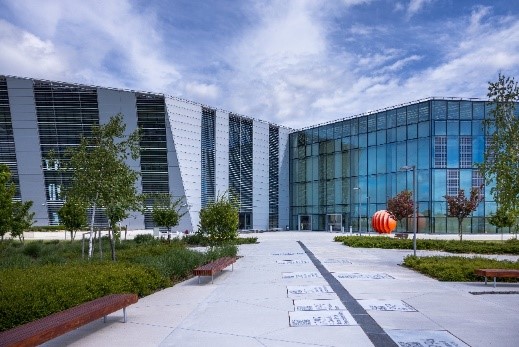
ELI ALPS, Szeged
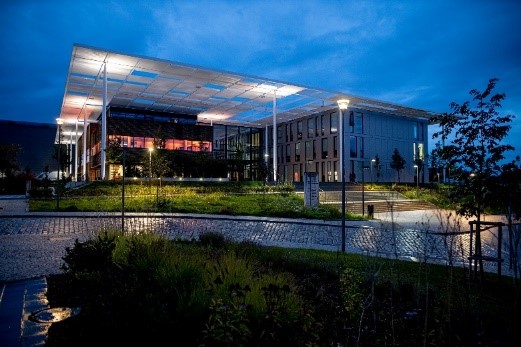
ELI Beamlines, Dolní Břežany
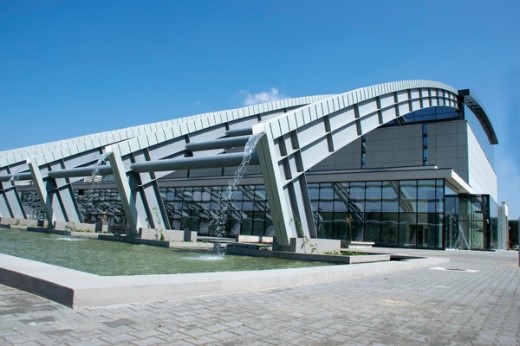
ELI NP, Măgurele
High flux attosecond pulses from surface plasma harmonics
Magas fluxusú attoszekundumos impulzusok keltése felületi plazmában
Although high-order harmonic generation in surface plasmas can be traced back to as early as 1981, the first demonstration of high-flux attosecond pulse generation from surface plasma was reported by Y. Nomura et al only in 2009 [1]. Attosecond pulses are the time domain representation of high-order harmonics generation. The first high flux surface high-order harmonics generation was demonstrated by B. Dromey, et. al in 2007 [2]. However, the temporal duration (attosecond characteristics) of such pulses were not known until the experiment was carried out by Y Nomura et al [1] in 2009. In comparison to gas harmonics, the temporal characterization of harmonics generated from surface plasmas is challenging. Surface high-order harmonics are generated by focusing high power laser pulses, from multi-terawatt or petawatt laser systems, on a solid surface. Consequently, the intensity at that tiny area reaches more than 1018 W/cm2 and materials at that focal area get ionized forming a high temperature, high density plasma. This ultra-high intensity laser field drives the surface electrons in the plasma into highly nonlinear oscillations, also referred to as a relativistic oscillating (plasma) mirror (ROM) [3, 4]. A laser pulse, reflected from this plasma mirror undergoes such oscillation and gets frequency up-shifted resulting in an attosecond burst of light every laser cycle.
As high-order harmonic generation by this technique is driven by high power, multi-terawatt or petawatt laser systems, attosecond pulses are produced at a low repetition rate. Sometimes the experiments are performed in the single-shot mode. Moreover, high-order harmonics generated with this technique contain both odd and even harmonics. Hence, most attosecond characterization techniques, which are mainly developed for gas harmonics, cannot be adapted. Due to such difficulties, attosecond pulse measurements of surface high-order harmonics were not attempted for a long period of time. The experiment performed by Y. Nomura et al was the first attempt for attosecond characterization of surface high-order harmonics generation and considered as an important milestone in attosecond science. The measurement was performed using a technique known as nonlinear volume auto-correlation of the coherent extreme ultra-violate (XUV) pulses generated in the interaction of relativistic laser pulse intensity with a surface plasma. Auto-correlation is a widely used technique for pulse duration measurements for femtosecond laser pulses. However, using such technique directly for attosecond pulse measurement is extremely challenging. Therefore, two intense attosecond pulse trains were overlapped on gas jet and nonlinear two-photon ionization is used for auto-correlation as shown in the figure below.Bár a magasharmonikusok felületi plazmában való keltésének története 1981-re nyúlik vissza, a magasrendű harmonikusok időbeli képének tekintett nagy fluxusú, attoszekundumos hosszúságú impulzusok felületi plazmából való keltésének lehetősége csupán 2009-ben, Y. Nomura és munkatársainak kísérlete után vált ismertté [1], és a magas fluxusú, felületi magasharmonikusok keltését is csak 2007-ben demonstrálták először [2]. A gázokban történő magasharmonikus-keltéssel összehasonlítva a felületi plazmában keltett harmonikusok karakterizálása nagyobb kihívást jelent. A felületi magasharmonikusok keltéséhez nagy energiájú, több terrawattos vagy petawattos lézerimpulzusokat fókuszálnak szilárd felületre. Emiatt a fókuszterületre eső energia eléri vagy meghaladja a 1018 W/cm2-t, ionizáció lép fel, és magas hőmérsékletű, nagy sűrűségű plazma jön létre. Ez az ultranagy intenzitású lézertér a felületi elektronokat erősen nemlineáris oszcillációkra kényszeríti a plazmában, azaz relativisztikus oszcilláló (plazma)tükör (ROM) effektust vált ki [3, 4]. A plazmatükörről visszaverődő lézerimpulzus átveszi ezt az oszcillációt, frekvenciája megnő és emiatt lézerciklusonként egy-egy attoszekundumos fényimpulzus jön létre.
Mivel ennél a technikánál a magasharmonikusok keltését nagy energiájú, több terrawattos vagy petawattos lézerrel érjük el, az attoszekundumos impulzusok keltése alacsony ismétlési frekvencián, időnként egylövéses üzemmódban történik. Az ily módon előállított magasharmonikusok páros és páratlan rendű felharmonikusokat is tartalmaznak, ezért az elsősorban gázokban keltett felharmonikusok karakterizálására kifejlesztett módszerek nem alkalmazhatók. E nehézségek sokáig késleltették a felületi magasharmonikusok mérését. Először Y. Nomura és munkatársai tettek kísérletet a felületi magasharmonikusok karakterizálására. Eredményük mérföldkőnek számít az attofizikában.
A mérésekhez a relativisztikus lézerimpulzus és a felületi plazma kölcsönhatásakor keletkező koherens extrém ultraibolya (XUV) impulzusok nemlineáris térfogati autokorrelációját használták. Az autokorreláció a femtoszekundumos impulzusdiagnosztika egyik széles körben alkalmazott technikája. Ám a technika alkalmazása attoszekundumos impulzusok mérésére nehezebb technikai körülményeket támaszt. Ezért két nagy energiájú, attoszekundumos impulzussorozatot hoztak fedésbe gázsugáron és a létrejövő nemlineáris kétfotonos ionizációt használták autokorreláció céljából az ábrán bemutatott elrendezésben:
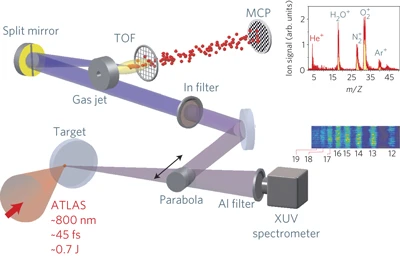 "
"
Schematic diagram for nonlinear XUV auto-correlation. Attosecond pulses are generated in the interaction of a multi-terawatt laser pulse with a plasma mirror. The attosecond XUV pulses are divided and time delayed using a split mirror and focused on a gas-jet. Non-linear two photon ionization events were observed in the time-of-flight (TOF) measurement [1].
Nemlineáris XUV autokorreláció sematikus diagramja. Attoszekundumos impulzusok egy terrawattos lézerimpulzus és egy plazmatükör kölcsönhatásakor jönnek létre. Az attoszekundumos XUV impulzusokat egy nyalábosztó tükör kettéosztja és időbeli késleltetéssel egy gázsugárra fókuszálja. A nemlineáris, kétfotonos ionizációs események repülési idő (TOF) spektrométerrel figyelhetők meg [1].
This experiment demonstrates the generation of attosecond light pulses with a duration of τXUV=0.9±0.4 fs. The estimation of focused XUV intensity on the gas-jet is around IXUV≃(0.5–1)×1011 W cm-2. At ELI-ALPS two attosecond beamlines, SHHG-SYLOS and SHHG-HF, will deliver attosecond light pulses generated from surface plasma by CWE, ROM and CSE and will support attosecond research into this new regime [5].
Ez a kísérlet a τXUV=0.9±0.4 fs hosszúságú attoszekundumos impulzuskeltést mutatja be. A gázsugárra fókuszált XUV impulzus becsült intenzitása IXUV≃(0.5–1)×1011 W cm−2. Az ELI-ALPS Lézeres Kutatóintézetben két attoszekundumos nyalábvonal, az SHHG-SYLOS és az SHHG-HF biztosítja majd az attoszekundumos impulzuskeltést felületi plazmából a koherens nyomdokhullám keltés (coherent wake emission – CWE), a relativisztikusan oszcilláló tükör (ROM) és koherens szinkrotron emisszió (coherent synchrotron emission – CSE) technikákkal az attofizikai kutatások támogatására [5].
Referencia
[1] Y. Nomura, et al.; Nature Physics 5 (2009)124–128
[2] B. Dromey, et. al,; Phys. Rev. Lett. 99 (2007) 085001
[3] T. Baeva, S. Gordienko, and A. Pukhov; Phys. Rev. E 74 (2006) 046404
[4] F. Quéré, et. al,; Phys. Rev. Lett. 96 (2006) 125004
[5] S. Mondal, et. al,; J. Opt. Soc. Am. B 35 (2018) A93
References
[1] Y. Nomura, et al.; Nature Physics 5 (2009)124–128
[2] B. Dromey, et. al,; Phys. Rev. Lett. 99 (2007) 085001
[3] T. Baeva, S. Gordienko, and A. Pukhov; Phys. Rev. E 74 (2006) 046404
[4] F. Quéré, et. al,; Phys. Rev. Lett. 96 (2006) 125004
[5] S. Mondal, et. al,; J. Opt. Soc. Am. B 35 (2018) A93
The 2018 Nobel Prize in Physics
A 2018-as fizikai Nobel-díj
The 2018 Nobel Prize in Physics was awarded for ground-breaking inventions in the field of laser physics with one half to Arthur Ashkin for the optical tweezers and their application to biological systems, the other half jointly to Gérard Mourou and Donna Strickland for their method of generating ultrashort, high intensity, optical pulses.
2018-ban a fizikai Nobel-díjat három kutató nyerte el a lézerfizika területén elért úttörő jellegű eredményeikért. A díj felét Arthur Ashkin kapta az optikai csipeszek kifejlesztéséért és azok biológiai rendszerekben való alkalmazásáért. A díj másik felén Gérard Mourou és Donna Strickland osztozott a nagyintenzitású, ultrarövid optikai impulzusok előállításáért.
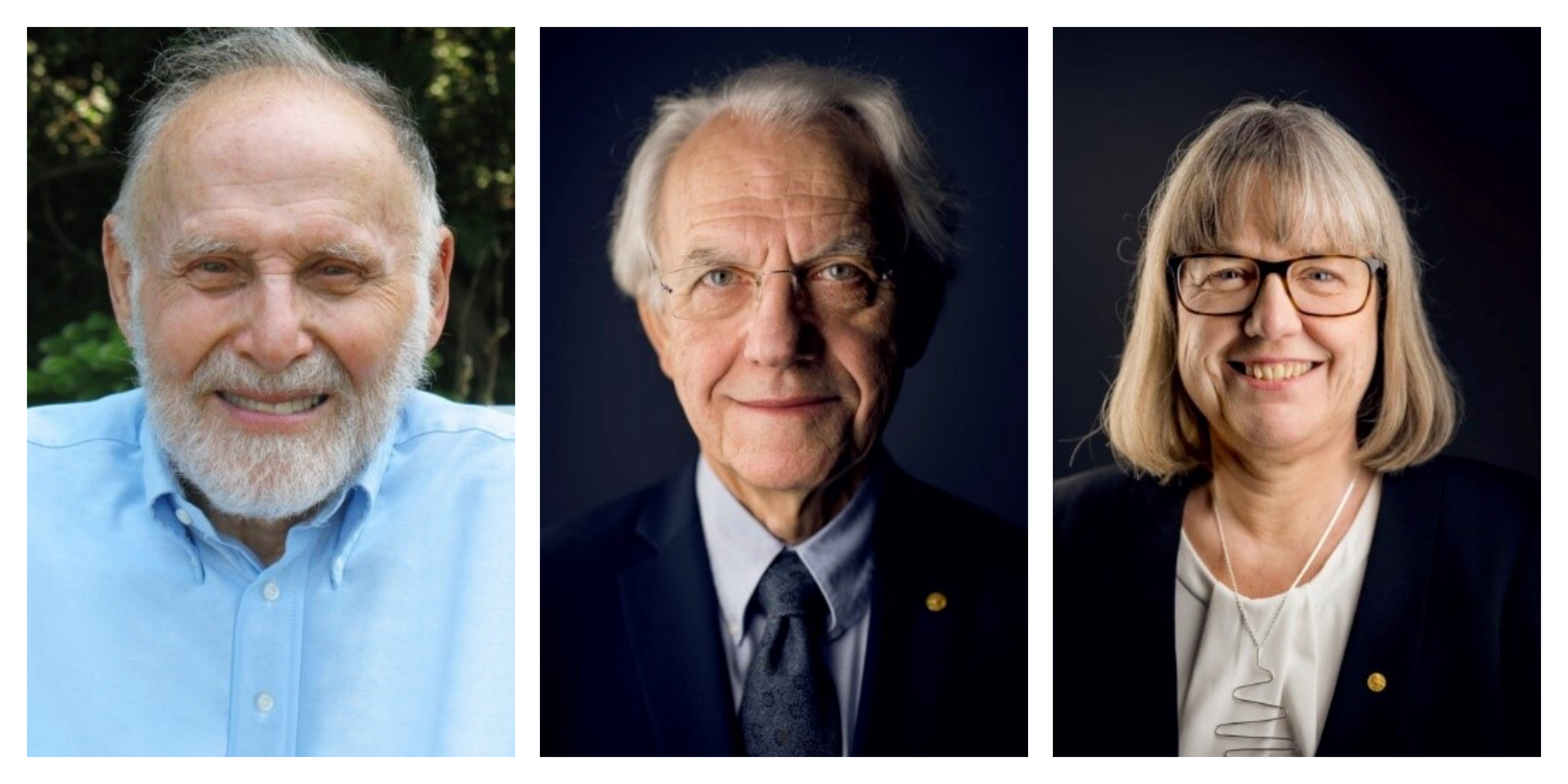
These inventions have paved the way to the observation of tiny biological systems and incredibly fast processes.
In Ashkin’s optical tweezers, laser beams capture and move minute objects like atoms, bacteria and live cells. Researchers were first able to grab a live bacterium without damaging it in 1987. This meant the beginning of the investigation of biological systems with unprecedented depth.E találmányok új utakat nyitottak a tudományban: apró biológiai rendszerek és hihetetlenül gyors folyamatok megfigyelését tették lehetővé.
Ashkin lézercsipeszében fénysugarak ragadják meg és mozdítják el az egészen kicsi objektumokat: atomokat, baktériumokat, élő sejteket. Először 1987-ben sikerült élő baktériumot annak károsítása nélkül megfogni, és ezzel kezdetét vette a biológiai rendszerek minden korábbinál mélyebb vizsgálata.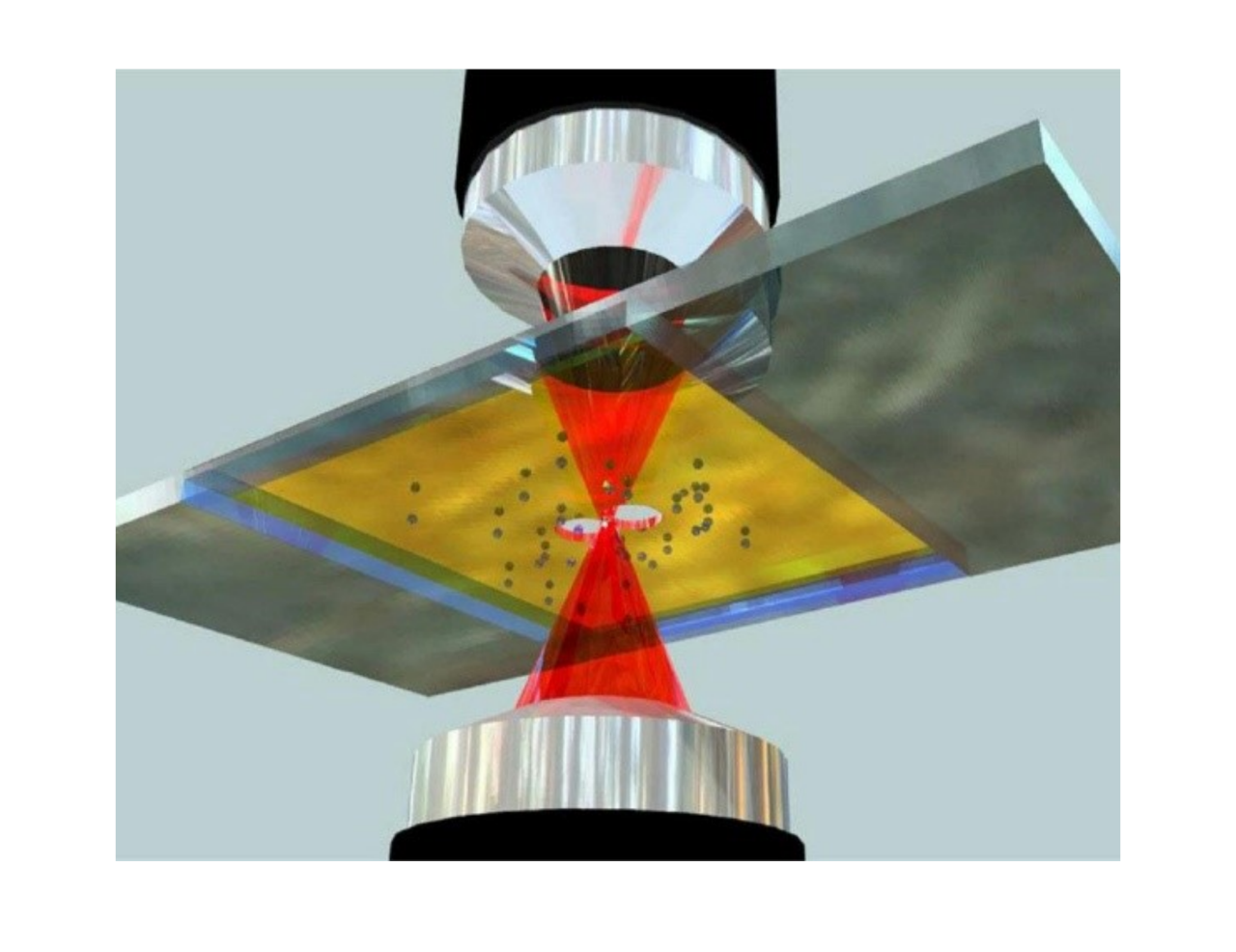
Strickland and Mourou overcame the technological obstacle to the generation of ultrashort, high intensity laser pulses. Their paper published in 1985 presented the technique they named Chirped Pulse Amplification (CPA), which allowed for the construction of equipment capable of generating laser pulses with higher intensities and shorter durations than ever before.
Above a certain intensity, materials used during the amplification of laser pulses become damaged, which means that the pulses cannot directly be amplified indefinitely. The essence of Strickland and Mourou’s procedure (see Figure) is that first the pulse is temporally stretched – with the transported energy being spread, peak intensity decreases –, and then another bunch of energy is pumped into it. At this time, the pulse already has the required energy, but it is longer than needed, therefore it needs to be squeezed back. When the pulse is compressed, the energy it delivers is concentrated in a smaller area, which significantly increases the peak intensity.Strickland és Mourou az ultrarövid, nagyintenzitású lézerimpulzusok előállításának technológiai akadályát győzte le. 1985-ben publikált cikkükben a Chirped Pulse Amplification (CPA) névre keresztelt eljárásukat mutatták be: ennek alkalmazása tette lehetővé olyan berendezések megépítését, amelyek a korábbiaknál nagyobb intenzitású és rövidebb időtartamú lézerimpulzusokat állítanak elő.
A lézerimpulzusok erősítésénél használt anyagok egy bizonyos intenzitáshatár felett károsodnak, ezért az impulzusok közvetlenül nem erősíthetők fel tetszőleges mértékben. Strickland és Mourou eljárásának (lásd ábra) lényege, hogy az impulzust először időben megnyújtják – ekkor a szállított energia hosszabb időre való elosztásával a csúcsintenzitás csökken –, és csak ezután pumpálnak bele újabb energiaadagot. Ekkor az impulzus már a kívánt energiával rendelkezik, de még hosszabb a szükségesnél, ezért azt össze kell nyomni. Összenyomáskor az impulzusban szállított energia kisebb térrészre koncentrálódik, így a csúcsintenzitás jelentősen megnő.
Referencia
D. Strickland and G. Mourou: Compression of Amplified Chirped Optical Pulses; Optics Communications 56 (1985) 219-221
Reference
D. Strickland and G. Mourou: Compression of Amplified Chirped Optical Pulses; Optics Communications 56 (1985) 219-221Start of a new era
Egy új korszak kezdete
In 2023, ELI ALPS Laser Research Institute reached a major milestone: the implementation phase of the large infrastructure project cofinanced by the European Union came to an end with the closure of project No. GINOP-2.3.6-15-2015-00001 of Hungary’s Economic Development and Innovation Operational Programme (GINOP). The building complex, which was completed in 2017, houses state-of-the-art light and particle sources and related research equipment and auxiliary facilities to serve the local and international research community.
2023-ban jelentős mérföldkőhöz érkezett az ELI ALPS Lézeres Kutatóintézet: a Gazdaságfejlesztési és Innovációs Operatív Program GINOP-2.3.6-15-2015-00001 azonosítószámú projektjének lezárásával befejeződött az uniós nagyprojekt megvalósítási szakasza. A 2017-re elkészült épületegyüttesben csúcsminőségű fény- és részecskeforrások és ezekhez kapcsolódóan egyéb kutatási berendezések és kiegészítő egységek szolgálják a helyi és nemzetközi kutatói közösséget.
The primary mission of ELI ALPS is to provide laser and secondary light and particle sources in the form of ultrashort bursts at high repetition rates. Energetic coherent light pulses of a few optical cycles are available from the terahertz (1012 Hz) to the X-ray (1018–1019 Hz) frequency ranges.
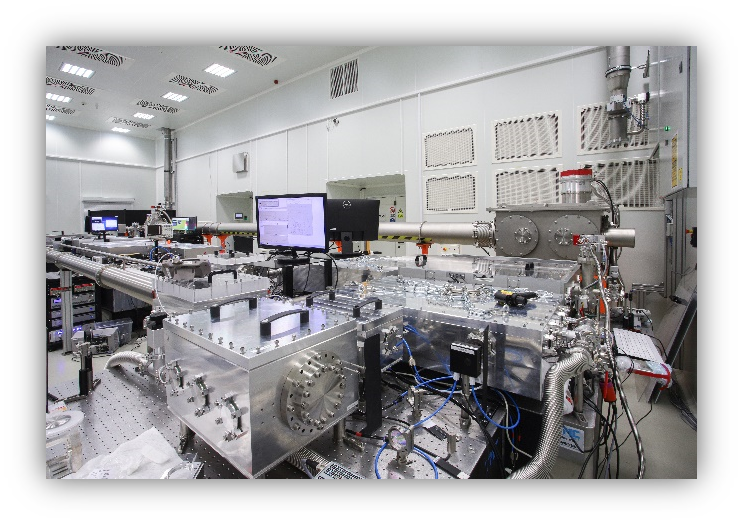
These facilities make it possible to investigate the extremely fast dynamics of electrons in atoms, molecules, plasmas and solids through snapshots on the femtosecond and attosecond timescales. The availability of secondary sources and state-of-the-art lasers, including PW-class lasers under one roof allows researchers to conduct unique time-resolved studies of the non-relativistic and relativistic interactions of light with any matter in any state.
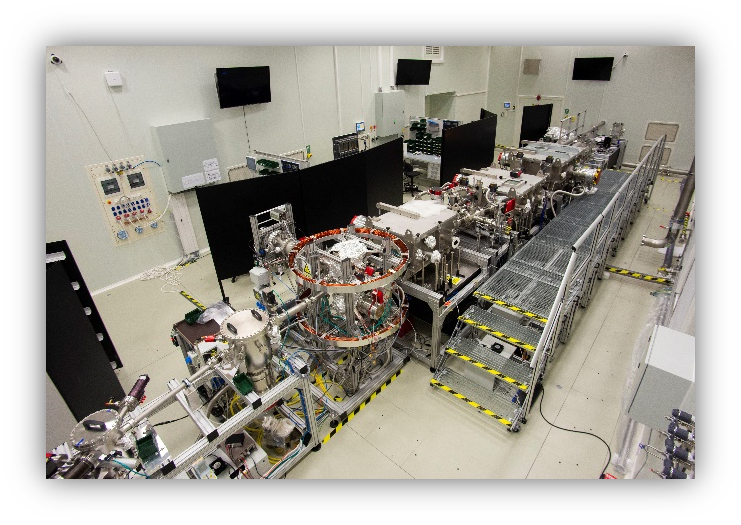
The Institute's equipment is available for experiments to researchers from all over the world through successful user proposals, typically in the fields of physics, chemistry, biology, medicine and materials sciences. Basic research conducted at ELI ALPS Laser Research Institute is expected to lead to breakthrough achievements that will open new horizons in many disciplines and industries.
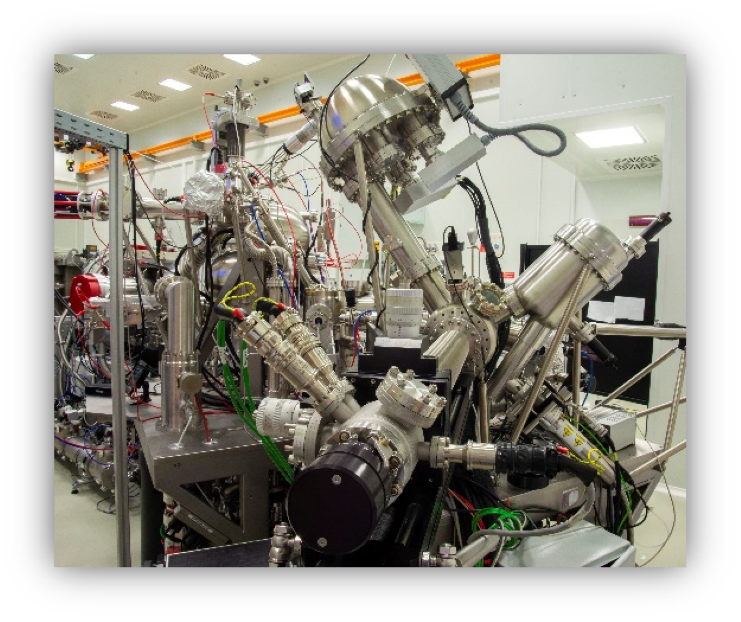
Az ELI ALPS elsődleges feladata, hogy lézer-, illetve másodlagos fény- és részecskeforrásaival ultrarövid, nagy ismétlési frekvenciájú impulzussorozatokat biztosítson. A néhány optikai ciklusból álló, nagy energiájú koherens fényimpulzusok a terahertzestől (1012 Hz) a röntgen (1018–1019 Hz) frekvenciatartományig állnak rendelkezésre.
Ezekkel lehetővé válik az atomokban, molekulákban, plazmákban és szilárd testekben lévő elektronok rendkívül gyors dinamikájának tanulmányozása femtoszekundumos és attoszekundumos léptékű pillanatfelvételek készítésével. Annak köszönhetően, hogy itt egy létesítményen belül másodlagos források és csúcstechnológiát képviselő lézerek – köztük PW-osztályú lézerek – is rendelkezésre állnak, egyedülálló időbontott vizsgálatok végezhetők a fény és bármely halmazállapotú anyag nemrelativisztikus és relativisztikus kölcsönhatásaival kapcsolatban.
Az Intézet berendezései sikeres felhasználói pályázatok útján érhetők el a világ bármely tájáról érkező kutatók számára. Az elvégezhető kísérletek jellemzően a fizika, a kémia, a biológia, az orvostudomány és az anyagtudományok területeit ölelik fel. Az ELI ALPS Lézeres Kutatóintézetben végzett alapkutatások várhatóan olyan áttörő eredményekhez vezetnek, amelyek új távlatokat nyitnak számos tudományágban és iparágban.
The 2023 Nobel Prize for Physics
A 2023-as fizikai Nobel-díj

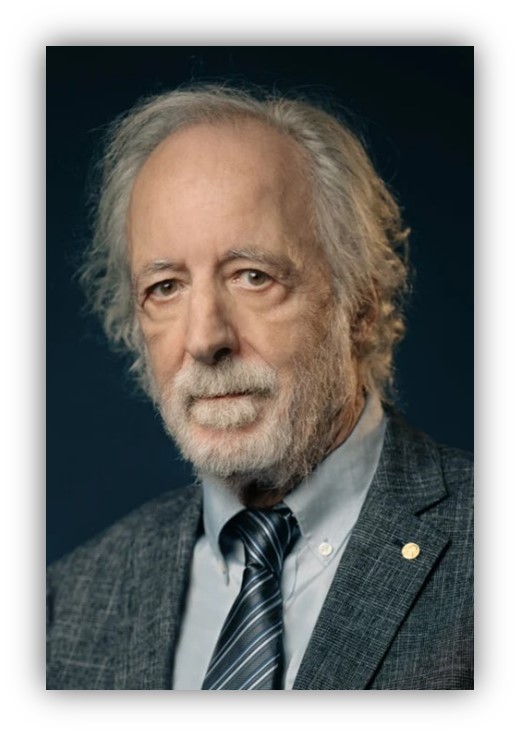

The 2023 Nobel Prize in Physics was awarded for the study of the movement of electrons in atoms, molecules and solids using attosecond spectroscopy. Pierre Agostini, Ferenc Krausz and Anne L'Huillier generated attosecond light pulses that can be used to take snapshots of the extremely fast motion of electrons. In 1987, Anne L'Huillier discovered that many different overtones of light arose when she transmitted infrared laser light through a noble gas. This phenomenon laid the ground for subsequent breakthroughs in producing attosecond pulses.
The theoretical possibility of generating attosecond pulses was established in 1992. In 2001, the research groups of Ferenc Krausz and Pierre Agostini successfully detected attosecond pulses independently of each other. Although the techniques were similar, the underlying principles were very different.
Pierre Agostini and his research team identified 250 attosecond flashes. In 2003, Anne L'Huillier and her team used this method to generate 170 attosecond long pulses.
Ferenc Krausz and his research team in Vienna were working on a method that would produce a single attosecond pulse. The first pulse, which they managed to isolate and measure in 2001, lasted 650 attoseconds. In 2008, at the Max Planck Institute for Quantum Optics in Garching, Germany, he was able to produce 80 attosecond pulses, which earned him a Guinness World Record.
Attosecond science can now be applied to molecular physics, physical chemistry, condensed matter physics and applied fields such as materials science, pharmaceuticals, electronics and even biomedical research.
Attosecond physics is one of the focus areas in the research profile of the ELI ALPS Laser Research Institute. Ferenc Krausz and Anne L'Huillier have played a major role in the establishment of the institute. Their Nobel Prize sends the message that generation of attosecond pulses is a major discovery for mankind.
A 2023-as fizikai Nobel-díjat az elektronok atomokban, molekulákban és szilárd anyagokban történő mozgásának attoszekundumos spektroszkópiás tanulmányozásáért ítélték oda. Pierre Agostini, Krausz Ferenc és Anne L’Huillier olyan attoszekundumos fényimpulzusokat hoztak létre, amelyekkel pillanatfelvételek készíthetők az elektronok rendkívül gyors mozgásáról.
1987-ben Anne L’Huillier fedezte fel, hogy amikor infravörös lézerfényt nemesgázon keresztül továbbított, felharmonikusok keletkeztek. Ez a jelenség alapozta meg az attoszekundumos impulzusok későbbi előállítását.
Az attoszekundumos impulzusok generálásának elvi lehetőségét 1992-ben fogalmazták meg. 2001-ben két különböző eljárással a Krausz-csoport és az Agostini-csoport is sikeresen mutatta ki az attoszekundumos impulzusokat. Bár a technika hasonló, a két eljárás elvét tekintve merőben eltér.
Pierre Agostini és kutatócsoportja 250 attoszekundumos felvillanásokat azonosított. 2003-ban e módszer alkalmazásával Anne L’Huillier és csoportja 170 attoszekundumos impulzust hozott létre.
Krausz Ferenc bécsi kutatócsoportjával olyan eljáráson dolgozott, amely egyetlen attoszekundumos impulzust eredményez. Az első impulzus, amelyet először 2001-ben sikerült izolálniuk és megmérniük, 650 attoszekundumig tartott. Később, a technikák fejlődésének köszönhetően egyre rövidebb attoszekundumos impulzusokat lehetett előállítani. 2008-ban Krausz Ferenc a garchingi Max Planck Kvantumoptikai Intézetben már 80 attoszekundumos impulzust hozott létre, amivel a Guiness-rekordok könyvébe is bekerült. ,
Az attoszekundumos tudomány ma már a molekuláris fizika, a fizikai kémia, a kondenzáltanyag-fizika és az alkalmazott területek, például az anyagtudomány, a gyógyszerészet, az elektronika vagy akár az orvos-biológiai vizsgálatok területén is alkalmazható.
Az ELI ALPS Lézeres Kutatóintézet kutatási profiljában az egyik fókuszterület az attoszekundumos fizika. Krausz Ferenc és Anne L’Huillier komoly szerepet játszottak az intézet létrejöttében. Nobel-díjuk azt üzeni, hogy az attoszekundumos impulzusok keltése az emberiség számára jelentős felfedezésnek minősül.